
- The Machine Comes to the Mold
- Rolling Up to a Giant
- Mold Repair Workflow
- Precision Next to Polished Surfaces
- Vertical and Overhead Mold Faces
- Tool-Steel Discipline and Acceptance
- Frequently Asked Questions
- Can the Sirius Light handle molds heavier than 25 tons?
- What steps ensure stable welding on massive molds?
- How do I prevent damage to polished mold surfaces during repair?
- Is preheating always required for tool steel mold repairs?
- Related Articles
Quick Answer: To weld heavy molds—even up to 25 tons—using laser technology, operators deploy a mobile, open-frame laser welding system like the Sirius Light, which brings the laser to the stationary mold. This approach enables precise, low-HAZ repairs directly on large tooling without moving the mold, ensuring both efficiency and surface integrity.
| Feature | Description |
|---|---|
| Mobility | Heavy-duty mobile, open-frame system |
| Load Capacity | Unlimited (no table-bound restriction; suitable for molds of 25 tons and above) |
| Articulated Arm Reach | Up to 1830 mm |
| Axis Resolution | 0.01 mm |
| Optics | Leica 10× stereo microscope |
| Laser Type | Pulsed Nd:YAG |
| Software | Sigomatic (teach-in, programmable weld paths) |
All features and values are stated verbatim from the article body.
The Machine Comes to the Mold
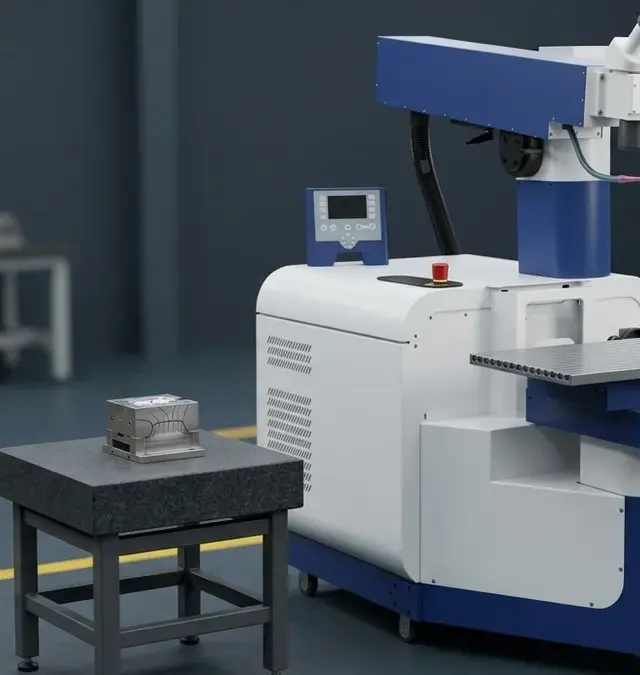
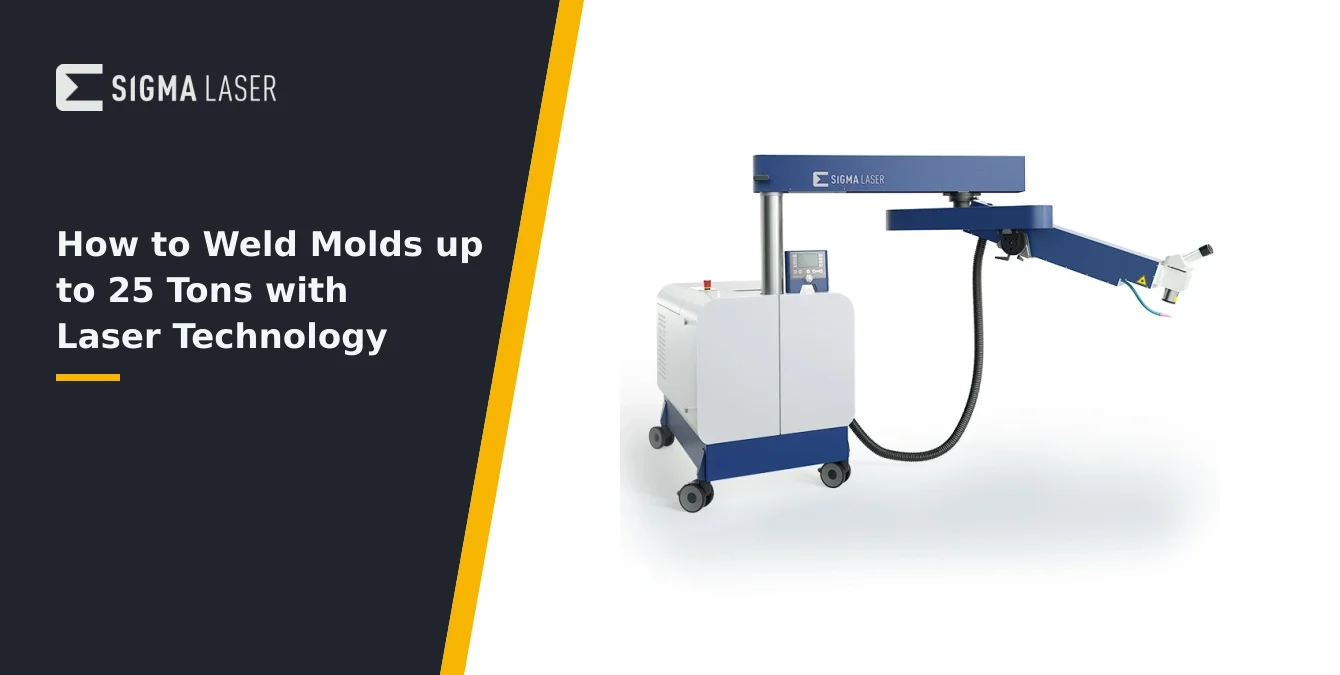
Laser welding of heavy molds—particularly those weighing up to 25 tons—demands a fundamentally different approach from table-bound or gantry-based systems. Sigma Laser’s Sirius Light is engineered specifically for this scenario: it is a heavy-duty mobile laser welding unit with an open-frame architecture, meaning the workpiece remains stationary throughout the process. There is no imposed load limit; the Sirius Light is capable of servicing even the largest industrial molds, including those weighing 25 tonnes or more, as an illustrative example.
This open-frame design is critical for mold and die shops, where moving massive tooling is often impractical or risky. Instead, the Sirius Light is brought directly to the mold, regardless of its size or installed position. The system’s 1830 mm articulated arm reach allows operators to access virtually any area of the mold, whether it is positioned on the shop floor, within a press, or on a maintenance stand. The absence of a load table restriction means that the only limiting factor is physical access, not the weight or dimensions of the mold itself.
For operators and production engineers, this approach minimizes downtime and eliminates the need for heavy lifting or secondary handling equipment. The Sirius Light’s robust mobility and reach enable in-situ repairs, surface build-ups, and precision modifications without disassembly. This is especially valuable for large injection molds, die-casting tools, or stamping dies, where every movement carries risk and cost.
- Unlimited load capacity—no table-bound restrictions
- 1830 mm articulated reach for deep or awkward geometries
- Ideal for in-place repair of even 25-tonne molds
Rolling Up to a Giant
Positioning a mobile laser welding system like the Sirius Light alongside a massive mold is a critical operational step. The process begins with a site assessment: operators evaluate the mold’s orientation, accessibility, and the target repair zones. The Sirius Light’s heavy-duty chassis and precision casters are designed to traverse industrial floors, but stability is paramount—especially when extending the articulated arm to its full 1830 mm reach.
Once the system is in proximity to the mold, operators engage the locking mechanisms on the chassis to prevent unwanted movement. This is a non-negotiable safety and precision requirement; even minor shifts can compromise weld quality or operator safety. The Sirius Light’s design ensures that, when locked, the base remains immobile, providing a stable platform for arm extension and fine positioning.
With the unit secured, the operator extends the arm to the required working position. The articulated design allows for precise alignment with the defect area, whether it is on the mold’s upper surface, sidewall, or deep within a cavity. At this stage, operators verify the stability of both the machine and the arm, checking for any play or flex that could affect the laser’s focus or path accuracy. The Leica 10× stereo microscope assists in confirming the focal point and alignment before welding begins.
- Assess mold position and plan approach path
- Lock casters and verify machine stability before arm extension
- Use articulated arm and microscope to achieve precise alignment
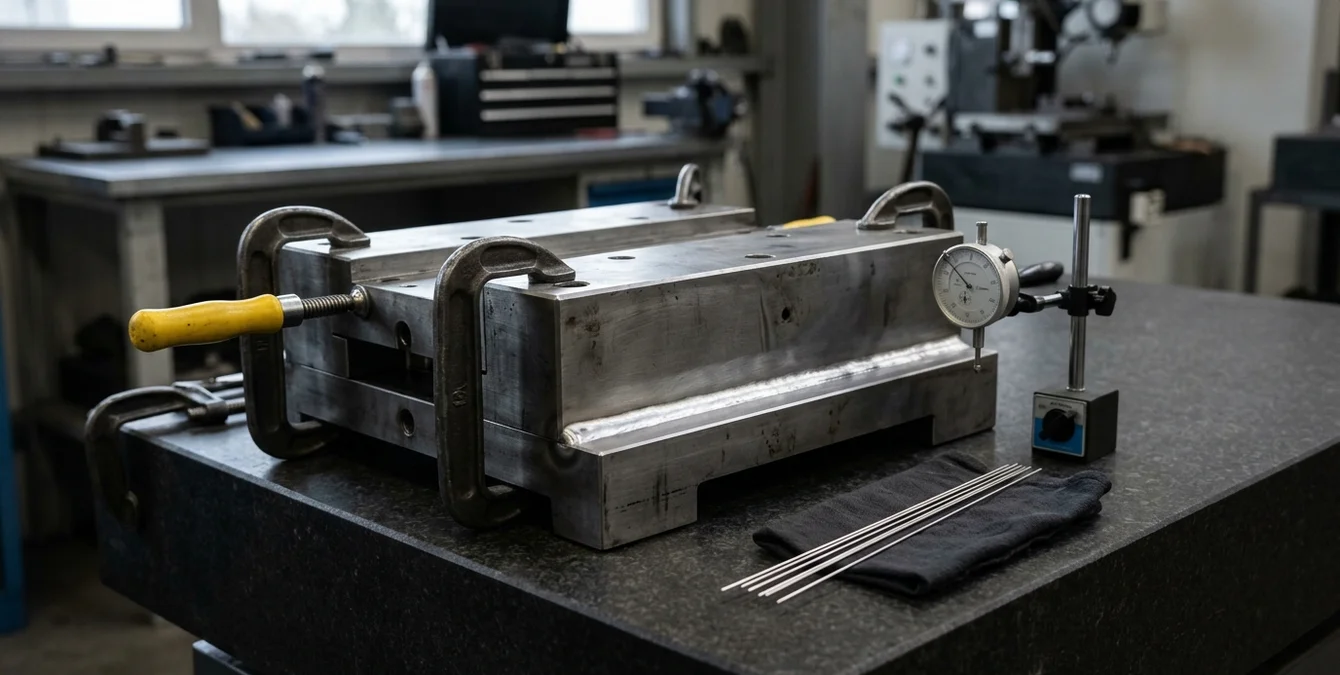
| Step | Purpose |
|---|---|
| Clean and inspect defect area | Remove contamination and identify repair zones |
| Apply filler wire and build up with pulsed laser passes | Incremental material addition with minimal heat input |
| Contour and finish | Restore original geometry and surface quality |
| Final surface finishing | Grinding, polishing, or EDM as needed |
| Monitor weld quality | Ensure layer integrity and dimensional conformity |
Workflow steps and purposes are taken directly from the article.
Mold Repair Workflow
The workflow for repairing heavy molds with laser technology follows a structured sequence to ensure both metallurgical quality and dimensional accuracy. The process begins with thorough cleaning of the repair area. Removing oil, oxidation, and debris is essential to prevent contamination and ensure proper weld fusion. Operators then identify and mark the defect—cracks, worn edges, or surface pitting—using visual inspection and, where necessary, non-destructive testing methods.
Next, the operator prepares the area for material build-up. Filler wire, matched to the base material (often a tool steel such as 1.2343), is introduced into the weld zone. The Sirius Light’s pulsed Nd:YAG laser delivers controlled energy precisely where needed, allowing for incremental build-up with minimal heat input. This minimizes the heat-affected zone (HAZ) and reduces the risk of distortion or temper loss in adjacent areas.
After building up the damaged area, operators contour the weld using the laser’s fine spot control and, if necessary, manual finishing tools. The final step is surface finishing, which may involve grinding, polishing, or EDM—industry-standard practices to restore the mold’s original geometry and surface quality. Throughout the workflow, operators monitor weld quality, layer integrity, and dimensional conformity, referencing the original mold specifications as needed.
- Clean and inspect the defect area
- Apply filler wire and build up with pulsed laser passes
- Contour and finish to restore original geometry
Precision Next to Polished Surfaces
Repairing molds often requires working adjacent to finished or highly polished surfaces, where even minor thermal or mechanical damage is unacceptable. The Sirius Light addresses this challenge with its 0.01 mm axis resolution, enabling operators to position the laser spot with extreme accuracy. This precision is especially valuable when repairing intricate features, fine edges, or tight cavity corners.
The use of pulsed Nd:YAG laser technology further enhances control. Pulsed operation delivers energy in short, controlled bursts, minimizing heat input and sharply reducing the size of the heat-affected zone (HAZ). This is critical for maintaining the integrity of adjacent polished or textured surfaces, as it prevents unwanted discoloration, warping, or microstructural changes.
Operators use the Leica 10× stereo microscope to monitor the weld area in real time, ensuring that each pulse is delivered exactly where intended. The teach-in functions of the Sigomatic software allow for the programming of precise weld paths, further reducing the risk of overrun or accidental marking. After welding, operators should inspect the transition zones—between repaired and original surfaces—under magnification to verify that surface quality and geometry have been preserved.
- 0.01 mm axis resolution for fine positioning
- Pulsed Nd:YAG minimizes HAZ near sensitive surfaces
- Microscope-assisted monitoring for real-time control
| Benefit | Description |
|---|---|
| 360° beam deflection | Access to hard-to-reach or non-standard positions |
| Rapid adaptation | Modular design supports quick changes for different geometries |
| Improved access | Enables welding on vertical walls, deep pockets, and overhead features |
Accessory functions and benefits are summarized from the article’s description.
Vertical and Overhead Mold Faces
Mold repair is rarely confined to flat, horizontal surfaces. Many defects occur on vertical walls, undercuts, or even overhead features within deep cavities. The ability to weld in these orientations is essential for comprehensive mold maintenance. Sigma’s Swivel Optics accessory is specifically designed to address this need, providing 360° beam deflection for access to hard-to-reach or non-standard positions.
Operators fit the Swivel Optics module to the Sirius Light’s laser head, allowing the beam to be directed vertically, horizontally, or at any required angle. This flexibility is invaluable when working on cavity walls, deep pockets, or overhead features, where conventional optics would be obstructed or misaligned. The modular nature of the Swivel Optics also supports rapid adaptation to different mold geometries during a single repair session.
When welding in vertical or overhead orientations, operators must pay particular attention to shielding gas coverage and filler wire positioning, as gravity can affect both. Proper fixturing of the wire and adjustment of the shielding nozzle are best practices to ensure consistent weld quality. After welding, visual and microscopic inspection of the repaired area is recommended to confirm complete fusion and surface integrity, especially in less accessible regions.
- Swivel Optics enable 360° beam positioning
- Essential for cavity walls, deep pockets, and overhead repairs
- Adjust shielding gas and wire feed for non-horizontal welds
Tool-Steel Discipline and Acceptance
Most heavy molds are manufactured from tool steels such as 1.2343 (hot work steel), which present unique challenges during repair welding. Industry best practice dictates preheating the mold to a specified temperature before welding to reduce thermal gradients and minimize the risk of cracking. Controlled cooling after the repair is equally important to maintain the steel’s mechanical properties and prevent the formation of brittle microstructures.
Operators should consult the material parameter table or the mold manufacturer’s guidelines to determine the appropriate preheat and post-weld heat treatment protocols. During the welding process, the Sirius Light’s pulsed Nd:YAG laser helps control heat input, but adherence to temperature management remains essential for metallurgical integrity. After the repair, a dimensional check—using precision measuring tools or coordinate measuring machines (CMM)—verifies that the mold geometry conforms to specification.
Acceptance criteria for repaired molds typically include visual inspection for surface quality, non-destructive testing for subsurface defects, and hardness checks in the heat-affected zone. Documentation of the repair process, including welding parameters, filler material, and heat treatment cycles, supports traceability and future maintenance. Operators should maintain a disciplined approach to each stage, recognizing that tool-steel repairs demand both technical expertise and rigorous process control.
- Preheat and controlled cooling for tool steels (e.g., 1.2343)
- Dimensional check after repair to ensure conformity
- Document parameters and acceptance criteria for traceability
Frequently Asked Questions
Can the Sirius Light handle molds heavier than 25 tons?
Yes. The Sirius Light has no load capacity limit due to its open-frame, mobile design. It can service molds well above 25 tons, provided there is physical access for the articulated arm and the mold is properly positioned for repair.
What steps ensure stable welding on massive molds?
After positioning the Sirius Light, always lock the casters and verify the base is stable before extending the arm. Check for any movement or flex, and use the microscope for precise alignment. Stability is essential for both weld quality and operator safety.
How do I prevent damage to polished mold surfaces during repair?
Use the Sirius Light’s 0.01 mm axis resolution and pulsed Nd:YAG mode to tightly control energy input. Monitor the process with the stereo microscope and avoid overbuilding. Inspect transition zones after welding to confirm no thermal or mechanical damage.
Is preheating always required for tool steel mold repairs?
Preheating is industry best practice for tool steel repairs to reduce thermal shock and prevent cracking. Always consult your material parameter table or mold manufacturer’s guidelines for specific preheat and cooling requirements before beginning any repair.