
- Key Takeaways
- What is a fiber laser welding machine?
- Fiber Laser Welding Advantages
- Industrial Applications
- Maintenance and Cost Considerations
- Why Choose Fiber Over Lamp-Pumped Nd:YAG?
- Maintenance and Longevity
- Pulse Frequency and Precision
- Pulse Energy for Deep Repair
- Which power class do you need?
- 300 W: Precision and Delicacy
- 450 W: Versatile and Efficient
- 600 W: Robust and Powerful
- Mobile or stationary fibre system?
- Sineo Fibre: Mobility for Versatility
- Sidanus Fibre: Precision and Stability
- Siega Fibre: Compact Efficiency with SPT
- What does a fibre machine cost to own?
- Initial Investment
- Operating Costs
- Maintenance and Upkeep
- Industrial Applications and Value
- How do you test before you buy?
- Sample Welds on Your Material
- Demo Checklist
- Frequently Asked Questions
- What materials can be welded with a fiber laser welding machine?
- How does fiber laser welding compare to MIG and TIG welding?
- What factors influence the choice between Nd:YAG and fiber laser welding machines?
- How does fiber laser welding impact production efficiency?
- Are fiber laser welding machines suitable for automation?
- What distinguishes Sigma Laser fibre welding machines in demanding industrial applications?
- Related Articles
- Sources
Quick Answer: Fiber laser welding machines are precision tools that utilize a fiber optic cable to deliver the laser beam, offering high efficiency and superior beam quality. These machines are ideal for applications requiring precision, speed, and minimal thermal distortion. Key advantages include low maintenance, high electrical efficiency, and versatility across various materials. When choosing a fiber laser welding machine, consider factors such as power output, beam quality, and integration capabilities to ensure alignment with your specific industrial requirements.
Key Takeaways
Fiber laser welding machines have revolutionized the welding landscape, offering precision and efficiency that traditional methods struggle to match. For buyers at the decision-making stage, understanding the advantages, applications, and types of fiber laser machines is crucial to making an informed investment.
- Fiber laser welding machines provide superior energy efficiency and lower operational costs compared to CO2 and traditional welding systems.
- Their high precision and minimal heat input make them ideal for applications requiring tight tolerances and reduced thermal distortion.
- Industries such as automotive, aerospace, and electronics benefit significantly from fiber laser welding due to its ability to weld complex geometries and delicate materials.
- Compared to traditional welding methods, fiber laser welding offers faster processing speeds, leading to increased throughput and productivity.
- Different types of fiber laser welding machines, including continuous wave and pulsed systems, cater to a wide range of material thicknesses and welding requirements.
- Maintenance and downtime are significantly reduced with fiber laser systems due to their robust design and fewer consumable parts.
- Fiber laser welding is highly adaptable, capable of integrating with robotic systems for automated production lines.
With these key advantages, fiber laser welding machines present a compelling choice for industries seeking to enhance their welding capabilities. The following sections will delve deeper into the specifics of fiber laser technology, its applications, and how it compares with other welding methods.
| Advantage | Description |
|---|---|
| High Precision | Enables tight tolerances and minimal heat-affected zones |
| Low Maintenance | Robust fiber delivery system reduces downtime and costs |
| Superior Beam Quality | Low M² value allows for precise, distortion-free welding |
| High Electrical Efficiency | Lower operational costs compared to CO2 and traditional systems |
| Versatility | Suitable for a wide range of materials and thicknesses |
| Integration Capability | Easily integrates with robotic and automated production lines |
What is a fiber laser welding machine?
A fiber laser welding machine is an industrial tool that uses an ytterbium fiber laser source to produce a beam at a wavelength of 1070 nm. This machine offers both continuous wave (CW) and pulsed operation modes, making it versatile for various applications. The fiber delivery system is designed to be low-maintenance, ensuring efficient and cost-effective operation.
Fiber laser welding machines typically operate with power levels ranging from a few hundred watts to several kilowatts, depending on the application. The beam quality is characterized by a low M² value, which allows for precise welding with minimal distortion. The welding speed can vary significantly, typically from a few millimeters per second to several meters per minute, depending on the material and thickness.
Fiber Laser Welding Advantages
Fiber laser welding machines offer several advantages in industrial settings. They enable high precision with minimal heat input, reducing the heat-affected zone and preserving the integrity of complex assemblies. The maintenance requirements are relatively low due to the robust design of the fiber delivery system, contributing to a lower overall cost of ownership. These machines are suitable for high-volume production lines, including automotive, aerospace, and electronics manufacturing.
Fiber lasers are particularly effective for welding materials such as stainless steel, aluminum, and titanium. They can achieve penetration depths typically up to several millimeters in a single pass, depending on the material and machine settings. The reduced heat-affected zone minimizes thermal distortion, which is critical in maintaining tight tolerances in precision applications.
Industrial Applications
Fiber laser welding is widely used in industries that demand precision and efficiency. Applications range from welding intricate electronic components to robust automotive parts. The flexibility of fiber lasers makes them ideal for joining materials such as metals and alloys, including 1.2344 (AISI H13). For a deeper dive into the process physics and benefits, visit our fiber laser welding guide for engineers.
In the automotive industry, fiber laser welding is employed for assembling body panels and powertrain components, where speed and precision are paramount. In the aerospace sector, the ability to weld high-strength alloys with minimal distortion is a significant advantage, ensuring the structural integrity of critical components.
Maintenance and Cost Considerations
The maintenance of fiber laser welding machines is straightforward, largely due to the durable nature of the fiber source and beam delivery system. This reliability translates into reduced downtime and lower maintenance costs, making them an ideal choice for industrial operations seeking efficiency and cost-effectiveness. Although initial investment costs can be significant, the long-term savings and enhanced productivity often justify this expenditure.
Proper training and adherence to operational guidelines ensure safe and efficient use.
| Parameter | Fiber Laser Welding Machine | Lamp-Pumped Nd:YAG Laser Welding Machine |
|---|---|---|
| Maintenance | Low; no lamp to replace, fewer consumables | Higher; requires lamp replacement and more frequent maintenance |
| Pulse Frequency Range | Up to 1000 Hz | Lower (not specified here) |
| Precision at Small Spot Sizes | High; spot sizes typically 0.1–2.0 mm | Good, but less precise at smallest spots |
| Pulse Energy | Lower than Nd:YAG; suited for thin/intricate welds | Higher; advantageous for deep repair welding |
| Peak Power (example) | Not specified here | Up to 13 kW (e.g., Sidanus Light) |
| Best Suited For | Precision, high-volume, minimal heat-affected zone applications | Deep penetration, repair of thick molds/components |
All values are general and for comparison only; refer to specific product datasheets for exact specifications.
Why Choose Fiber Over Lamp-Pumped Nd:YAG?
In industrial settings where precision and efficiency are crucial, selecting the right laser welding technology can significantly impact both production quality and operational costs. The fiber laser welding machine offers distinct advantages, particularly in terms of maintenance, pulse frequency range, and precision at small spot sizes, making it a compelling option for diverse industrial applications.
Maintenance and Longevity
Fiber laser systems are renowned for their low-maintenance requirements compared to lamp-pumped Nd:YAG lasers. The absence of a lamp-pumping mechanism reduces the need for frequent replacements and adjustments, thereby decreasing downtime and maintenance costs. This characteristic makes fiber lasers ideal for high-volume production environments where machine uptime is critical.
Fiber lasers, such as the Sidanus Fibre, offer a robust operational lifespan due to their solid-state construction and efficient energy conversion. This reliability is crucial in sectors like automotive and aerospace, where continuous operation is essential.
Pulse Frequency and Precision
The pulse frequency range of fiber lasers extends up to 1000 Hz, offering superior control over welding parameters and enabling precise welds at small spot sizes. This feature is crucial in applications demanding tight tolerances and minimal heat-affected zones, such as electronics and medical device manufacturing. The comparison of Nd:YAG and fiber laser welding highlights these precision capabilities, emphasizing the fiber laser’s adaptability to complex geometries and sensitive materials.
Fiber lasers are particularly effective in welding thin materials and intricate components due to their high beam quality and small spot sizes, typically ranging from 0.1 to 2.0 mm. This precision is supported by standards like ISO 15614-11, which governs the qualification of welding procedures for laser welding.
Pulse Energy for Deep Repair
While fiber lasers excel in many areas, lamp-pumped Nd:YAG lasers maintain an edge in pulse energy, which can be advantageous for deep repair welding applications. Their capacity to deliver high pulse energy makes them suitable for tasks that require substantial penetration and material deposition, such as repairing thick molds or heavy components.
For instance, the Sidanus Light can achieve peak powers up to 13 kW, making it well-suited for applications requiring deep penetration and robust material bonding.
- Fiber Laser Welding Advantages: Ideal for applications requiring minimal maintenance and high precision.
- Industrial Laser Welding Applications: Extensively used in automotive, aerospace, and electronics industries.
- Fiber Laser Welding Machine Cost: Offers a cost-effective solution when considering longevity and reduced maintenance requirements.
Which power class do you need?
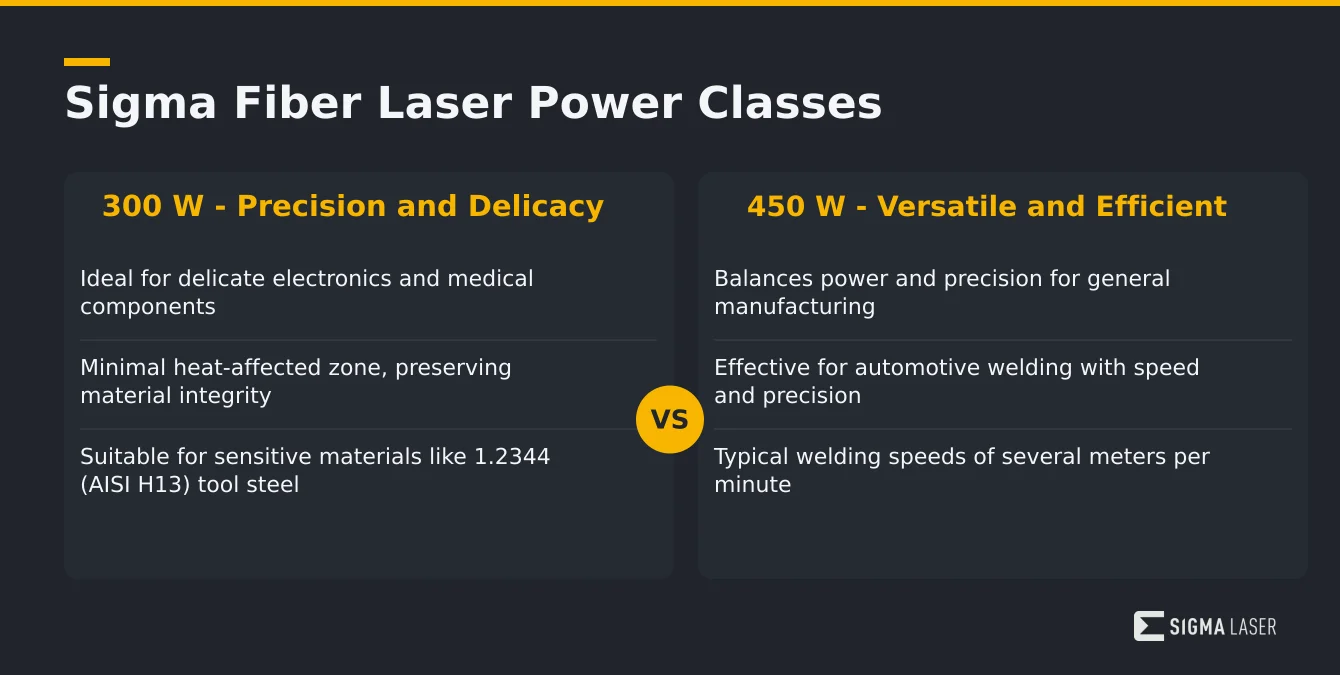
Choosing the right power class for a fiber laser welding machine is critical for optimizing production efficiency and meeting specific industrial welding requirements. Sigma Laser offers three distinct power classes: 300 W, 450 W, and 600 W, each designed to cater to different operational needs and welding applications. Understanding these power levels helps in selecting the most suitable machine for your project, whether it involves intricate precision tasks or more robust welding applications.
Fiber laser welding is typically characterized by its high beam quality and precision, enabling tight tolerances and minimal heat-affected zones. The typical wavelength for fiber lasers is around 1070 nm, which offers excellent absorption in metals such as stainless steel and aluminum alloys, making them ideal for a wide range of industrial applications.
300 W: Precision and Delicacy
The 300 W power class is ideal for applications requiring high precision and minimal heat input. This power level is particularly beneficial in industries like electronics and medical technology, where welding delicate components is crucial. The finer control offered by a 300 W system ensures minimal distortion and a smaller heat-affected zone, preserving the integrity of sensitive materials.
In precision applications, the heat-affected zone can be as small as a few millimeters, ensuring that the surrounding material properties remain unchanged. This is critical when working with sensitive materials such as 1.2344 (AISI H13) tool steel, commonly used in high-precision tooling.
450 W: Versatile and Efficient
Positioned as a versatile option, the 450 W power class is suitable for a wide range of industrial laser welding applications. It effectively balances power and precision, making it an excellent choice for general manufacturing processes that require flexibility without compromising on precision. For an in-depth comparison, explore our 300 W vs 450 W fiber laser comparison to better understand each class’s advantages.
The 450 W class is particularly effective for welding tasks that require a balance between speed and precision, such as in the automotive industry where both factors are critical. Typical welding speeds for fiber lasers in this class can reach several meters per minute, depending on material thickness and joint configuration.
600 W: Robust and Powerful
The 600 W power class is designed for heavy-duty industrial tasks, offering substantial power for welding thicker materials or larger components. This class is particularly suited for aerospace and automotive industries, where strength and penetration depth are paramount. The increased power capability enables faster processing times, enhancing overall production efficiency.
For applications involving thicker materials, such as structural steel or aerospace-grade alloys, the 600 W class provides the necessary penetration depth, which can typically reach several millimeters in a single pass. This capability is essential for ensuring the structural integrity of welded joints in high-stress environments.
When considering the fiber laser welding machine cost and its maintenance requirements, each power class presents its own set of considerations. For further insights into selecting the appropriate laser power for your industrial applications, refer to our detailed guide on laser welding power selection.
Compliance with relevant standards, such as ISO 15614-11, which specifies the qualification of welding procedures for metallic materials, ensures that the welding processes meet industry benchmarks for quality and reliability.
Mobile or stationary fibre system?
Choosing the right fiber laser welding machine involves evaluating specific industrial requirements and the operational context. Sigma Laser offers a range of solutions with their Sineo Fibre, Sidanus Fibre, and Siega Fibre, each designed to meet distinct industrial needs.
Sineo Fibre: Mobility for Versatility
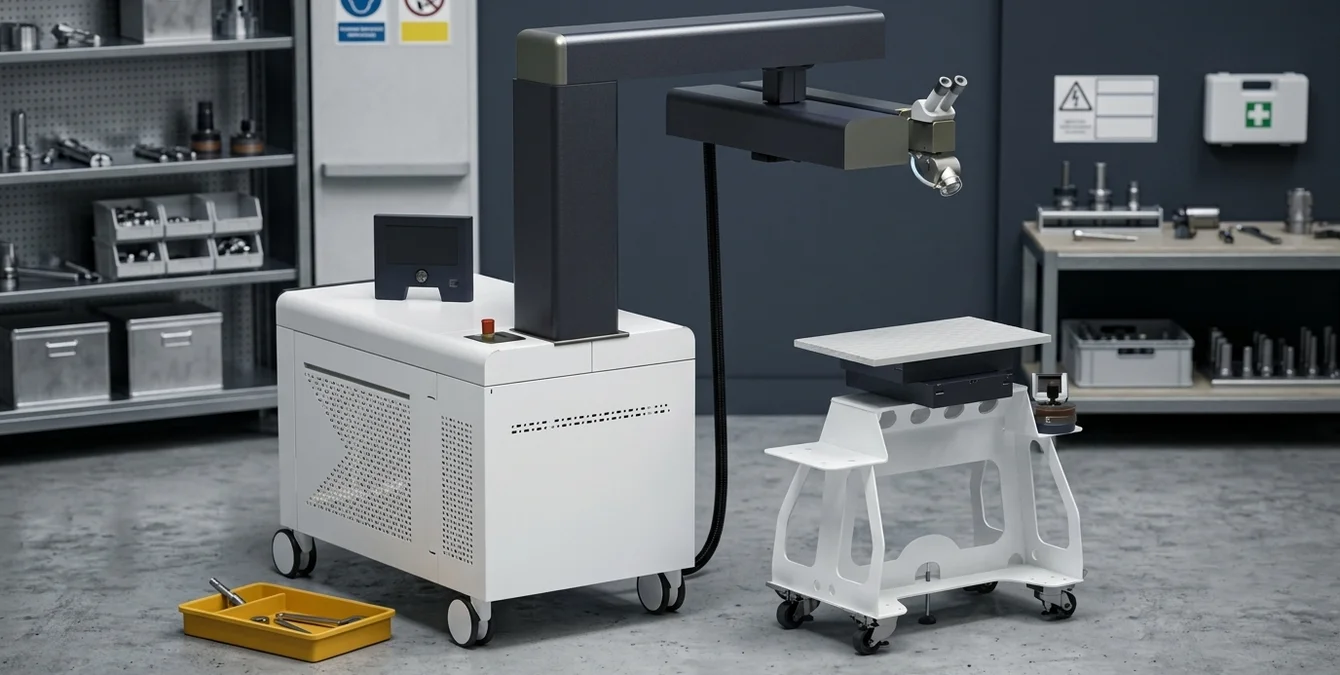
The Sineo Fibre is a mobile system that provides flexibility in various industrial laser welding applications. It is equipped with a ytterbium fibre laser and operates at a frequency of 1000 Hz, making it suitable for on-site tasks where machine mobility is crucial. This capability is particularly advantageous in industries where components are too large or complex to move to a stationary welding station.
In general, fibre laser welding systems can achieve penetration depths of up to several millimeters, depending on the material and specific process parameters. The heat-affected zone (HAZ) is typically minimized due to the precision of the laser beam, which is critical for maintaining the integrity of the surrounding material.
Sidanus Fibre: Precision and Stability
For applications requiring high precision, the Sidanus Fibre offers a stationary solution with exceptional fine 5-axis positioning. This system is ideal for environments where stability and accuracy are paramount, such as in the aerospace or medical device sectors. Its robust design ensures consistent performance, reducing the need for frequent adjustments and maintenance.
Compliance with standards such as ISO 15614-11 ensures that welding procedures are rigorously tested and qualified, which is crucial for high-stakes industries.
Siega Fibre: Compact Efficiency with SPT
The Siega Fibre stands out with its compact design and integration of Super Pulse Technology (SPT), providing enhanced control over heat input and weld quality. This machine is well-suited for tasks demanding high-quality welds on sensitive materials, such as 1.2344 (AISI H13) tool steels. The SPT feature allows for finer control, critical in industries like electronics and automotive manufacturing.
When considering fiber laser welding advantages, it’s essential to weigh factors such as cost, maintenance, and application needs. Each Sigma fibre system offers distinct benefits, aligning with specific industrial demands and ensuring optimal productivity and precision.

| Parameter | Typical Value/Range |
|---|---|
| Laser Source | Ytterbium fiber laser |
| Wavelength | 1070 nm |
| Power Output | Several hundred watts to several kilowatts |
| Operation Modes | Continuous wave (CW) and pulsed |
| Spot Size | Typically 0.1–2.0 mm |
| Welding Speed | Few mm/s to several m/min (material/thickness dependent) |
| Penetration Depth | Up to several millimeters in a single pass |
These are general industry values and not tied to a specific Sigma Laser model.
What does a fibre machine cost to own?
Understanding the ownership costs of a fiber laser welding machine is crucial for making informed investment decisions in industrial settings. These machines, such as those offered by Sigma Laser, provide precision and efficiency in applications ranging from automotive to medical technology. However, beyond the purchase price, several factors contribute to the total cost of ownership.
Initial Investment
The initial cost of acquiring a fiber laser welding machine includes the price of the equipment itself, which varies based on power output, capabilities, and additional features. For instance, machines like the Sidanus Fibre and Siega Fibre offer advanced functionalities tailored to specific industrial needs. Decision-makers should evaluate these capabilities against their production requirements and long-term goals.
Fiber laser machines typically operate at wavelengths around 1070 nm, offering high precision and minimal thermal distortion, which is essential for sensitive applications. The initial investment should also consider the potential for integration with existing production lines, which can enhance overall efficiency.
Operating Costs
Operating costs are another significant component of total ownership. Key elements include energy consumption, which can vary between different machine models and usage patterns. Maintenance expenses, including routine checks and potential repairs, also contribute to operating costs. Regular maintenance ensures optimal performance and extends the machine’s lifespan, making it a critical consideration. For more detailed insights, consider exploring laser welding machine operating costs.
The energy efficiency of fiber lasers is typically higher compared to other laser types, which can result in lower operational costs over time. Additionally, the maintenance of fiber lasers is generally less intensive due to fewer moving parts and the absence of consumable electrodes.
Maintenance and Upkeep
Fiber laser welding machines require consistent maintenance to function at peak efficiency. This includes scheduled inspections, replacement of consumables, and software updates. The robust design of Sigma Laser machines minimizes downtime, but adherence to maintenance schedules is essential for sustained performance. To understand the nuances of these costs, visit fiber laser welding machine price and key cost factors.
Adhering to standards such as ISO 15614-11 for welding procedure qualification can help ensure that maintenance practices meet industry benchmarks, thereby supporting the longevity and reliability of the equipment ISO 15614-11.
Industrial Applications and Value
The value derived from investing in a fiber laser welding machine extends to numerous industrial applications, including aerospace, electronics, and food packaging. The precision and versatility of these machines, especially when equipped with advanced features like Sigma’s Swivel Optics, enhance productivity and product quality. By optimizing welding processes, businesses can achieve substantial returns on investment over time.
- Automotive: High precision and reduced cycle times
- Medical: Minimal heat input for delicate components
- Aerospace: Robust welds for critical components
In conclusion, while the acquisition of a fiber laser welding machine involves a significant initial outlay, the long-term benefits and efficiencies can justify the investment. By considering both upfront and ongoing costs, businesses can make informed decisions that align with their strategic objectives.
How do you test before you buy?
For companies considering the integration of a fiber laser welding machine into their production process, evaluating its capabilities through sample welds on your specific materials is a critical step. Sigma Laser provides the opportunity to conduct tests using your own materials, allowing you to see firsthand the precision and efficiency that fiber laser technology offers. This practical approach ensures that the machine’s performance aligns with your operational needs and material requirements.
Sample Welds on Your Material
Testing with your materials allows you to evaluate key factors such as weld quality, penetration depth, and speed. For instance, when working with alloys like 1.2344 (AISI H13), it is essential to assess how the machine handles the material’s thermal properties. Fiber lasers are known for their high precision and minimal heat input, which is crucial for maintaining the integrity of heat-sensitive materials. Typically, fiber laser systems can achieve penetration depths of up to several millimeters depending on the material and thickness, while maintaining a small heat-affected zone (HAZ) to minimize distortion.
Demo Checklist
Before finalizing your decision, it’s important to have a comprehensive demo checklist. Consider the following points:
- Verify the compatibility of the laser with your materials and required welding standards such as EN ISO 15614-11 and EN ISO 14732.
- Assess the machine’s ease of integration into existing workflows, including industrial laser welding applications. Consider the machine’s compatibility with automation systems and its ability to interface with existing production lines.
- Evaluate the maintenance requirements of the system, ensuring that it aligns with your capacity for ongoing upkeep. Fiber lasers typically require less maintenance due to fewer moving parts and the absence of consumable electrodes.
- Analyze the total cost of ownership, not just the initial fiber laser welding machine cost, to ensure budget alignment. This includes considering factors like energy efficiency, which is often higher in fiber lasers compared to other types, potentially reducing operational costs over time.
By following this checklist, you can make an informed decision that maximizes the utility and cost-effectiveness of your investment.
For more insights on the advantages of fiber laser welding and its applications across industries, explore our detailed guide on laser welding basics.
Frequently Asked Questions
What materials can be welded with a fiber laser welding machine?
Fiber laser welding machines are highly versatile and can weld a wide range of materials, including stainless steel, carbon steel, aluminum, brass, and titanium. The precision and control offered by fiber lasers make them suitable for both thin and thick materials, providing strong, clean welds with minimal distortion.
How does fiber laser welding compare to MIG and TIG welding?
Fiber laser welding offers superior speed and precision compared to MIG and TIG welding. It produces minimal heat-affected zones, resulting in less distortion and higher-quality welds. While MIG and TIG are effective for various applications, fiber lasers excel in automation and high-volume production with reduced post-processing requirements.
What factors influence the choice between Nd:YAG and fiber laser welding machines?
The choice between Nd:YAG and fiber laser welding machines depends on factors such as material type, thickness, and production volume. Fiber lasers typically offer higher efficiency, lower maintenance, and better beam quality, making them preferable for high-speed, precision applications. Nd:YAG lasers may be suitable for specific applications requiring pulse control.
How does fiber laser welding impact production efficiency?
Fiber laser welding significantly enhances production efficiency by offering faster welding speeds, reduced setup times, and minimal post-processing. The precision and repeatability of fiber lasers reduce material waste and rework, contributing to higher throughput and lower operational costs, thereby improving overall return on investment.
Are fiber laser welding machines suitable for automation?
Fiber laser welding machines are highly compatible with automation due to their precision, speed, and ability to integrate with robotic systems. They support consistent, high-quality welds in automated production lines, making them ideal for industries seeking to enhance productivity and maintain stringent quality standards.
What distinguishes Sigma Laser fibre welding machines in demanding industrial applications?
Sigma Laser fibre welding systems feature 5-axis CNC kinematics (X·Y·Z·C·D), enabling precise, repeatable seams on complex geometries. With unlimited workpiece size and weight capacity, the machine adapts to large or immobile parts—ideal for aerospace, automotive, and toolmaking environments where flexibility and accuracy are essential.
Sources
- ISO 15614-11:2002 – Specification and qualification of welding procedures for metallic materials — This standard specifies the requirements for the qualification of welding procedures for metallic materials, including fiber laser welding.
- EN ISO 4063:2009 – Welding and allied processes – Nomenclature of processes and reference numbers — Provides a nomenclature of welding processes, including fiber laser welding, with reference numbers.
- IEC 60825-1:2014 – Safety of laser products – Part 1: Equipment classification and requirements — This standard covers the safety requirements for laser products, including fiber laser welding machines.
- Fraunhofer Institute for Laser Technology ILT — Fraunhofer ILT conducts research and development in laser technology, including fiber laser welding.
- NIST – National Institute of Standards and Technology — NIST provides resources and research on standards and technology, including laser welding.
- Journal of Laser Applications — A peer-reviewed journal that publishes research on laser applications, including fiber laser welding technologies.
- Welding Journal — Published by the American Welding Society, this journal covers advancements in welding technologies, including fiber laser welding.