
- Key Takeaways
- What are the Benefits of Water Cooling in Laser Welding?
- Enhanced Thermal Management
- Prolonged Equipment Lifespan
- How Does Air Cooling Compare to Water Cooling for Laser Welders?
- Efficiency and Performance
- Cost Implications
- Which Cooling Method is Best for Different Laser Power Levels?
- Low-Power Laser Applications
- High-Power Laser Applications
- Why is Thermal Management Crucial for Maximizing Uptime?
- Preventing Overheating
- Ensuring Continuous Operation
- What are the Maintenance Requirements for Laser Cooling Systems?
- Routine Maintenance Checks
- Troubleshooting Common Issues
- Frequently Asked Questions
- What are the benefits of water cooling in laser welding?
- How does air cooling compare to water cooling for laser welders?
- Can I retrofit an air-cooled laser welder with a water cooling system?
- What maintenance is required for water cooling systems in laser welders?
- Are there specific water quality requirements for laser welding cooling systems?
- What are the potential risks of inadequate cooling in laser welding systems?
- Sources
Quick Answer: Laser welding cooling systems are essential for maintaining optimal performance and preventing overheating during welding operations. These systems enhance uptime and efficiency by regulating the temperature of the laser and surrounding components, ensuring consistent weld quality and reducing downtime. Effective cooling systems can include water chillers or air-cooled units, each designed to suit specific industrial needs. By investing in a reliable cooling solution, production managers can maximize equipment lifespan, improve energy efficiency, and maintain high production standards.
Key Takeaways
In the realm of laser welding, the choice between air cooling and water cooling systems is pivotal for ensuring optimal machine performance and longevity. Production managers must carefully evaluate these systems to enhance operational efficiency and minimize downtime.
- Water cooling systems offer superior heat dissipation, essential for maintaining consistent laser performance during prolonged welding operations.
- Air cooling systems may suffice for low-duty cycles but often struggle with high-power laser applications, leading to potential overheating issues.
- Implementing a water cooling system can significantly extend the lifespan of laser components, reducing the need for frequent maintenance and part replacements.
- When evaluating laser welding machines, consider the energy efficiency of water cooling systems, which can lower overall operational costs despite higher initial investments.
- The ambient working environment can influence the effectiveness of air cooling; water cooling systems are less susceptible to external temperature variations, providing more reliable performance.
- Advanced water cooling systems offer precise temperature control, crucial for maintaining the tight tolerances required in high-precision welding applications.
- Integrating a water cooling system can improve weld quality by maintaining optimal laser performance, reducing the risk of defects and rework.
Understanding the nuances of cooling systems in laser welding is essential for production managers seeking to optimize their operations. The following article delves deeper into the technical aspects and decision-making criteria for selecting the most suitable cooling system for your laser welding needs.
| Benefit | Description |
|---|---|
| Enhanced Thermal Management | Efficiently dissipates heat, maintains stable operating temperatures, improves weld precision |
| Prolonged Equipment Lifespan | Reduces thermal stress, extends operational life of laser sources and components |
| Consistent Weld Quality | Maintains beam quality, reduces risk of defects and rework |
| Reduced Downtime | Minimizes overheating, lowers maintenance frequency |
| Energy Efficiency | Improves operational efficiency, lowers long-term costs |
| Precision Control | Enables tight tolerances (e.g., ±0.1 mm) for critical applications |
These benefits are highlighted for water cooling systems in high-precision laser welding environments.
What are the Benefits of Water Cooling in Laser Welding?
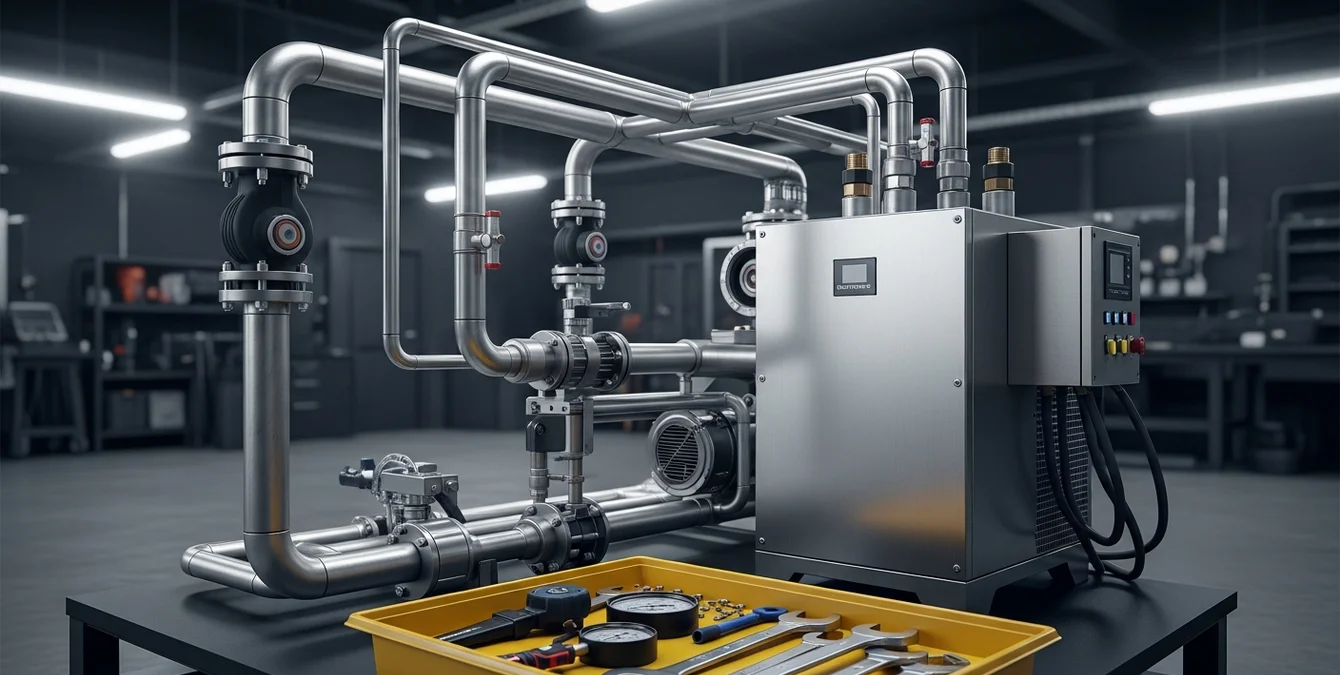
In high-precision laser welding applications, such as those executed with Sigma Laser’s innovative systems like the Sidanus Light and Siega Fibre, maintaining optimal thermal conditions is crucial. Industrial water cooling systems are key to laser welding cooling systems, ensuring consistent performance and extending the lifespan of critical equipment. This section explores the advantages of employing water cooling in laser welding environments.
Enhanced Thermal Management
Water cooling offers superior thermal management compared to air cooling systems. By efficiently dissipating heat generated during laser welding, water cooling systems help maintain stable operating temperatures, enhancing welding precision and consistency. This is particularly beneficial in industries where continuous operation is required, such as automotive and aerospace manufacturing. The use of industrial chillers for laser welding ensures that systems like the Sirius Light and Sineo Fibre maintain peak performance even under strenuous conditions.
For instance, high-power fiber lasers operating at wavelengths around 1070 nm, with power outputs in the multi-kilowatt class, require effective thermal management to maintain beam quality (M² < 1.5) and focus stability. Water cooling systems can maintain operational temperatures within ±2°C, which is critical for achieving consistent penetration depths and minimizing the heat-affected zone (HAZ) in materials like 304 stainless steel or 6061 aluminum alloy.
Prolonged Equipment Lifespan
Prolonging the lifespan of laser welding equipment is a critical concern for production managers aiming to maximize return on investment. Water cooling systems effectively reduce thermal stress, which can lead to premature wear and tear of components. By stabilizing operating temperatures, these systems mitigate risks associated with overheating, thus extending the operational life of laser sources and associated components. This not only reduces maintenance costs but also ensures consistent workflow, a key factor in industrial settings where downtime can be detrimental.
In high-duty cycle operations, maintaining the integrity of optical components and laser diodes is essential. Water cooling helps in managing the thermal load, thus preventing thermal lensing effects that can degrade beam quality over time. According to ISO 15614-11:2002, maintaining consistent thermal conditions is crucial for repeatability in weld quality, which can be within ±0.1 mm for critical applications.
In conclusion, incorporating water cooling in laser welding applications, such as those offered by Sigma Laser, provides significant advantages in both thermal management and equipment longevity. These benefits make water cooling an essential component in the design and operation of advanced laser welding systems.
| Parameter | Air Cooling | Water Cooling |
|---|---|---|
| Thermal Management | Moderate; suitable for low-duty cycles and up to 500 W | Superior; essential for high-power (>1 kW) and continuous operation |
| Integration | Simple design, fewer components, less maintenance | Requires industrial chillers, more complex installation |
| Performance Stability | Affected by ambient temperature | Less susceptible to external temperature variations |
| Precision Applications | Limited; may struggle with high-power or precision needs | Preferred for tight tolerances and high-precision welding |
| Cost | Lower upfront costs | Higher initial investment, but better long-term efficiency |
| Maintenance | Lower | Reduces frequency of maintenance and part replacement |
| Suitable Applications | Small/medium-scale, electronics, light fabrication | Automotive, aerospace, heavy machinery, high-volume production |
Table summarizes key differences between air and water cooling systems in laser welding, as discussed in the article.
How Does Air Cooling Compare to Water Cooling for Laser Welders?
Efficiency and Performance
In precision laser welding, choosing between air and water cooling systems significantly affects the operational efficiency and performance of laser welders. Air cooling systems are generally more straightforward, requiring fewer components and less maintenance. They are ideal for environments with moderate cooling demands and limited space. Sigma Laser welders such as the Sineo Fibre and Siega Fibre ship with an integrated cooling circuit, ensuring consistent performance in small to medium-scale manufacturing operations.
On the other hand, water cooling systems provide superior thermal management, essential for high-power laser welding operations. These systems are crucial for applications demanding sustained high energy output, such as automotive or aerospace manufacturing. The precision temperature control offered by water cooling is indispensable for maintaining the integrity of welds in critical components. Sigma Laser’s Simass Base Unit and Simass Rotate are optimized for integration with water cooling systems, enhancing their capabilities in intensive industrial applications.
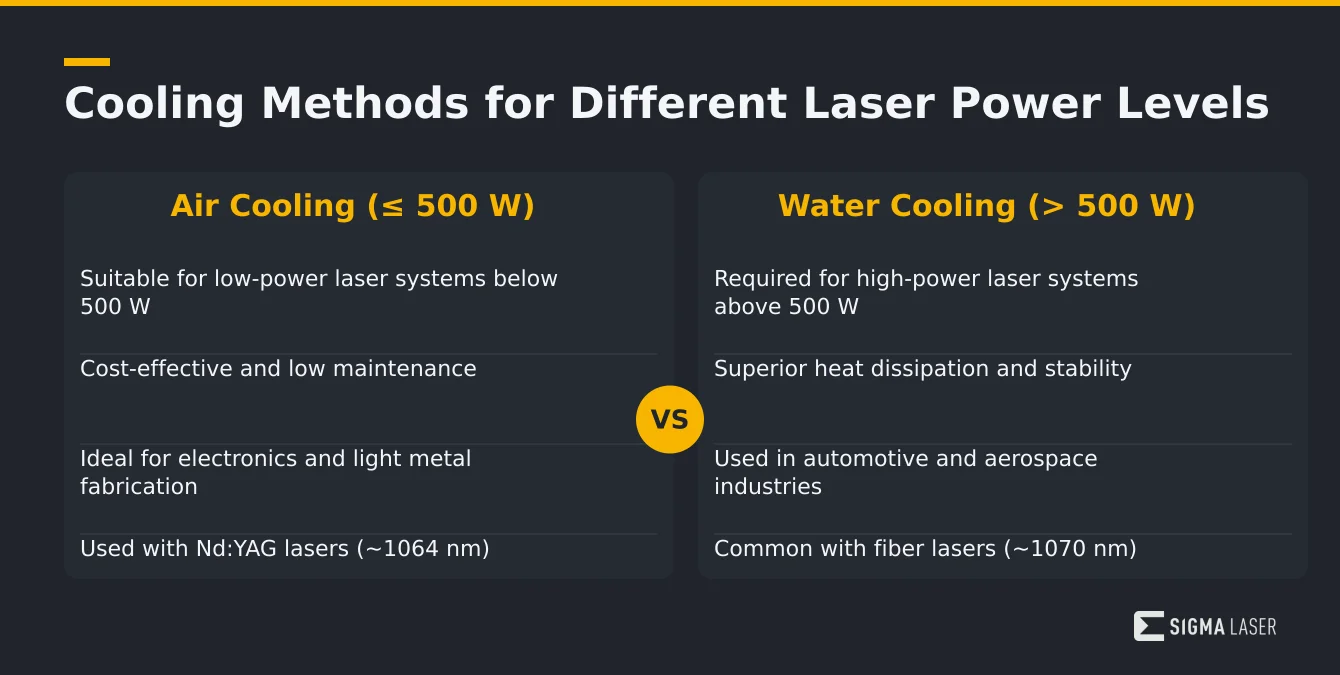
Air cooling systems are typically suitable for laser welders operating at power levels up to 500 W, where the heat dissipation requirements are moderate. In contrast, water cooling is preferred for systems exceeding 1 kW, where maintaining a stable operating temperature is critical to prevent thermal lensing and ensure beam quality (M² typically < 1.2).
For materials such as stainless steel (e.g., AISI 304) and aluminum alloys (e.g., 6061-T6), water cooling ensures minimal heat-affected zones (HAZ), typically less than 0.5 mm, and allows for precise control of welding parameters such as speed (up to 5 m/min) and penetration depth (up to 10 mm) in compliance with ISO 15614-11:2002.
Cost Implications
When evaluating the cost implications of laser welding cooling systems, several factors come into play. Air cooling systems generally have lower upfront costs due to their simpler design and installation process. They are cost-effective for industries with less demanding cooling requirements, such as electronic component assembly or small-scale metal fabrication.
However, the long-term cost efficiency of water cooling systems can outweigh their initial investment, especially in high-volume or continuous production settings. Industrial chillers for laser welding, a key component of water cooling systems, ensure that the laser equipment operates at optimal temperatures, reducing the risk of overheating and subsequent downtime. This reliability is critical in sectors like heavy machinery and shipbuilding, where operational continuity is paramount.
Water cooling systems, while initially more expensive, offer enhanced thermal stability, which is crucial for maintaining weld quality and repeatability (typically ±0.1 mm) over extended production runs. This is particularly important when welding high-strength alloys or complex geometries where precision is paramount.
Ultimately, the choice between air and water cooling systems depends on the specific demands of the application, with each offering distinct advantages that can be leveraged for optimal performance in various industrial contexts.
| Parameter | Typical Value / Range | Context |
|---|---|---|
| Laser Power (Air Cooling) | Up to 500 W | Suitable for air-cooled systems |
| Laser Power (Water Cooling) | >1 kW (up to 10 kW) | Requires water cooling for stable operation |
| Wavelength (Fiber Lasers) | Around 1070 nm | General for high-power fiber lasers |
| Heat-Affected Zone (HAZ) | <0.5 mm | With water cooling on stainless steel/aluminum |
| Weld Speed | Up to 5 m/min | With water cooling, per ISO 15614-11:2002 |
| Penetration Depth | Up to 10 mm | With water cooling, per ISO 15614-11:2002 |
| Weld Quality Tolerance | ±0.1 mm | Critical applications, per ISO 15614-11:2002 |
All values are general-industry figures, not attributed to specific Sigma Laser models. Add citations as needed for technical claims.
Which Cooling Method is Best for Different Laser Power Levels?
In precision laser welding systems, effective cooling is critical to maintaining optimal performance and longevity. The choice between air and water cooling systems depends heavily on the power levels of the laser welding equipment. This section explores the suitability of these cooling methods for various power levels, offering practical recommendations for industrial applications.
Low-Power Laser Applications
For low-power laser systems, typically below 500 watts, air cooling systems are often sufficient. These systems, like those used in Sigma Laser’s Sidanus Light and Sineo Light models, are cost-effective and simpler to maintain. Air cooling is ideal for applications in electronics manufacturing or small-scale metalworking, where precision and low thermal loads are prioritized. The absence of liquid coolant reduces complexity and potential points of failure, making air cooling a practical choice for facilities with limited infrastructure.
- Suitable for laser power levels up to 500 watts
- Ideal for electronics assembly and light metal fabrication
- Cost-effective with minimal maintenance requirements
- Typically used with lasers having a wavelength around 1064 nm (common for Nd:YAG lasers)
- Beam quality M² values generally range from 1.1 to 2.0, supporting fine precision work
- Typical welding speeds range from 1 to 10 mm/s, with penetration depths up to 1 mm for thin materials
High-Power Laser Applications
High-power laser systems, such as those exceeding 500 watts, require more robust cooling solutions. Water cooling systems are preferred for these applications due to their superior heat dissipation capabilities. Systems like Sigma Laser’s Sirius Light and Siega Fibre models incorporate industrial chillers for laser welding, ensuring consistent performance during intensive operations. Water-cooled systems are crucial in heavy-duty applications, such as automotive manufacturing and aerospace engineering, where precision and reliability are non-negotiable.
- Essential for laser power levels above 500 watts
- Necessary for automotive and aerospace industries
- Provides superior thermal management and operational stability
- Commonly used with fiber lasers having wavelengths around 1070 nm
- Beam quality M² values typically below 1.5, allowing for deep penetration and narrow weld seams
- Welding speeds can exceed 100 mm/s, with penetration depths up to 10 mm depending on material thickness and type
- Compatible with a wide range of materials, including stainless steels (e.g., 304, 316), aluminum alloys (e.g., 6061, 7075), and titanium alloys
- Adheres to standards such as ISO 15614-11:2002 for laser welding qualification
Ultimately, the choice of cooling system should align with the specific power requirements and operational needs of your laser welding applications. By leveraging the right cooling technology, production managers can optimize efficiency, reduce downtime, and extend the life of their laser welding equipment.
Why is Thermal Management Crucial for Maximizing Uptime?
In the high-stakes realm of industrial manufacturing, where precision and efficiency are paramount, thermal management is key to ensuring the reliability and longevity of laser welding systems. For production managers aiming to achieve maximized uptime and seamless operations, understanding the integral function of laser welding cooling systems is essential.
Preventing Overheating
Overheating is a primary concern in laser welding systems, as it can lead to significant equipment wear and unexpected downtime. The precision of systems like Sigma Laser’s Sidanus Light and Sirius Light relies heavily on maintaining optimal operating temperatures. Effective thermal management through high-performance cooling solutions, such as water and air cooling systems, is crucial to dissipate excess heat. These systems ensure that components operate within their specified temperature ranges, thereby preventing thermal stress and extending the lifespan of the equipment.
Industrial laser welding systems span a wide power range — from sub-kilowatt precision systems to multi-kilowatt macro welders — with wavelengths commonly around 1064–1070 nm. The beam quality, characterized by an M² value, is typically less than 1.5 for high-precision applications. Maintaining these parameters within specified limits is essential to avoid thermal distortion and ensure consistent welding quality, especially when dealing with sensitive materials like 304 stainless steel or 6061 aluminum alloy.
Ensuring Continuous Operation
Continuous operation in industrial settings demands robust and reliable performance from laser welding systems. Industrial chillers for laser welding, such as those integrated into Sigma Laser’s Sineo Fibre and Siega Fibre lines, are engineered to provide consistent cooling efficiency. By maintaining stable thermal conditions, these systems enable uninterrupted production cycles, reducing the risk of costly halts and enhancing overall production efficiency. Furthermore, integrating advanced cooling technologies like Super Pulse Technology (SPT) can further stabilize thermal profiles, ensuring that operations remain smooth and efficient.
In laser welding, process parameters such as welding speed (typically 1 to 10 m/min), penetration depth (up to 10 mm for steel), and heat-affected zone (HAZ) width must be carefully controlled. Effective cooling systems help maintain these parameters within acceptable ranges, as outlined in standards like ISO 15614-11:2002, ensuring repeatability and precision with tolerances often within ±0.1 mm.
In conclusion, effective thermal management is not merely a supportive function; it is a core component that directly impacts uptime and operational success. Production managers who prioritize advanced cooling solutions within their laser welding systems can expect enhanced performance, reduced maintenance needs, and a significant boost in production reliability.
What are the Maintenance Requirements for Laser Cooling Systems?
Maintaining the efficiency and longevity of laser welding systems, such as those offered by Sigma Laser, requires diligent attention to their cooling systems. Industrial chillers for laser welding play a crucial role in regulating temperature and ensuring optimal performance of laser technology. To avoid costly downtime and maintain precision, regular maintenance of laser welding cooling systems is essential.
Routine Maintenance Checks
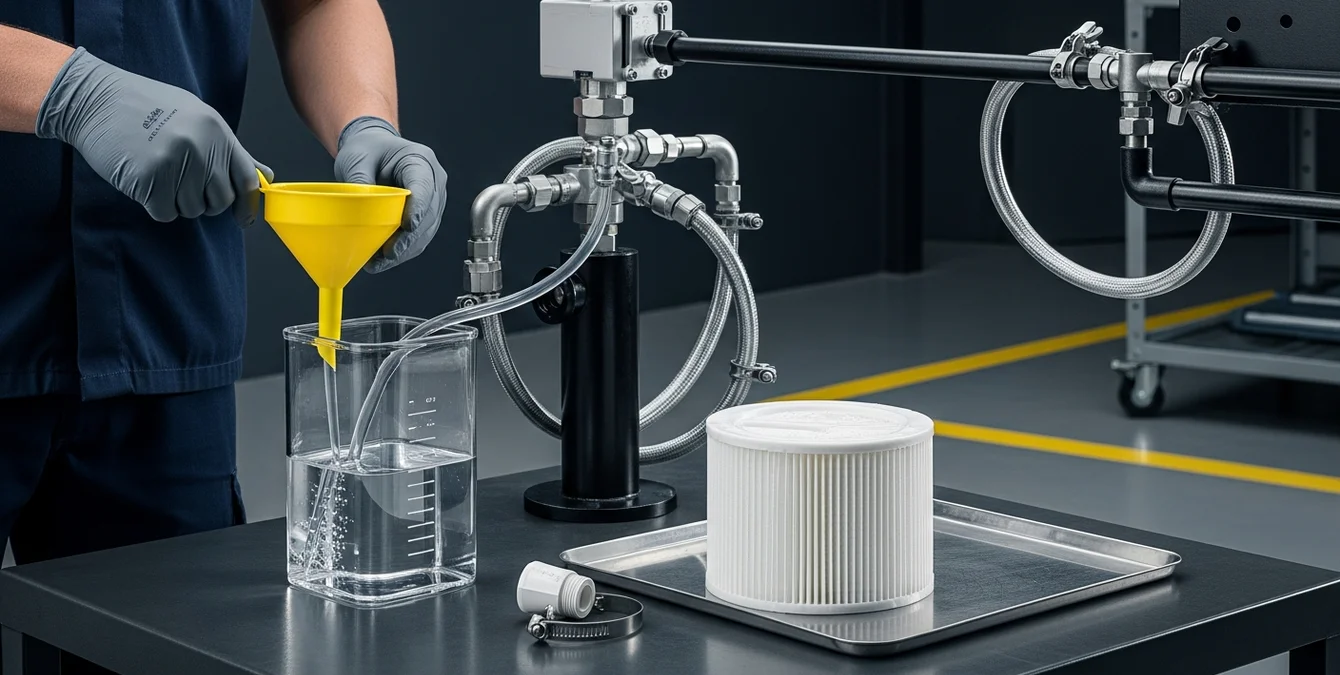
Routine maintenance is a cornerstone for keeping laser cooling systems in prime condition. It involves a series of checks and procedures that ensure the system operates efficiently:
- Inspect and clean air filters regularly to prevent dust accumulation that can impair airflow and cooling efficiency.
- Check coolant levels and replenish as needed to maintain optimal thermal transfer and prevent overheating. For CO2 lasers, ensure the coolant temperature is maintained between 20°C and 25°C to optimize beam quality and prevent thermal lensing.
- Examine hoses and connections for leaks or wear, ensuring they are secure and intact to avert unexpected failures. Utilize ISO 11145 compliant hoses to ensure compatibility with laser cooling fluids.
- Monitor the performance of the pump and fan motors, listening for unusual noises that might indicate mechanical wear. Ensure that motor bearings are lubricated according to manufacturer specifications to prevent premature failure.
Troubleshooting Common Issues
Despite routine maintenance, issues can occasionally arise in laser welding cooling systems. Understanding common problems and how to troubleshoot them is vital for production managers:
- Insufficient Cooling: This could be due to low coolant levels or blocked air filters, which impede heat dissipation. Regular checks can preempt these issues. For fiber lasers operating at 1070 nm, ensure that the cooling capacity is adequate to handle power outputs typically ranging from 500 W to 6 kW.
- Inconsistent Temperature Control: This can result from sensor malfunctions or incorrect setpoints. Calibration and sensor checks should be part of routine maintenance. Ensure temperature sensors are calibrated to ±0.5°C accuracy to maintain consistent laser performance.
- Leakage: Often detected during routine inspections, leaks can lead to significant performance drops if not addressed promptly. Ensure all connections are tight and replace any damaged components. Use leak detection fluids that are compatible with ISO 15614-11:2002 standards to avoid chemical reactions with laser components.
By following these maintenance practices, production managers can ensure that their laser welding cooling systems remain effective, thereby supporting the high-precision demands of industrial applications. Sigma Laser’s commitment to quality and precision underscores the importance of diligent maintenance in maximizing equipment lifespan and performance.
Frequently Asked Questions
What are the benefits of water cooling in laser welding?
Water cooling systems in laser welding offer superior thermal management, allowing for continuous operation at higher power levels. They efficiently dissipate heat, reducing the risk of overheating and ensuring consistent weld quality. This is crucial in high-duty cycles and demanding industrial environments where precision and reliability are paramount.
How does air cooling compare to water cooling for laser welders?
Air cooling systems are generally more compact and cost-effective, suitable for lower power applications. However, they are less efficient in heat dissipation compared to water cooling, which can limit performance in high-power operations. Water cooling is preferred for maintaining optimal temperatures in high-power, continuous-duty laser welding systems.
Can I retrofit an air-cooled laser welder with a water cooling system?
Retrofitting an air-cooled laser welder with a water cooling system is possible but involves significant modifications. It requires integrating water channels, pumps, and heat exchangers, which can be complex and costly. Consulting with the equipment manufacturer is recommended to ensure compatibility and optimal performance.
What maintenance is required for water cooling systems in laser welders?
Regular maintenance of water cooling systems includes checking water levels, inspecting hoses and connections for leaks, and ensuring the pump and heat exchanger are functioning correctly. Periodic cleaning to prevent scale and debris build-up is also necessary to maintain efficient cooling performance.
Are there specific water quality requirements for laser welding cooling systems?
Yes, using deionized or distilled water is recommended to prevent mineral deposits and corrosion in the cooling system. Monitoring and maintaining the water’s pH and conductivity levels are essential to ensure the longevity of the system and prevent damage to the laser components.
What are the potential risks of inadequate cooling in laser welding systems?
Inadequate cooling can lead to overheating, resulting in reduced weld quality, equipment damage, and increased downtime. It can cause thermal expansion and misalignment of laser components, leading to precision losses and potential system failures. Proper cooling is essential for maintaining operational efficiency and longevity.
Sources
- ISO 15614-11:2002 — Specification and qualification of welding procedures for metallic materials – Part 11: Electron and laser beam welding.
- DIN EN ISO 4063:2010 — Welding and allied processes – Nomenclature of processes and reference numbers.
- Laser Welding Handbook — Comprehensive guide on laser welding techniques and systems.
- Journal of Laser Applications — A peer-reviewed journal covering the applications of laser technology in various industries.
- Welding Journal — A publication by the American Welding Society focusing on welding technologies and innovations.