
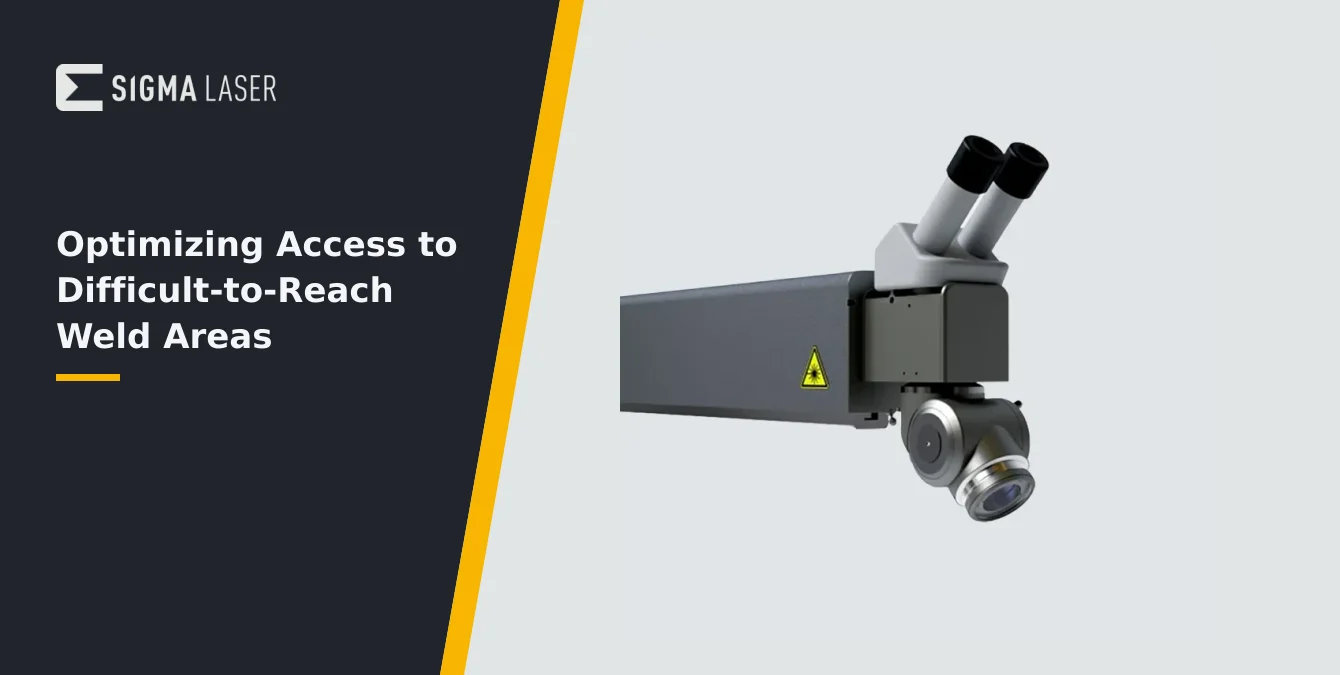
- The Access Toolbox
- Bring the Laser to the Part
- Planning Access Before Fixturing
- Deep Cavities, Vertical Walls, Overhead
- Wire Feed in Awkward Positions
- Example Scenarios
- Frequently Asked Questions
- How does Swivel Optics improve weld access?
- What should I check before welding in deep cavities?
- How do mobile Sigma machines help with large or fixed parts?
- How can I ensure consistent wire feed in awkward positions?
- Related Articles
Quick Answer: Optimizing access to difficult-to-reach weld areas requires the right combination of Sigma’s 5-axis kinematics, specialized optics, and modular accessories. By leveraging Swivel Optics, telescopic lenses, and mobile platforms, operators can position the laser precisely—even in deep, vertical, or overhead locations—while maintaining weld quality and safety.
| Accessory / Module | Function / Benefit |
|---|---|
| Swivel Optics | 360° beam deflection for accessing internal surfaces and confined cavities |
| Telescopic Lens | Extends working distance to reach deep within components while maintaining focus |
| Swivelling Y Axis | Fine adjustment of laser head position/orientation for approach from any angle |
| Motor-driven Z Axis | Powered vertical positioning for precise seam approach |
| Swivelling Wire Feed | Consistent filler wire delivery on vertical/angled surfaces; adjustable feed speed and retraction |
All accessories are modular and designed to optimize access in challenging weld geometries.
The Access Toolbox
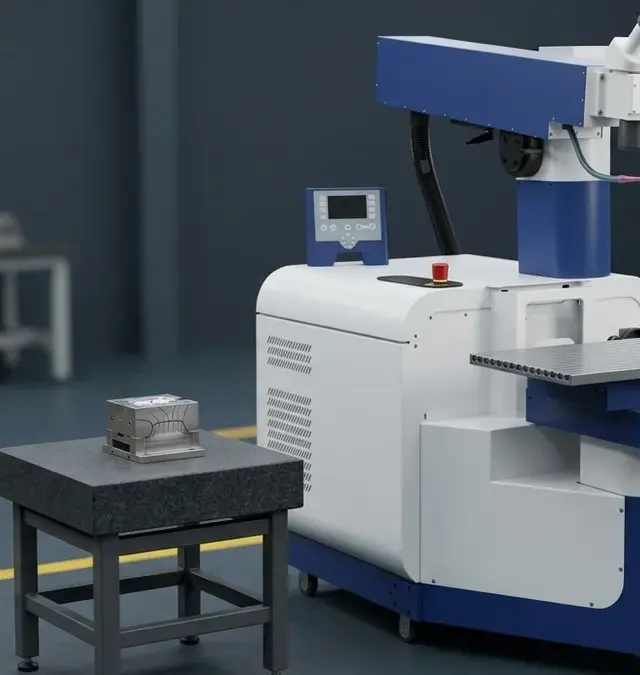
Successfully addressing difficult access weld areas starts with understanding and utilizing the full range of Sigma Laser’s access-enhancing hardware. All Sigma welding systems are equipped with true 5-axis kinematics (X, Y, Z, C, D), enabling both the laser head and the workpiece to be positioned with high precision. This multi-axis capability is fundamental for maneuvering around complex geometries and ensuring the laser beam is always optimally aligned with the weld seam, regardless of part orientation.
For challenging geometries—such as vertical walls, deep recesses, or overhead features—Sigma offers a suite of modular accessories. The Swivel Optics module provides 360° beam deflection, allowing operators to direct the laser beam into positions that would otherwise be inaccessible with a fixed optic. This is especially valuable for welding on internal surfaces or within confined cavities. When additional reach is required, the optional Telescopic Lens extends the working distance, granting access to areas deep within a component while maintaining focus and beam quality.
Axis extension modules such as the Swivelling Y Axis and Motor-driven Z Axis further expand the operational envelope. These powered axes allow for fine adjustment of the laser head’s position and orientation, making it possible to approach the weld seam from any required angle. For applications involving filler wire, the Swivelling Wire Feed system ensures consistent wire delivery even when working on vertical or angled surfaces, with adjustable feed speed and retraction behavior to suit the welding mode and position.
By combining these tools, operators can systematically eliminate access barriers, reduce the need for complex fixturing, and maintain process consistency even in the most demanding weld locations.
| Model | Mobility Features | Maximum Reach | Typical Application |
|---|---|---|---|
| Sineo Light | Industrial castor wheels with lock | up to 1830 mm | In-situ welding of large/fixed parts |
| Sineo Fibre | Industrial castor wheels with lock | up to 1830 mm | Mobile fibre laser welding for large assemblies |
| Sirius Light | Robust chassis, heavy-duty mobility | up to 1830 mm | Heavy-duty mobile Nd:YAG welding (e.g. large molds) |
All listed systems are engineered for mobility and extended reach, enabling the laser to be brought directly to the weld area.
Bring the Laser to the Part
In many production environments, the size, weight, or geometry of the workpiece makes it impractical to manipulate the part for optimal laser access. Sigma addresses this challenge with a range of mobile laser welding machines—specifically, the Sineo Light, Sineo Fibre, and Sirius Light models. Each is engineered with mobility and reach as core features, allowing the laser head to be brought directly to the weld area rather than repositioning the workpiece.
The Sirius Light and Sineo series machines offer an impressive reach of up to 1830 mm. This extended arm length enables operators to access weld seams deep inside large molds, dies, or assemblies without disassembling or moving the part. The open-frame design of all Sigma systems ensures there is no table-bound load limit; operators can work on extremely large or heavy components—such as 25-tonne molds—without concern for machine capacity or workspace constraints.
Mobility is further enhanced by features such as heavy-duty castors with locking mechanisms (Sineo Light/Fibre) and robust chassis construction (Sirius Light). These allow the machine to be positioned precisely around the workpiece, even in crowded or irregular shop-floor environments. Once in place, the 5-axis kinematics and modular accessories take over, providing the fine control needed to reach and weld even the most inaccessible seams.
By bringing the laser to the part, Sigma’s mobile systems minimize downtime, eliminate unnecessary material handling, and enable in-situ repairs or modifications—critical advantages for tooling, mold, and maintenance professionals working with large-scale or fixed installations.
| Planning Step | Purpose |
|---|---|
| Mock-up dry run | Verify axis travel and accessory positioning before welding |
| Collision check (Sigomatic/Sigomatic Pro) | Ensure no interference between machine, fixtures, or part geometry |
| Cable/accessory/microscope routing | Prevent movement impediments and maintain operator visibility |
| Adjust fixturing/machine position | Optimize access and safety before welding begins |
Systematic pre-weld planning reduces rework and equipment risk, ensuring optimal weld access.
Planning Access Before Fixturing
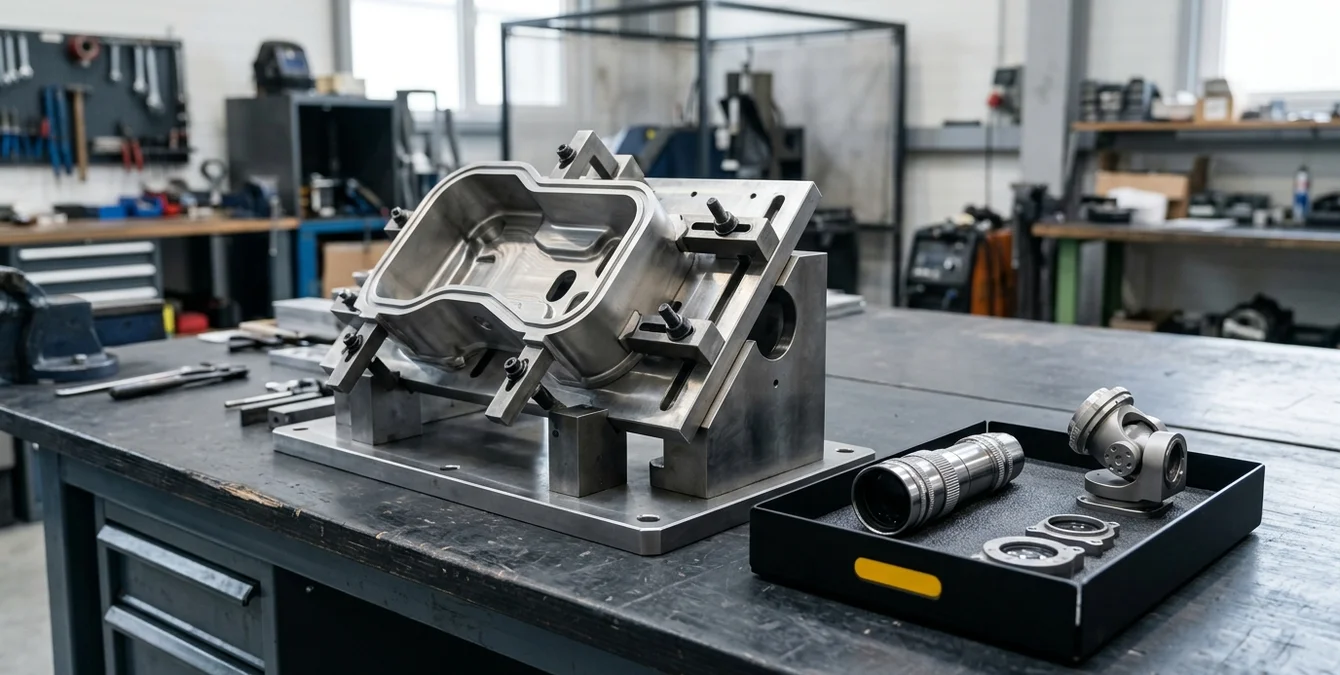
Optimizing weld access begins well before the first arc is struck. Effective planning at the fixturing stage is essential for ensuring that both the laser head and any required accessories can reach the intended weld areas without obstruction. Operators and engineers should carefully evaluate whether to move the part or the laser beam for each weld seam, considering factors such as part size, weight, geometry, and production flow.
Mock-up dry runs are a valuable best practice. By simulating the welding process with the actual fixturing and machine setup—without activating the laser—operators can verify that all axes have sufficient travel, that the Swivel Optics and telescopic lens can be positioned as needed, and that there are no unforeseen collisions between the machine, fixtures, or part geometry. This is especially important when working with large or irregular components, where access pathways may be tight.
Collision checks should be performed systematically, using the Sigomatic or Sigomatic Pro software to jog axes through the planned weld path and observe clearances in real time. Operators should pay close attention to cable routing, accessory protrusions, and microscope positioning, ensuring nothing impedes movement or blocks the operator’s line of sight. Adjustments to fixturing or machine positioning should be made as needed before welding begins.
By investing time in pre-weld access planning, teams can avoid costly rework, reduce the risk of equipment damage, and ensure that each weld is performed under optimal conditions for quality and safety.
Deep Cavities, Vertical Walls, Overhead
Welding within deep cavities, on vertical surfaces, or in overhead positions presents unique access challenges that require specialized solutions. Sigma’s Swivel Optics module is specifically designed to address these scenarios, enabling the laser beam to be deflected at virtually any angle within a 360° range. This allows operators to direct the beam into recesses, around corners, or onto surfaces that would otherwise be unreachable with a fixed optic.
When working inside deep cavities, operators must also consider the working distance of the integrated Leica 10× stereo microscope, which is 100 mm. Ensuring that the microscope can be positioned with a clear view of the weld area is critical for maintaining process control and quality. The optional Telescopic Lens can be employed to extend the effective working distance, allowing both the laser and the microscope to reach further into the part while preserving focus and spatial awareness.
For vertical or overhead welds, the combination of Swivel Optics and powered axis modules (such as the Motor-driven Z Axis) allows the laser head to approach the seam from below, above, or from the side as required. Operators should verify that the chosen configuration provides unobstructed access and that all safety measures are in place, especially when working overhead or in confined spaces.
- Check microscope and optic alignment before welding in deep or vertical locations.
- Use Swivel Optics to adjust beam angle without repositioning the part.
- Employ the Telescopic Lens for extended reach in deep cavities.
By systematically applying these tools and techniques, operators can maintain weld quality and consistency even in the most challenging access situations.
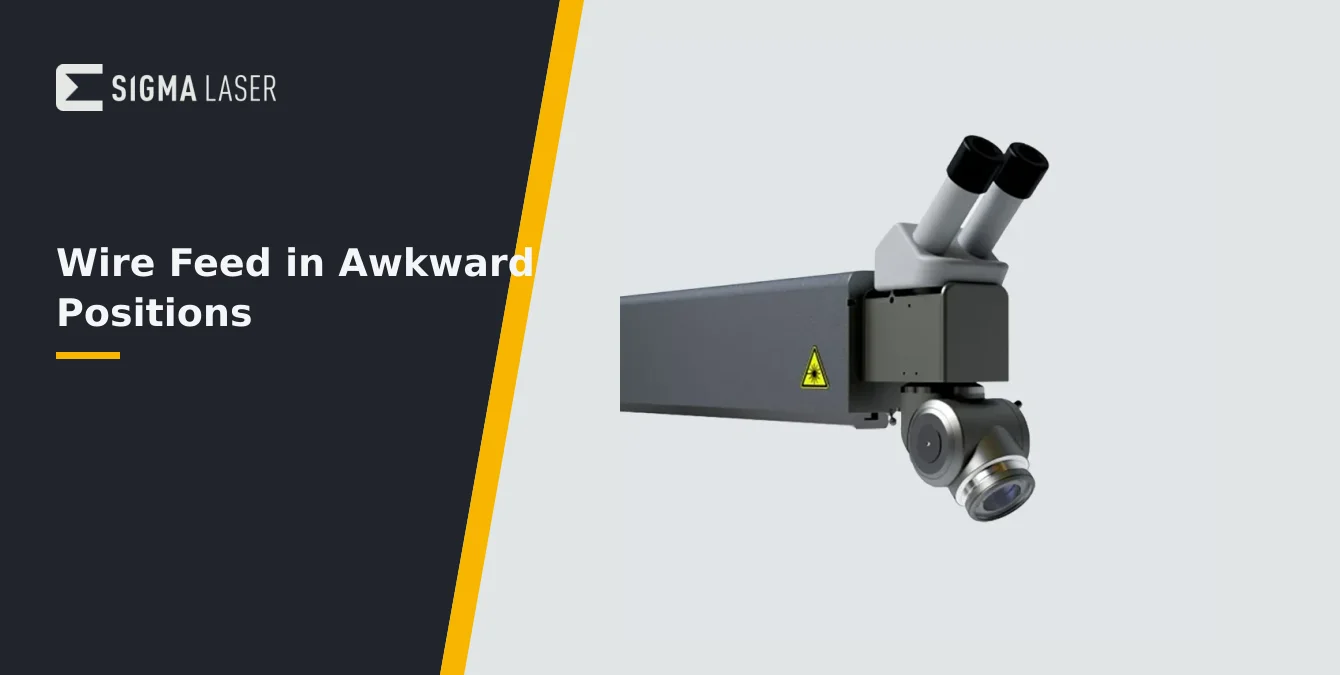
Wire Feed in Awkward Positions
Delivering filler wire accurately is often a critical requirement when welding in difficult-to-reach or non-horizontal positions. Sigma’s Swivelling Wire Feed accessory is engineered to maintain consistent wire delivery on vertical, angled, or even robotic axes, ensuring that the weld pool receives the correct amount of filler material regardless of part orientation.
The Swivelling Wire Feed system allows operators to adjust both the feed speed and the retraction behavior, matching the requirements of the selected welding mode (pulsed or CW) and the geometry of the weld area. This flexibility is essential when working in positions where gravity or access constraints could otherwise cause wire misalignment or inconsistent feeding.
Before welding, operators should inspect the wire feed mechanism for dust, debris, or wire fragments, as these can impede smooth operation, especially in non-standard positions. During setup, it is important to verify that the wire path remains clear throughout the full range of axis movement and that the feed nozzle can be positioned close enough to the weld pool without interfering with optics or fixtures.
Consistent wire delivery in awkward positions contributes directly to weld quality, minimizing defects such as underfill or porosity. Operators should monitor the wire feed performance during test runs and adjust parameters as needed to achieve stable, repeatable results.
Example Scenarios
To illustrate the practical application of these access optimization strategies, consider several common scenarios encountered in mold repair, pipe fabrication, and component assembly:
- Mold Internals: Repairing cracks or adding material deep within a mold cavity requires precise beam delivery and clear visual access. By combining Swivel Optics, the Telescopic Lens, and powered axes, operators can reach internal features without disassembling the mold or compromising alignment.
- Pipe Branch Joints: Welding at the intersection of main and branch pipes often involves confined spaces and complex angles. Sigma’s 5-axis kinematics, mobile platforms, and Swivelling Wire Feed enable operators to position the laser and filler wire precisely at the joint, ensuring full penetration and smooth transitions.
- Housing Corners: Electronic housings or mechanical enclosures frequently require seam welding in tight corners or along vertical walls. Swivel Optics and the Motor-driven Z Axis allow the laser head to approach these areas from above or the side, while maintaining ergonomic microscope positioning for operator comfort and control.
In each of these scenarios, the key to success lies in selecting the appropriate combination of machine mobility, axis control, and modular accessories. Operators should perform dry runs, verify access, and adjust parameters as needed to ensure that every weld—no matter how difficult to reach—meets the required standards for quality and durability.
Frequently Asked Questions
How does Swivel Optics improve weld access?
Swivel Optics allows 360° beam deflection, enabling the laser to reach surfaces inside cavities, on vertical walls, or overhead. This flexibility means operators can weld in positions that would be inaccessible with fixed optics, improving both process capability and ergonomics.
What should I check before welding in deep cavities?
Verify that the microscope and optics can be positioned with a clear view of the weld area, and use the Telescopic Lens if additional reach is needed. Perform a dry run to check for collisions and ensure all axis movements are unobstructed before starting the weld.
How do mobile Sigma machines help with large or fixed parts?
Mobile machines like Sineo Light/Fibre and Sirius Light have up to 1830 mm reach and unlimited load capacity, allowing the laser head to access weld areas on large or immobile parts without moving the workpiece. This reduces downtime and simplifies setup.
How can I ensure consistent wire feed in awkward positions?
Use the Swivelling Wire Feed accessory, which allows for adjustable speed and retraction on vertical or angled axes. Inspect the feed mechanism for obstructions, and perform test runs to confirm smooth, reliable wire delivery throughout the weld path.