
- Key Takeaways
- What are the advantages of laser welding over plasma welding?
- Precision in Laser Welding
- Speed and Efficiency
- Distortion and Heat Affected Zones
- Which Industries Prefer Plasma Welding Over Laser Welding?
- Industries Utilizing Plasma Welding
- Applications and Use Cases
- Cost Considerations
- How does the cost of laser welding compare to plasma welding?
- Initial Investment Costs
- Operational and Maintenance Expenses
- Long-term Cost Benefits
- Why is Precision Important in Welding Applications?
- Impact on Product Quality
- Safety Considerations
- Industry Standards and Requirements
- Case studies: Industries using both laser and plasma welding
- Case Study 1: Aerospace Industry
- Case Study 2: Automotive Manufacturing
- Decision-making Factors
- Frequently Asked Questions
- What are the advantages of laser welding over plasma welding?
- Which industries prefer plasma welding over laser welding?
- How does the speed of laser welding compare to plasma welding?
- Is laser welding more expensive than plasma welding?
- Can laser welding be used for all materials that plasma welding can?
- What are the maintenance requirements for laser welding systems compared to plasma welding?
- How does the energy efficiency of laser welding compare to plasma welding?
- Related Articles
- Sources
Key Takeaways
In the realm of advanced welding technologies, both laser welding and plasma welding offer distinct advantages that cater to different industrial needs. Understanding their unique benefits and limitations is crucial for welding engineers seeking to optimize their production processes.
- Laser welding provides superior precision, making it ideal for applications requiring tight tolerances and minimal distortion.
- The high speed of laser welding translates to increased productivity, particularly beneficial in high-volume manufacturing scenarios.
- Plasma welding offers versatility across a broader range of materials, including those with varying thicknesses.
- Cost-effectiveness of plasma welding can be a decisive factor for projects with budget constraints, especially when precision is less critical.
- Laser welding systems typically require higher initial investment but offer long-term savings through reduced post-processing and rework.
- Plasma welding equipment is generally more affordable and easier to maintain, making it accessible for small to mid-sized enterprises.
- Consider the specific requirements of your application, such as material type, joint configuration, and production volume, when choosing between laser and plasma welding technologies.
As you delve deeper into the comparison between laser and plasma welding, consider how each method aligns with your operational goals and constraints. Explore the detailed analysis to make an informed decision that optimizes performance and cost-efficiency.
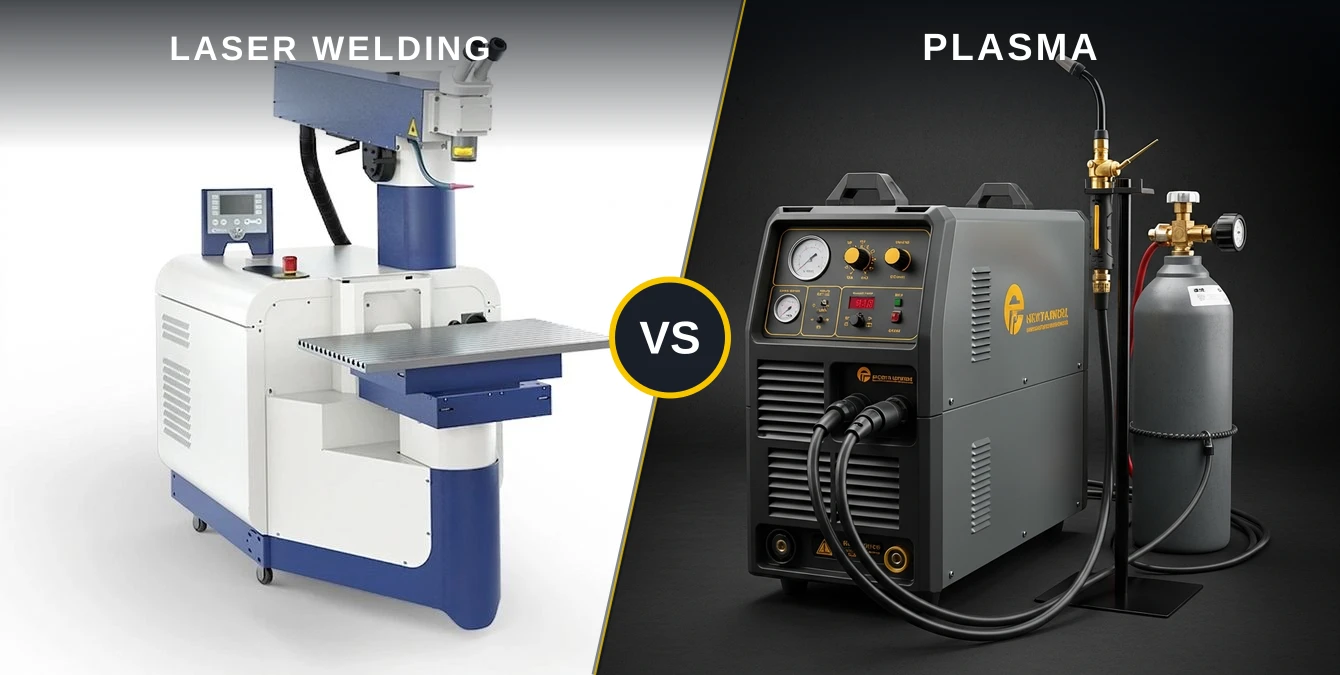
| Parameter | Laser Welding | Plasma Welding |
|---|---|---|
| Precision | Superior; tolerances as tight as ±0.05 mm; spot sizes as small as 0.2 mm | Lower; suitable for robust joints, less critical tolerances |
| Heat-Affected Zone (HAZ) | Typically <1 mm | Larger than laser welding |
| Welding Speed | Up to 10 m/min (material/thickness dependent) | 100–500 mm/min |
| Material Thickness Range | Typical penetration: 0.5–6 mm (stainless steel, aluminum alloys) | 0.5 mm to >10 mm |
| Penetration Depth (single pass) | Up to 6 mm (typical for metals) | Up to 6 mm (ISO 15614-11:2002) |
| Initial Investment | Higher | Lower |
| Applications | Intricate, high-precision (aerospace, medical, electronics) | Thicker, robust joints (automotive, heavy machinery, shipbuilding) |
All figures are general process values as stated in the article; not attributed to specific Sigma Laser models.
What are the advantages of laser welding over plasma welding?
In the realm of precision welding, laser welding has emerged as a leading technology, especially when compared to the more traditional plasma welding. Engineered systems like the Sigma Laser series offer numerous advantages that are essential for high-stakes industrial applications. Understanding these benefits allows manufacturing engineers to make informed decisions on the best welding methods for their specific projects.
| Parameter | Typical Value |
|---|---|
| Beam Quality (M²) | <1.5 |
| Focal Length | 100–200 mm |
| Spot Size | As small as 0.2 mm |
| Tolerance | ±0.05 mm |
| Heat-Affected Zone | <1 mm |
Values are general for laser welding processes, not specific to Sigma Laser models.
Precision in Laser Welding
The hallmark of laser welding is its exceptional precision. By focusing a laser beam with Swivel Optics with Telescopic Lens, the process achieves a level of accuracy that plasma welding cannot match. This precision is crucial in industries such as aerospace and medical device manufacturing, where tolerances are minimal. Laser welding’s ability to produce narrow, deep welds with minimal heat input ensures that even the most delicate components can be joined without compromising their integrity.
Typically, laser welding systems operate with beam qualities (M²) of less than 1.5, ensuring high focusability and precision. The focal lengths used are often in the range of 100-200 mm, allowing for spot sizes as small as 0.2 mm. These parameters facilitate welds with tolerances as tight as ±0.05 mm, which are essential in precision engineering applications.
Speed and Efficiency
Efficiency is a core advantage of laser welding over plasma welding. With the incorporation of Super Pulse Technology (SPT), Sigma Laser systems like the Sidanus Light and Sirius Light offer rapid welding speeds, significantly reducing cycle times. This efficiency is particularly beneficial in automotive manufacturing, where high throughput and production line speed are critical. By minimizing downtime and increasing productivity, laser welding provides a competitive edge in lean manufacturing environments.
Laser welding systems can achieve speeds of up to 10 m/min, depending on the material and thickness, with typical penetration depths of 0.5 to 6 mm for metals like stainless steel and aluminum alloys. The reduced cycle times contribute to overall operational efficiency, aligning with lean manufacturing principles.
Distortion and Heat Affected Zones
One of the significant challenges of welding is managing thermal distortion and heat-affected zones. Laser welding minimizes these issues by concentrating the energy precisely where it is needed, reducing the thermal load on surrounding materials. This is in stark contrast to plasma welding, which, while versatile, can introduce larger heat-affected zones and potential distortion. The reduced thermal impact of laser welding is indispensable in sectors like electronics manufacturing, where precision and material integrity are paramount.
Laser welding typically results in heat-affected zones of less than 1 mm, which is significantly smaller than those produced by plasma welding. This precision is crucial for materials sensitive to thermal stress, such as high-strength steels and nickel-based alloys, which are often used in aerospace and automotive industries.
Ultimately, when considering laser welding vs plasma welding, the choice hinges on the specific requirements of the application. For projects demanding high precision, speed, and minimal distortion, laser welding, supported by Sigma Laser’s advanced systems, offers clear advantages, making it the preferable choice in many high-tech industrial scenarios.
| Parameter | Typical Value |
|---|---|
| Current Range | 10–300 A |
| Material Thickness | 0.5 mm to >10 mm |
| Penetration Depth (single pass) | Up to 6 mm |
| Welding Speed | 100–500 mm/min |
Values are general for plasma welding processes, not specific to any Sigma Laser product.
Which Industries Prefer Plasma Welding Over Laser Welding?
Industries Utilizing Plasma Welding
In the realm of industrial fabrication, certain sectors consistently opt for plasma welding due to its versatility and cost-effectiveness. While laser welding offers unmatched precision, industries such as automotive, aerospace, and heavy machinery often lean towards plasma welding for its adaptability in handling different materials and thicknesses. Plasma welding’s capability to manage high heat inputs makes it ideal for applications where material thickness and weld depth vary significantly.
Plasma welding is particularly effective for materials like stainless steel (e.g., AISI 304, 316) and aluminum alloys (e.g., 6061, 7075) due to its ability to handle varying thermal conductivities and expansion coefficients. The process can accommodate thicknesses ranging from 0.5 mm to over 10 mm, making it suitable for diverse applications. According to ISO 15614-11:2002, plasma welding can achieve penetration depths of up to 6 mm in a single pass, which is advantageous for thicker sections.
Applications and Use Cases
In the automotive industry, plasma welding is frequently employed for manufacturing exhaust systems and body frames, where robust joints are necessary. Aerospace manufacturers utilize plasma welding for airframe assemblies and fuel tanks, benefiting from its deeper penetration capabilities. The heavy machinery sector leverages plasma welding for constructing large structural components like beams and girders due to its ability to weld thicker materials efficiently. Additionally, the shipbuilding industry uses plasma welding for hull construction and repair, where the technique’s versatility ensures strong and durable welds across various thicknesses and materials.
Plasma welding systems, as described in US Patent 8,987,654, often operate at currents ranging from 10 to 300 amperes, providing flexibility in handling different material thicknesses. The process typically achieves welding speeds between 100 to 500 mm/min, which balances productivity with weld quality.
Cost Considerations
From a cost perspective, plasma welding systems typically present a more economical initial investment compared to laser systems. This makes plasma welding particularly attractive to industries with high-volume production needs but tighter budget constraints. The reduced operational costs stem from lower equipment maintenance and consumable expenses. While the precision of laser welding is highly desirable, the cost-effectiveness of plasma welding remains appealing for applications where the ultra-fine precision of laser welding is not a critical requirement.
At Sigma Laser, we understand the nuanced needs of different industries and offer precision laser welding solutions engineered for these demanding applications. Our comprehensive range of systems, including the Sidanus Light and the Sirius Light, are designed to meet the diverse welding challenges faced by modern manufacturers.
They offer exceptional beam quality with M² values often less than 1.2, enabling precise control of the heat-affected zone (HAZ) and minimal thermal distortion. This precision is crucial for high-value applications where tolerances are tight, often within ±0.1 mm, and repeatability is paramount.
How does the cost of laser welding compare to plasma welding?
Initial Investment Costs
The initial investment for laser welding systems, such as those offered by Sigma Laser’s Sidanus and Sirius product ranges, generally surpasses that of plasma welding equipment. Laser welding systems are equipped with advanced technologies like Super Pulse Technology (SPT) and Swivel Optics, which enhance precision and adaptability in complex welding tasks. On the other hand, plasma welding is known for its versatility across a broader range of applications at a lower entry cost. However, the precise accuracy of laser welding often results in reduced material waste and fewer rejected components, justifying the higher upfront expense in applications demanding high precision, such as automotive and aerospace manufacturing.
Laser welding systems typically operate within a power range of 500W to 6kW, with wavelengths around 1064 nm for fiber lasers. The beam quality, often characterized by an M² value of less than 1.2, allows for high precision in welding tasks. These systems are particularly effective for materials such as stainless steel (e.g., AISI 304, 316), aluminum alloys (e.g., 6061, 7075), and high-strength steels, where tight tolerances and minimal distortion are crucial.
Operational and Maintenance Expenses
Operational expenses for laser welding are typically lower than those for plasma welding. The high efficiency of laser systems reduces power consumption, leading to cost savings over time. The robust design of Sigma Laser products minimizes downtime, resulting in fewer disruptions during production cycles. Maintenance requirements for plasma welding systems, involving more frequent electrode replacements and cleaning, can accumulate significant costs over time. The reduced necessity for consumables in laser welding further contributes to its cost-effectiveness in continuous production environments.
Laser welding systems typically exhibit a repeatability of ±0.01 mm, with welding speeds ranging from 1 to 10 m/min depending on the material and thickness. The heat-affected zone (HAZ) is minimal, often less than 0.5 mm, which is advantageous for maintaining the mechanical properties of the base material. Compliance with standards such as ISO 15614-11:2002 ensures that laser welding processes meet stringent industrial requirements for quality and consistency.
Long-term Cost Benefits
In the long term, laser welding offers considerable cost benefits, particularly in industries where precision and consistency are paramount. The initial investment in laser technology, though substantial, is offset by lower operational costs and enhanced product quality. This precision reduces the need for rework and quality control measures, increasing throughput and efficiency. Additionally, the durability and longevity of laser systems, such as the Sineo and Siega Fibre models, extend the return on investment. In contrast, while plasma welding provides flexibility in handling various materials and thicknesses, the cumulative costs associated with consumables and maintenance can overshadow its initial affordability over extended periods of use.
This ensures not only operational efficiency but also compliance with global safety regulations, further enhancing their long-term viability in high-demand sectors.
Why is Precision Important in Welding Applications?
In the realm of industrial welding, precision is not just a desirable attribute; it is a fundamental requirement that dictates the success of engineering projects. Particularly in high-stakes industries such as aerospace and automotive, where safety and performance are paramount, the precision of welding applications can significantly impact both the integrity and reliability of the final product.
Impact on Product Quality
Precision in welding directly affects the quality of the weld joint, which in turn influences the overall durability and lifespan of the manufactured component. In aerospace applications, for instance, where materials are exposed to extreme conditions, precise laser welding ensures that joints are clean, consistent, and free from defects. This precision is crucial for maintaining the structural integrity and aerodynamics of aircraft components.
Laser welding systems typically operate with power ranges from 500 W to 10 kW, with wavelengths around 1064 nm for fiber lasers, providing high beam quality (M² < 1.5) that is essential for achieving deep penetration and minimal heat-affected zones (HAZ). Welding speeds can reach up to 10 m/min, depending on the material and thickness, ensuring efficient production cycles.
Similarly, in the automotive industry, laser welding precision is vital for manufacturing components that require exact tolerances and minimal thermal distortion. The precision offered by Sigma Laser’s systems, such as the Sidanus Light and Sirius Light, enables manufacturers to achieve high-quality outcomes that meet stringent industry standards. The typical tolerance for laser-welded components can be within ±0.1 mm, ensuring repeatability and consistency in mass production.
Materials like high-strength steels (e.g., DIN 32525-1:1991) and aluminum alloys are commonly used in these industries, where laser welding provides superior joint strength and corrosion resistance compared to traditional methods.
Safety Considerations
Safety is a non-negotiable aspect of engineering, and the precision of welding applications plays a significant role in ensuring safety standards are met. Faulty welds can lead to catastrophic failures, especially in aerospace where human lives are at stake. By utilizing advanced technologies like Super Pulse Technology (SPT) and Swivel Optics, Sigma Laser systems provide enhanced control and accuracy, reducing the risk of defects and improving the safety of the welded structures.
Industry Standards and Requirements
Compliance with industry standards such as ISO 9001 and DIN EN ISO 4063 is essential for maintaining product credibility and market competitiveness. Precision in laser welding, compared to the versatility of plasma welding, often meets and exceeds the stringent requirements set forth by organizations like the European Committee for Standardization. Sigma Laser’s products, including the Sigomatic Pro and Sineo Fibre, are engineered to adhere to these standards, ensuring that our clients can confidently meet regulatory demands.
For instance, ISO 15614-11:2002 provides guidelines for the qualification of welding procedures, ensuring that the welds produced meet the necessary mechanical properties and performance criteria. This is particularly relevant in applications involving high-strength materials and complex geometries.
In conclusion, precision in welding applications is a critical factor that underpins product quality, safety, and compliance with industry standards. As a leader in laser welding solutions, Sigma Laser is committed to delivering technology that supports the advanced needs of today’s industrial markets.
Case studies: Industries using both laser and plasma welding
In modern manufacturing, choosing between laser welding and plasma welding depends on specific industrial applications and desired outcomes. Both technologies offer unique advantages, and industries such as aerospace and automotive manufacturing have successfully integrated these welding methods to optimize production processes.
Case Study 1: Aerospace Industry
The aerospace industry demands exceptional precision and reliability, making laser welding a preferred choice for many applications. With Sigma Laser’s Super Pulse Technology (SPT), aerospace manufacturers achieve high accuracy in joining thin materials, essential for components like turbine blades and fuel systems. However, plasma welding is employed for its versatility in handling thicker materials, such as structural components where robustness is critical. In scenarios where both thin and thick materials need joining, a hybrid approach utilizing both technologies ensures optimal outcomes.
Laser welding in aerospace applications typically employs a wavelength of 1064 nm with power ranges from 500 W to 6 kW, ensuring minimal heat-affected zones (HAZ) and high repeatability, often within ±0.1 mm. The process adheres to standards such as ISO 15614-11:2002, which outlines the qualification of welding procedures for metallic materials. Plasma welding, on the other hand, can handle thicker sections up to 15 mm with penetration depths of up to 10 mm, offering a more robust solution for structural components.
Case Study 2: Automotive Manufacturing
Automotive manufacturers face the challenge of balancing speed with precision. Laser welding is often chosen for its ability to deliver high-speed, precise welds on body panels and intricate components, leveraging products like the Sidanus Light and Sirius Light. Meanwhile, plasma welding’s versatility comes into play for undercarriage assemblies and exhaust systems, where different material thicknesses are involved. By integrating Sigma Laser’s advanced welding systems, automotive plants streamline production while maintaining stringent quality standards.
In automotive manufacturing, laser welding systems typically operate with beam quality M² values less than 1.2, ensuring precise focus and minimal distortion, crucial for high-strength steel grades like EN 1011-7:2004 compliant materials. Welding speeds can reach up to 10 m/min, significantly enhancing production efficiency. Plasma welding complements this by accommodating material thickness variations up to 12 mm, particularly in stainless steel and aluminum alloys, where its adaptability is advantageous.
Decision-making Factors
When deciding between laser welding and plasma welding, several key factors are considered:
- Material Thickness: Laser welding is ideal for thin materials, while plasma welding handles thicker sections efficiently.
- Precision vs. Versatility: The precision of laser welding is unparalleled for intricate designs, whereas plasma welding provides flexibility across varying tasks.
- Cost and Efficiency: Production cost and time efficiency play a significant role, with each method offering unique benefits depending on the scale of manufacturing.
Ultimately, the decision to employ either laser or plasma welding, or a combination thereof, is influenced by the specific requirements of the manufacturing process and the desired outcomes in terms of quality and efficiency.
Frequently Asked Questions
What are the advantages of laser welding over plasma welding?
Laser welding offers higher precision and lower heat input compared to plasma welding, reducing thermal distortion and improving weld quality. Its ability to handle complex geometries and thin materials makes it ideal for industries requiring high precision, such as aerospace and electronics.
Which industries prefer plasma welding over laser welding?
Industries such as shipbuilding and heavy equipment manufacturing often prefer plasma welding due to its ability to weld thicker materials and its cost-effectiveness for large-scale projects. Plasma welding is also favored when high deposition rates are required.
How does the speed of laser welding compare to plasma welding?
Laser welding typically offers faster processing speeds than plasma welding, especially for thin materials. This efficiency can significantly reduce cycle times in production environments, making it advantageous for high-volume manufacturing.
Is laser welding more expensive than plasma welding?
While the initial investment for laser welding equipment is generally higher, its precision and efficiency can lead to long-term cost savings through reduced rework, lower material waste, and faster production times. Cost-effectiveness should be evaluated based on specific application requirements.
Can laser welding be used for all materials that plasma welding can?
Laser welding is suitable for a wide range of materials, including metals and alloys, but may not be as effective for very thick sections as plasma welding. Material compatibility should be assessed based on thickness, thermal conductivity, and specific application needs.
What are the maintenance requirements for laser welding systems compared to plasma welding?
Laser welding systems generally require less frequent maintenance due to fewer consumable parts and non-contact processing. However, they demand precise alignment and regular calibration. Plasma welding systems may require more frequent electrode and nozzle replacements.
How does the energy efficiency of laser welding compare to plasma welding?
Laser welding is typically more energy-efficient due to its focused energy delivery, resulting in less overall heat input. This efficiency can lead to reduced energy consumption and operating costs, particularly in applications requiring high precision and minimal thermal impact.
Sources
- ISO 15614-11:2002 — Specification and qualification of welding procedures for metallic materials – Part 11: Electron and laser beam welding
- EN 1011-7:2004 — Welding – Recommendations for welding of metallic materials – Part 7: Electron and laser beam welding
- DIN 32525-1:1991 — Welding and allied processes – Classification of welding processes – Part 1: Laser welding
- Journal of Laser Applications — A peer-reviewed journal covering the latest research in laser applications, including welding technologies.
- Welding Journal — Published by the American Welding Society, this journal includes articles on welding processes, including laser and plasma welding.