
- Key Takeaways
- What is the Difference Between Fiber and CO2 Laser Welding?
- Mechanisms of Fiber and CO2 Lasers
- Wavelength and Material Compatibility
- How Do Fiber and CO2 Lasers Affect Production Speed?
- Setup Time and Efficiency
- Cutting Speed and Precision
- What are the Maintenance Requirements for Fiber and CO2 Lasers?
- Routine Maintenance Tasks
- Common Part Replacements
- Why Choose Fiber Laser Welding for Industrial Applications?
- Efficiency and Cost-Effectiveness
- Industries Benefiting from Fiber Lasers
- Which Industries Benefit Most from CO2 Laser Applications?
- CO2 Laser Use Cases
- Industry-Specific Advantages
- Case Studies: Fiber vs CO2 Laser Applications
- Case Study 1: Automotive Industry
- Case Study 2: Aerospace Sector
- Detailed Cost Analysis for Different Industries
- Initial Investment Comparison
- Operating Costs and ROI
- Frequently Asked Questions
- What are the maintenance requirements for fiber and CO2 lasers?
- How do fiber and CO2 lasers affect production speed?
- Which laser type is more energy-efficient: fiber or CO2?
- Are there differences in the materials that fiber and CO2 lasers can weld?
- What are the cost implications of using fiber vs CO2 laser systems?
- How does the beam quality differ between fiber and CO2 lasers?
- Can fiber and CO2 lasers be used interchangeably in all industrial applications?
Key Takeaways
In the realm of industrial welding, choosing between fiber and CO2 lasers requires a nuanced understanding of their respective efficiencies, cost implications, and material compatibilities. This evaluation is crucial for engineering and procurement professionals aiming to optimize production processes and control expenses.
- Fiber lasers generally offer higher energy efficiency and lower operational costs compared to CO2 lasers, making them a cost-effective choice for high-volume production.
- CO2 lasers, while more expensive to operate, can handle a broader range of materials, including non-metals, which are not suitable for fiber lasers.
- Fiber lasers provide superior performance on reflective materials such as aluminum and copper, reducing the risk of back reflections that can damage laser equipment.
- Maintenance costs are typically lower for fiber lasers due to their solid-state construction and absence of moving parts, leading to less downtime and fewer repairs.
- CO2 lasers excel in welding thicker materials, offering deeper penetration capabilities that are essential for certain industrial applications.
- For applications requiring high precision and minimal heat distortion, fiber lasers deliver enhanced accuracy and control, which is beneficial for intricate welding tasks.
- Assessing the specific material requirements and production goals of your project will guide the choice between fiber and CO2 laser welding, ensuring alignment with operational objectives.
This comprehensive comparison of fiber versus CO2 laser welding will equip you with the critical insights needed to make informed decisions, balancing cost-effectiveness with material and process demands. Dive deeper into the specifics to strategically align your welding technology with your production goals.
What is the Difference Between Fiber and CO2 Laser Welding?
In the realm of precision welding, understanding the differences between fiber and CO2 laser welding is crucial for selecting the right technology for your industrial application. Both methods offer unique advantages and are engineered to meet specific manufacturing requirements. Sigma Laser’s advanced solutions, such as the Siega Fibre and Sidanus Fibre, exemplify the cutting-edge technology available in both categories.
Mechanisms of Fiber and CO2 Lasers
Fiber lasers, such as those found in the Siega Fibre, utilize a solid-state gain medium, typically glass fibers doped with rare-earth elements. This configuration allows for high power output with excellent beam quality, leading to efficient, precise welding. Fiber laser efficiency is particularly noted for its low maintenance and high durability, making it suitable for harsh industrial environments.
Fiber lasers typically operate with power outputs ranging from 500 W to over 10 kW, with beam quality values (M²) often less than 1.1, indicating excellent focusability. The focal length of fiber laser optics can vary, commonly between 100 mm to 300 mm, optimizing the spot size for specific applications.
In contrast, CO2 lasers, exemplified by Sigma Laser’s Sidanus Light, employ a gas medium where CO2 is the active laser medium. This technology is renowned for its ability to deliver high power with a long wavelength, suitable for cutting and welding thicker materials. CO2 laser applications often include automotive and aerospace industries, where robust and deep penetration welding is necessary.
CO2 lasers typically operate at power levels from 1 kW to 20 kW, with a beam quality (M²) generally around 1.2 to 1.5. These lasers are effective for deep penetration welding, achieving depths up to 25 mm in mild steel, with welding speeds that can reach up to 10 m/min depending on the material and thickness.
Wavelength and Material Compatibility
The choice between fiber and CO2 laser welding often hinges on material compatibility due to their differing wavelengths. Fiber lasers generally operate at a wavelength around 1 µm, making them ideal for reflective metals like copper and aluminum. This short wavelength ensures minimal material absorption, reducing the risk of damage and enhancing precision.
Fiber lasers are particularly effective with materials such as 3000 and 5000 series aluminum alloys, as well as copper alloys like C10100. The precision of fiber lasers allows for tolerances typically within ±0.1 mm, which is crucial for applications requiring high accuracy.
Conversely, CO2 lasers operate at a wavelength of 10.6 µm, which is more effective on non-metallic materials and thicker metals. This makes them suitable for applications that require extensive material penetration, such as cutting and welding of mild steel and stainless steel.
CO2 lasers are compatible with a wide range of materials, including steels of grades such as S355 and AISI 304, where the heat-affected zone (HAZ) is typically controlled to be within 1 mm to 3 mm, depending on the process parameters.
In summary, the decision between fiber and CO2 laser welding should align with your specific manufacturing needs, considering factors like material type, desired precision, and operational environment. Leveraging Sigma Laser’s tailored solutions ensures that your operations meet the rigorous demands of modern industrial applications.
How Do Fiber and CO2 Lasers Affect Production Speed?
In the realm of precision laser welding, choosing between fiber and CO2 lasers can significantly impact production speed. Understanding the nuances of fiber vs. CO2 laser welding is crucial for manufacturing engineers and procurement managers aiming to optimize operational efficiency. Both laser types offer unique advantages depending on specific industrial applications, setup time, cutting speed, and precision.
Setup Time and Efficiency
Fiber lasers, such as Sigma Laser’s Siega Fibre, are renowned for their efficient setup processes. With minimal warm-up times and easy integration into existing workflows, fiber lasers reduce downtime and enhance overall productivity. The modular design of fiber lasers, including components like the Z-Axis Module and Motor-driven Turning Device, allows for rapid reconfiguration, catering to dynamic production needs.
Fiber lasers typically operate within a wavelength range of 1070-1080 nm, providing excellent beam quality with an M² value often less than 1.1, which is ideal for precision applications. Their compact design and absence of moving parts contribute to a high mean time between failures (MTBF), often exceeding 100,000 hours, ensuring long-term reliability in industrial settings.
In contrast, CO2 lasers, while historically favored for thick material applications, often require more extensive setup due to gas handling systems and calibration needs. However, for specific tasks like cutting non-metallic materials, CO2 laser applications remain unmatched in terms of surface finish and edge quality, albeit with longer setup durations.
CO2 lasers operate at a wavelength of approximately 10.6 µm, which is particularly effective for organic materials and polymers. Their beam quality, with M² values typically around 1.2 to 1.5, supports applications requiring broader beam profiles.
Cutting Speed and Precision
Fiber lasers excel in cutting speed and precision, particularly when dealing with thin metals or reflective materials. The high power density and efficient energy transfer of fiber lasers like the Sidanus Fibre facilitate rapid cutting with minimal thermal distortion. This efficiency translates into higher throughput and reduced cycle times, which are critical in high-volume production environments.
Typical fiber laser systems can achieve cutting speeds up to 30 m/min for thin stainless steel sheets (up to 3 mm thick), with penetration depths precisely controlled to within ±0.1 mm, minimizing the heat-affected zone (HAZ) and maintaining material integrity.
CO2 lasers, such as those enhanced with Super Pulse Technology (SPT), provide superior precision in applications requiring intricate detailing and smooth edges. While generally slower than fiber lasers for thin materials, CO2 lasers demonstrate unparalleled performance in cutting thick materials, where their broader beam width can be advantageous.
For example, CO2 lasers can efficiently cut through 20 mm thick mild steel at speeds around 1 m/min, with exceptional edge quality and a HAZ typically extending 0.5 mm from the cut edge, as per standards like ISO 15614-11:2002.
Ultimately, the decision between fiber and CO2 lasers hinges on specific production requirements. By considering factors such as setup time and cutting precision, industrial professionals can make informed decisions to enhance their manufacturing processes, leveraging Sigma Laser’s advanced laser welding systems to achieve optimal results.
What are the Maintenance Requirements for Fiber and CO2 Lasers?
In the realm of industrial manufacturing, maintaining the peak performance of laser welding systems, such as those offered by Sigma Laser, is crucial for efficiency and precision. Both fiber and CO2 laser systems, including models like the Sidanus Fibre and Sineo Fibre, have distinct maintenance needs that engineers and procurement teams must consider to ensure long-term reliability and minimal downtime.
Routine Maintenance Tasks
Routine maintenance for both fiber and CO2 lasers involves systematic inspections and cleaning protocols. For fiber lasers, it’s essential to regularly inspect and clean optics, as accumulated debris can degrade fiber laser efficiency. CO2 lasers, commonly used for applications requiring deep penetration and cutting thick materials, similarly require routine checks of the optical path and cleaning of mirrors and lenses to prevent beam distortion.
- Inspect and clean laser optics regularly to ensure optimal beam quality. Fiber lasers typically operate at wavelengths around 1070 nm, necessitating precise optical cleanliness to maintain beam quality (M² < 1.1).
- Check and calibrate system alignments to maintain precision in applications. Fiber lasers can achieve positional accuracy within ±0.1 mm, which is crucial for high-precision tasks.
- Monitor cooling systems to prevent overheating, particularly in high-power laser operations. CO2 lasers, often rated up to 10 kW, require robust cooling systems to handle thermal loads.
Common Part Replacements
Both fiber and CO2 lasers necessitate periodic part replacements to sustain operational efficiency. In fiber lasers, the diode module is a critical component that may require replacement after extensive use. CO2 lasers may need more frequent replacement of consumables like resonator tubes and mirrors due to their complex optical setup.
- Replace diode modules in fiber lasers to avoid unexpected downtimes. Diode lifespans typically range from 50,000 to 100,000 hours under optimal conditions.
- Regularly assess and replace CO2 laser resonator tubes to maintain performance. These tubes can degrade over time, affecting the laser’s ability to maintain consistent power output.
- Ensure availability of replacement parts to minimize downtime during maintenance. CO2 lasers often require mirrors with reflectivity greater than 99.5% to sustain beam integrity.
By adhering to these maintenance practices, manufacturing facilities can leverage the strengths of fiber vs CO2 laser welding systems, ensuring high-quality outputs and extending the lifespan of their equipment. These proactive measures align with industrial standards such as ISO 9001 and DIN EN ISO 4063, ensuring compliance and operational excellence.
Why Choose Fiber Laser Welding for Industrial Applications?
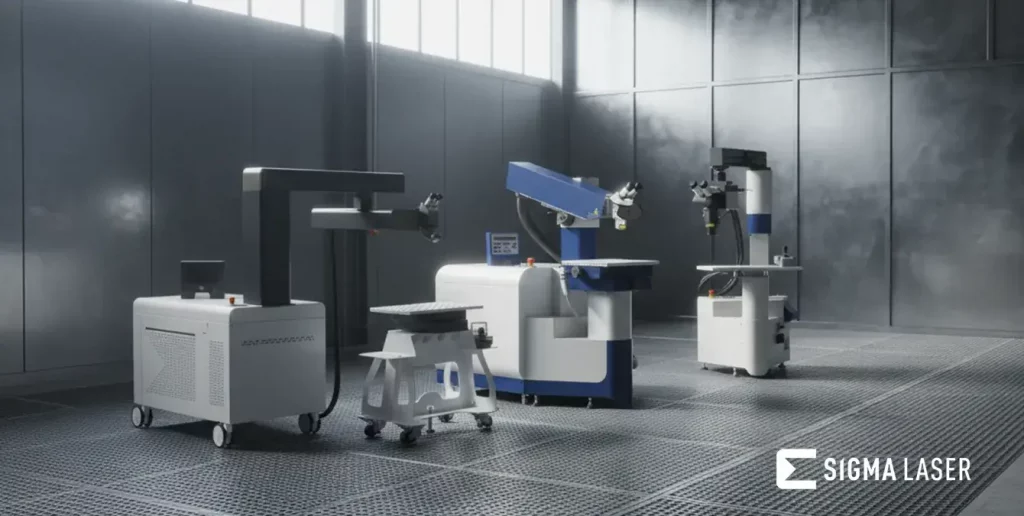
Fiber laser welding is a cutting-edge technology designed to meet the stringent demands of modern industrial applications. As a cornerstone of precision manufacturing, fiber laser welding systems like Sigma Laser’s Sidanus Fibre and Siega Fibre deliver unmatched efficiency and performance. The decision between fiber and CO2 laser welding often depends on specific operational needs, but fiber lasers are increasingly favored for their adaptability and precision.
Fiber lasers typically operate at wavelengths around 1070 nm, which is absorbed more efficiently by metals compared to the 10.6 µm wavelength of CO2 lasers. This allows fiber lasers to achieve higher energy density and more precise control, which is crucial when working with reflective materials such as aluminum alloys (e.g., 6061 and 7075) and stainless steels (e.g., 304, 316).
Efficiency and Cost-Effectiveness
The efficiency of fiber lasers is a key factor driving their adoption across various sectors. They provide high power levels, commonly ranging from 500 W to 6 kW, and superior beam quality with M² values typically less than 1.5, leading to faster processing times and reduced energy consumption. This efficiency results in lower operational costs and increased throughput, making fiber laser systems like Super Pulse Technology (SPT) from Sigma Laser an excellent choice for high-volume production environments.
Fiber lasers can achieve welding speeds up to 30 mm/s with penetration depths of up to 6 mm in steel, while maintaining a minimal heat-affected zone (HAZ), which is critical for maintaining the mechanical properties of the welded material. The repeatability of fiber laser welding systems is typically within ±0.1 mm, ensuring consistent quality across production runs.
Unlike CO2 lasers, fiber lasers require minimal maintenance due to their solid-state design, which eliminates the need for mirror alignment and gas changes. This not only reduces downtime but also significantly lowers the total cost of ownership over the equipment’s lifespan.
Industries Benefiting from Fiber Lasers
Fiber laser welding excels in various industries where precision and speed are critical. In the automotive sector, for instance, the Motor-driven Turning Device and Swivel Optics enable complex welds on automotive components with exceptional accuracy, meeting standards such as ISO 15614-11:2002 for welding procedure qualification. The aerospace industry benefits from fiber lasers’ ability to deliver consistent results on lightweight alloys, essential for maintaining structural integrity in compliance with stringent aerospace standards.
Moreover, the medical device industry relies on the precise control offered by fiber lasers to weld intricate components without compromising material properties. This versatility illustrates why fiber lasers are a preferred choice over traditional methods in these technologically advanced sectors.
Which Industries Benefit Most from CO2 Laser Applications?
CO2 lasers, such as those engineered by Sigma Laser, play a pivotal role in precision welding and cutting applications across various industries. The decision between fiber and CO2 laser welding often hinges on specific industrial needs, with CO2 lasers offering unique advantages in certain sectors.
CO2 Laser Use Cases
CO2 lasers are celebrated for their versatility in processing a wide array of materials, including both non-metals and metals with reflective surfaces. Key use cases include:
- Automotive Industry: CO2 lasers are extensively utilized for cutting and welding automotive components, due to their capability to handle complex geometries and reflective materials like aluminum. Typically operating at wavelengths around 10.6 µm, CO2 lasers can achieve power outputs ranging from 1 kW to 20 kW, making them suitable for deep penetration welding of aluminum alloys and high-strength steels.
- Textile Sector: In textiles, CO2 lasers deliver precision cutting and engraving capabilities, perfect for intricate patterns and designs without harming delicate fabrics. The non-contact nature of CO2 laser processing minimizes mechanical stress, ensuring a high-quality finish.
- Electronics Manufacturing: In electronics, CO2 lasers enable the precision cutting of circuit boards and other components, ensuring high accuracy and minimal material waste. With beam quality M² values typically around 1.1 to 1.2, these lasers offer fine control over the heat-affected zone, crucial for maintaining the integrity of sensitive electronic materials.
Industry-Specific Advantages
Each industry gains unique benefits from CO2 laser applications:
- Automotive: The ability to weld and cut robust materials efficiently with minimal distortion meets the high productivity demands of automotive manufacturing. CO2 laser systems can achieve welding speeds up to 10 m/min, with penetration depths of up to 10 mm in steel, adhering to standards like ISO 15614-11:2002 for welding procedure qualification.
- Textiles: CO2 lasers provide the advantage of contactless processing, ensuring high-quality finishes essential for fashion and upholstery applications. The precision of these lasers allows for tolerances as tight as ±0.1 mm, crucial for detailed textile designs.
- Electronics: The precision and control offered by CO2 lasers support the miniaturization trends in electronics, enhancing product quality and reducing lead times. With the ability to maintain repeatability within ±0.05 mm, CO2 lasers ensure consistent performance in high-volume production environments.
While fiber laser efficiency is often highlighted for speed and energy savings, CO2 laser applications remain vital across these industries due to their specific material compatibility and processing capabilities. The operational limitations of CO2 lasers, such as their larger footprint and the need for regular maintenance of optical components, are offset by their unmatched performance in specific applications.

Case Studies: Fiber vs CO2 Laser Applications
In the industrial laser welding landscape, choosing between fiber and CO2 laser technologies is crucial for achieving optimal results. Each laser type offers distinct advantages based on the application, material, and desired efficiency. This section explores real-world case studies, highlighting the performance and efficiencies of fiber and CO2 lasers across various industries.
Case Study 1: Automotive Industry
The automotive industry demands precision and speed in welding applications, especially with the integration of lightweight materials like aluminum and advanced high-strength steels. Sigma Laser’s ‘Siega Fibre’ laser systems have been instrumental in enhancing production lines.
In a recent collaboration with a leading European car manufacturer, the implementation of fiber laser technology led to:
- Increased welding speed by 30%, significantly reducing cycle times. Typically, fiber lasers operate at speeds up to 10 m/min, depending on material thickness and type.
- Enhanced weld quality due to the fiber laser’s high beam quality (M² < 1.1) and stability, which is crucial for maintaining a narrow heat-affected zone (HAZ) and minimizing thermal distortion.
- Reduced maintenance costs owing to the system’s robust design and fewer moving parts. Fiber lasers generally have a lifespan exceeding 50,000 hours under normal operating conditions.
Meanwhile, CO2 laser applications, although traditionally favored for thicker materials, faced challenges in precision and efficiency when applied to complex geometries. This case highlights the superior efficiency of fiber lasers in automotive applications where speed and precision are critical.
Fiber lasers are particularly effective with reflective materials such as aluminum alloys (e.g., 6061, 7075) and high-strength steels (e.g., DP800, DP1000), adhering to standards like ISO 15614-11 for welding procedure qualification.
Case Study 2: Aerospace Sector
The aerospace sector, characterized by stringent standards and high-performance requirements, presents unique challenges for laser welding technologies. A case study involving a major aerospace supplier demonstrated the advantages of Sigma Laser’s ‘Sidanus Light’ CO2 laser systems.
For components requiring deep penetration welds, the CO2 laser technology provided:
- Superior penetration and uniform welds on thicker titanium alloys, such as Ti-6Al-4V, with penetration depths typically reaching up to 10 mm in a single pass.
- Consistency in weld quality across diverse parts and assemblies, with repeatability within ±0.1 mm, crucial for maintaining tight aerospace tolerances.
- Compliance with ISO 15614-14 standards, ensuring reliability in critical aerospace applications. Additionally, CO2 lasers operate at a wavelength of 10.6 µm, which is advantageous for deep penetration in non-ferrous metals.
Although fiber lasers are gaining traction for their ability to handle reflective materials, CO2 laser applications in the aerospace industry continue to prove invaluable for specific tasks requiring deep, uniform welds. CO2 lasers are particularly effective for welding thicker sections of nickel-based superalloys, meeting stringent aerospace quality standards.
These case studies affirm that the choice between fiber and CO2 laser welding is highly application-dependent, with each technology offering unique benefits that align with specific industrial requirements and standards.
Detailed Cost Analysis for Different Industries
When evaluating laser welding systems for industrial applications, conducting a comprehensive cost analysis is essential. This section provides an in-depth engineering-level comparison of fiber and CO2 laser welding technologies, taking into account their initial investment, operating costs, and return on investment (ROI) across various sectors. These insights are vital for manufacturing engineers, procurement managers, and technical buyers aiming to optimize their welding operations with Sigma Laser’s advanced systems such as the Sidanus Fibre and Sirius Light.
Initial Investment Comparison
The initial investment for laser welding equipment can differ significantly between fiber and CO2 lasers. Fiber lasers, exemplified by Sigma Laser’s Sidanus Fibre, often have a higher upfront cost due to their complex technology and long lifespan. However, they offer superior precision and require less maintenance. CO2 lasers, like those used in Sigma Laser’s Sidanus Light systems, generally have a lower initial cost but may not match the longevity and efficiency of fiber lasers.
- Fiber Laser Systems: Higher initial cost; ideal for applications requiring high precision and minimal downtime. Typical power ranges from 1 kW to 6 kW, with beam quality M² values typically below 1.5, ensuring high precision and repeatability within ±0.1 mm.
- CO2 Laser Systems: Lower initial cost; suitable for applications with less stringent precision requirements. Power levels typically range from 2 kW to 10 kW, with beam quality M² values around 1.2 to 1.5, suitable for cutting and welding thicker materials.
Operating Costs and ROI
Operating costs and ROI are critical considerations in the fiber vs CO2 laser welding debate. Fiber lasers are known for their efficiency, consuming less power and requiring minimal maintenance, which translates to lower long-term operating costs. CO2 lasers, while effective for certain applications, may incur higher operating costs due to increased energy consumption and more frequent maintenance needs.
- Fiber Laser Efficiency: Lower power consumption, reduced maintenance, leading to faster ROI. Typical operational efficiency is around 25-30%, with welding speeds up to 10 m/min depending on material and thickness.
- CO2 Laser Applications: Higher energy use, potentially higher maintenance, affecting ROI. Operational efficiency is generally around 10-15%, with welding speeds typically reaching up to 5 m/min.
In industries such as automotive manufacturing and aerospace, where precision and reduced downtime are paramount, fiber lasers offer significant cost advantages over time. For applications where material versatility and initial cost are prioritized, CO2 lasers remain a viable option. The choice between these technologies should be informed by the specific needs and constraints of your operations, aligning with Sigma Laser’s commitment to delivering tailored welding solutions.
Fiber lasers are particularly effective for welding high-strength steel grades and aluminum alloys due to their precise control over the heat-affected zone (HAZ), typically limited to 0.2-0.5 mm. CO2 lasers, on the other hand, are well-suited for non-metallic materials and thicker sections of carbon steel, where broader HAZs are acceptable.
Compliance with standards such as ISO 15614-11:2002 and DIN EN ISO 4063:2010 ensures that both fiber and CO2 laser welding processes meet rigorous quality and safety requirements, further enhancing their industrial applicability.

Frequently Asked Questions
What are the maintenance requirements for fiber and CO2 lasers?
Fiber lasers generally require less maintenance due to their solid-state design and fewer moving parts. CO2 lasers, however, need regular maintenance of optical components and gas refills. Both systems benefit from routine inspections and cleaning to maintain optimal performance.
How do fiber and CO2 lasers affect production speed?
Fiber lasers typically offer faster processing speeds due to their higher power density and efficiency in cutting metals. CO2 lasers are slower for metals but can be faster for non-metallic materials due to their longer wavelength, which is better absorbed by such materials.
Which laser type is more energy-efficient: fiber or CO2?
Fiber lasers are more energy-efficient, converting electrical energy into laser light with efficiencies of up to 40%. CO2 lasers have lower efficiency, around 10-20%, leading to higher operational costs and energy consumption.
Are there differences in the materials that fiber and CO2 lasers can weld?
Fiber lasers excel in welding reflective metals like aluminum and copper due to their shorter wavelength. CO2 lasers are more suitable for non-metals and thicker materials, such as plastics and wood, due to their longer wavelength.
What are the cost implications of using fiber vs CO2 laser systems?
Fiber lasers, while having a higher initial cost, offer lower operating costs due to reduced maintenance and energy efficiency. CO2 lasers have a lower upfront cost but incur higher maintenance and energy expenses over time.
How does the beam quality differ between fiber and CO2 lasers?
Fiber lasers provide superior beam quality with a smaller spot size, allowing for precision welding and cutting. CO2 lasers have a larger spot size, which can be advantageous for applications requiring broader heat distribution.
Can fiber and CO2 lasers be used interchangeably in all industrial applications?
While both can perform welding tasks, their suitability depends on the material and application. Fiber lasers are preferred for metals and high-speed operations, while CO2 lasers are selected for non-metals and specific industrial applications requiring different wavelengths.