
- Key Takeaways
- What are the Challenges of Laser Welding Dissimilar Metals?
- Metallurgical Incompatibility
- Intermetallic Compound Formation
- How Can Metallurgical Compatibility be Achieved?
- Selecting Filler Materials
- Pre-Weld Treatments
- What are the Best Practices for Laser Welding Dissimilar Metals?
- Laser Parameter Optimization
- Joint Design Considerations
- Case Studies: Successful Laser Welding of Specific Metal Combinations
- Aluminum to Steel Welding
- Copper to Titanium Welding
- How Does Laser Welding Compare to Other Methods for Joining Dissimilar Metals?
- Advantages of Laser Welding
- Comparative Analysis with TIG and MIG
- Can Laser Welding Reduce Intermetallic Compound Formation?
- Controlled Cooling Techniques
- Laser Beam Modulation
- Frequently Asked Questions
- What are the best practices for laser welding dissimilar metals?
- How does laser welding compare to other methods for joining dissimilar metals?
- What challenges are associated with laser welding dissimilar metals?
- Can laser welding be used for all types of dissimilar metal combinations?
- What industries benefit most from laser welding dissimilar metals?
- What role does laser type play in welding dissimilar metals?
- Related Articles
Quick Answer: Laser welding dissimilar metals is a precise technique that addresses the challenges of joining different metal types, such as aluminum to steel. This method uses high-energy laser beams to create a concentrated heat source, allowing for minimal thermal distortion and strong, reliable joints. Key factors include selecting appropriate laser parameters and filler materials to accommodate differing thermal expansion rates and melting points, ensuring optimal weld integrity. Advanced control systems in industrial laser welding machines enhance precision and adaptability, making it an ideal solution for complex applications in aerospace, automotive, and manufacturing industries.
Key Takeaways
Welding dissimilar metals using laser technology presents unique challenges and opportunities, particularly in industries such as automotive and electronics where precision and material compatibility are crucial. Understanding the techniques to minimize intermetallic compound formation is essential for achieving optimal weld quality and performance.
- Laser welding offers precise control over heat input, which is critical for reducing the formation of brittle intermetallic compounds in dissimilar metal joints.
- Using laser pulse modulation can help manage the cooling rates, thereby minimizing the formation of unwanted phases at the weld interface.
- Preheating one or both of the metals before welding can reduce thermal stress and improve weld integrity by slowing down the cooling process.
- Employing filler materials that are compatible with both base metals can act as a buffer, reducing the formation of intermetallic compounds.
- In automotive applications, laser welding of dissimilar metals is used to join lightweight materials, enhancing fuel efficiency without compromising structural integrity.
- For electronics, laser welding ensures precise, low-heat input joining, which is critical for sensitive components and miniaturized circuits.
- Advanced simulation tools can predict intermetallic formation, allowing engineers to adjust parameters preemptively for optimal results.
These takeaways provide a foundation for exploring the intricacies of laser welding dissimilar metals. Dive deeper into each technique and application to enhance your welding processes and material compatibility strategies.
What are the Challenges of Laser Welding Dissimilar Metals?
In advanced manufacturing, welding dissimilar metals with a laser presents unique challenges due to the distinct physical and chemical properties of each metal involved. This process is crucial in industries where diverse material combinations are needed for optimal performance, such as aerospace and automotive. However, achieving high-quality welds between dissimilar metals requires careful attention to metallurgical dynamics and precise control of welding parameters.
Metallurgical Incompatibility
Metallurgical incompatibility is a core challenge when laser welding dissimilar metals. Each metal has its own melting point, thermal conductivity, and coefficient of thermal expansion. For example, joining aluminum to steel involves substantial differences in melting temperatures and thermal expansion rates, leading to issues like thermal distortion and residual stress. Sigma Laser’s advanced systems, such as the Sidanus Fibre and Sirius Light, are designed to mitigate these effects by enabling precise energy control and beam modulation, ensuring a more stable welding process.
Industrial laser systems used for these applications typically operate within power ranges of 1 kW to 6 kW, utilizing wavelengths around 1070 nm for fiber lasers. The beam quality, often denoted by M² values, is typically less than 1.2 to ensure high precision and focusability. Welding speeds can vary significantly, commonly ranging from 0.5 m/min to 3 m/min, depending on the material thickness and desired penetration depth, which can reach up to 3 mm in single-pass operations.
Standards such as ISO 15614-11:2002 provide guidelines for welding procedure qualification for dissimilar metal joints, ensuring that the welds meet the necessary mechanical and metallurgical criteria.
| Technique | Purpose / Effect |
|---|---|
| Laser Pulse Modulation | Controls cooling rates to reduce brittle phase formation |
| Preheating Metals | Reduces thermal stress and slows cooling |
| Compatible Filler Materials (e.g., nickel-based alloys) | Acts as buffer to minimize intermetallics |
| Precise Heat Input Control | Minimizes width of heat-affected zone (HAZ) |
| Advanced Simulation Tools | Predicts intermetallic formation for parameter optimization |
Combining these techniques helps achieve robust, high-quality welds between dissimilar metals.
Intermetallic Compound Formation
The formation of intermetallic compounds is another significant hurdle in laser welding dissimilar metals. These compounds often occur at the interface of the welded materials, resulting in brittle regions that can compromise the mechanical integrity of the joint. The presence of intermetallic phases, such as aluminum-iron compounds when welding aluminum to steel, can lead to premature failure under mechanical stress. Sigma Laser’s Super Pulse Technology (SPT) offers a solution by reducing heat input and allowing for rapid cooling, thus minimizing intermetallic compound formation. Additionally, Swivel Optics with Telescopic Lens provide enhanced focus and precision, further aiding in maintaining weld quality.
To minimize the formation of intermetallics, the heat-affected zone (HAZ) must be controlled to a minimal width, typically less than 0.5 mm. This requires precise modulation of laser parameters and often the use of filler materials compatible with both base metals, such as nickel-based alloys, which can act as a buffer layer to reduce the formation of brittle phases.
Addressing these challenges requires not only advanced laser technology but also a deep understanding of metallurgical principles and specific application requirements. By leveraging Sigma Laser’s cutting-edge solutions, industries can achieve reliable and robust joints in their applications, from lightweight automotive assemblies to structurally critical aerospace components.
How Can Metallurgical Compatibility be Achieved?
In precision engineering, achieving metallurgical compatibility when welding dissimilar metals is crucial for maintaining structural integrity and functionality. This is particularly important in industries that require high reliability, such as aerospace and automotive manufacturing. Laser welding dissimilar metals presents complex challenges, but with the right strategies, these can be effectively managed.
Selecting Filler Materials
A key strategy for welding dissimilar metals is the careful selection of filler materials. The filler material must be compatible with both base metals to minimize the formation of brittle intermetallic compounds, which can weaken the joint. For example, when joining stainless steel to aluminum, a nickel-based alloy can be used due to its superior adaptability and reduced tendency to form intermetallic compounds. Sigma Laser’s advanced laser welding systems, like the Sidanus Light and Siega Fibre, provide precision control to accommodate these specific filler materials, ensuring optimal bonding between dissimilar metals.
When using laser welding systems, it is critical to consider the laser parameters such as power (typically ranging from 1 kW to 6 kW), wavelength (commonly 1064 nm for Nd:YAG lasers and 1070 nm for fibre lasers), and beam quality (M² < 1.2) to ensure effective energy delivery and penetration depth. The focal length, often between 100 mm to 200 mm, plays a significant role in achieving the desired spot size and energy density, which are crucial for managing the heat input and minimizing the heat-affected zone (HAZ).
In compliance with ISO 15614-11:2002, the selection of filler materials should also consider the mechanical properties and corrosion resistance required for the application, ensuring that the joint meets the necessary performance criteria.
Pre-Weld Treatments
Pre-weld treatments are essential for preparing the metals and enhancing weld quality. Techniques such as surface cleaning and applying appropriate coatings can significantly reduce the risk of defects. For instance, using a laser ablation process to clean the surface can remove contaminants and oxides that might lead to weld imperfections. Additionally, pre-heating dissimilar metals can help balance thermal expansion rates, further minimizing stress and potential crack formation during the welding process. Implementing these pre-weld treatments is vital when using Sigma Laser’s Swivel Optics, which allow for precise manipulation and adaptability across different metallurgical conditions.
For effective pre-weld treatment, surface roughness should be controlled, typically maintaining Ra values below 1.6 µm, to ensure optimal laser absorption and minimize reflectivity issues. Pre-heating temperatures should be carefully controlled, often between 100°C to 300°C, depending on the specific materials involved, to prevent excessive thermal gradients and residual stresses.
By employing these strategies, industries can achieve robust and reliable welds despite the challenges of laser welding dissimilar metals. As the demand for joining innovative materials grows, understanding and implementing these techniques will remain crucial for manufacturing engineers and technical buyers.
| Challenge | Solution / Mitigation |
|---|---|
| Metallurgical Incompatibility | Precise energy control and beam modulation (e.g., Sigma Laser Sidanus Fibre, Sirius Light) |
| Intermetallic Compound Formation | Super Pulse Technology (SPT), compatible filler materials, controlled HAZ |
| Thermal Distortion & Residual Stress | Preheating, optimized laser parameters |
| Surface Contamination | Laser ablation cleaning, surface preparation |
Sigma Laser systems incorporate advanced features to address these challenges in demanding industrial applications.
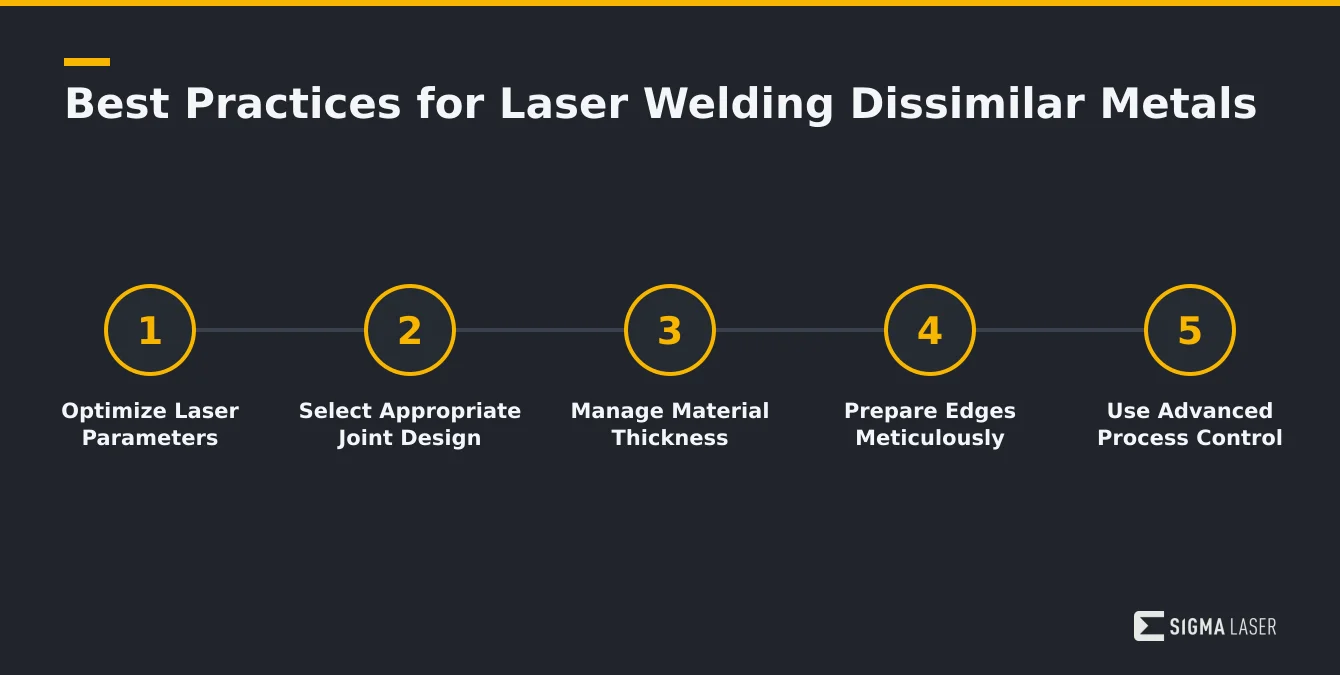
What are the Best Practices for Laser Welding Dissimilar Metals?
In advanced manufacturing, welding dissimilar metals using laser technology is a critical process that requires precision and expertise. At Sigma Laser, our precision laser welding systems, like the Sidanus Light and Siega Fibre, are designed to address the challenges of joining dissimilar metals. This guide offers insights into optimizing laser parameters, joint design considerations, and effective process control techniques to achieve successful welds with minimal intermetallic compound formation.
Laser Parameter Optimization
Optimizing laser parameters is crucial when welding dissimilar metals. By adjusting variables such as power density, pulse duration, and beam focus, manufacturers can reduce the risk of defects and enhance joint integrity. Key considerations include:
- Power Density: Use the appropriate power density to minimize intermetallic compound formation, a common issue with dissimilar metals. Sigma Laser’s Super Pulse Technology (SPT) allows for precise control over power levels. Typical power densities range from 10^4 to 10^6 W/cm², depending on material properties and thickness.
- Pulse Duration: Shorter pulse durations can decrease heat input and mitigate adverse thermal effects. Our Sineo Light system excels in delivering rapid, controlled pulses. Pulse durations typically range from 0.05 ms to 50 ms for most industrial applications.
- Beam Focus: Swivel Optics with Telescopic Lens can be employed to achieve the desired focus, ensuring optimal energy distribution across the weld area. A beam quality of M² < 1.5 is generally preferred for high precision applications.
Additionally, the wavelength of the laser, typically around 1064 nm for Nd:YAG lasers or 1070 nm for fiber lasers, plays a critical role in absorption characteristics of different metals, influencing the efficiency of the welding process.
Joint Design Considerations
Joint design is pivotal in the success of laser welding dissimilar metals. Proper design can alleviate thermal stresses and improve metallurgical compatibility. Consider these strategies:
- Joint Configuration: Adopt configurations that maximize contact area and minimize stress concentrations, such as lap joints and butt joints. For instance, a lap joint may be preferable when welding aluminum to steel to accommodate differences in thermal expansion coefficients.
- Material Thickness: Ensure uniform material thickness to prevent uneven heating and distortion. Sigma Laser’s Z-Axis Module allows for precise alignment and thickness management. Thicknesses typically range from 0.5 mm to 5 mm for optimal laser penetration and joint strength.
- Edge Preparation: Implement meticulous edge preparation to facilitate clean, defect-free welds. The Swivelling Y Axis provides flexibility in manipulating joint edges for optimal welding conditions. Edge preparation should comply with standards such as EN ISO 15614-11:2002 to ensure consistent quality.
By following these best practices, manufacturers can significantly enhance the quality and reliability of laser welding dissimilar metals. Sigma Laser is at the forefront of this technology, offering solutions that meet stringent industrial standards such as ISO 9001 and DIN EN ISO 4063. For more information on how our systems can be integrated into your production line, contact Sigma Laser today.
Case Studies: Successful Laser Welding of Specific Metal Combinations
In the realm of precision manufacturing, achieving robust joints between dissimilar metals presents both challenges and opportunities. At Sigma Laser, we have engineered solutions that leverage our advanced laser systems, such as the Siega Fibre and Sidanus Light, to address the complexities of welding dissimilar metals using laser technology. This section explores case studies that demonstrate the application of our systems in welding aluminum to steel and copper to titanium, focusing on the innovative approaches and outcomes achieved.
Aluminum to Steel Welding
The welding of aluminum to steel is notoriously challenging due to the formation of brittle intermetallic compounds. Utilizing Sigma Laser’s Super Pulse Technology (SPT) and Swivel Optics, our engineering team successfully minimized intermetallic compound formation. The key was in controlling the heat input and optimizing the beam profile to ensure a gradual thermal gradient.
- Challenge: Preventing structural weaknesses caused by intermetallic compounds.
- Solution: Implementing Super Pulse Technology (SPT) for precise energy delivery.
- Outcome: Achieved a robust weld joint with enhanced mechanical properties, validated by compliance with ISO 9001 and DIN 2304 standards.
- Specifications: The process typically employs a laser power range of 1 to 3 kW, with a wavelength of 1070 nm and beam quality M² < 1.2, ensuring a focused spot size of approximately 100 µm.
- Parameters: Welding speeds are typically between 0.5 to 2 m/min, with penetration depths up to 2 mm, and a heat-affected zone (HAZ) limited to 0.5 mm to ensure minimal thermal distortion.
- Material Compatibility: Commonly used materials include 6061 aluminum alloy and mild steel grades such as S235, adhering to EN 1011-1:2009 guidelines for joint preparation and execution.
This solution has been successfully applied in the automotive and aerospace industries, where weight reduction and material efficiency are paramount. Our systems not only met but exceeded the rigorous demands of these sectors.
Copper to Titanium Welding
Joining copper to titanium is another complex task due to the significant differences in their melting points and thermal conductivities. Through the use of Simass Rotate in conjunction with Swivel Optics with Telescopic Lens, Sigma Laser provided a precise, controlled environment to facilitate this dissimilar metal weld.
- Challenge: Managing thermal gradients and preventing weld cracking.
- Solution: Utilizing Simass Rotate for uniform heat distribution.
- Outcome: Produced high-strength, defect-free welds, meeting DIN EN ISO 4063 standards.
- Specifications: The laser system typically operates at powers between 1.5 to 4 kW, with a beam quality M² < 1.5, and a focal length of 150 mm, allowing for precise control over the weld pool.
- Parameters: Welding speeds are generally set between 0.3 to 1.5 m/min, with penetration depths reaching up to 1.5 mm, and a controlled HAZ of less than 0.7 mm.
- Material Compatibility: Typical materials include C11000 copper and Grade 2 titanium, with joint design considerations guided by ISO 15614-11:2002 to optimize metallurgical bonding.
This approach has been particularly beneficial in the electronics and medical device industries, where reliability and precision are critical. Our laser systems have established new benchmarks for performance and efficiency in welding dissimilar metals.
Through these case studies, Sigma Laser continues to set the standard for innovation in laser welding, with proven solutions that meet the demanding requirements of modern manufacturing engineers and procurement managers across Europe.
| Parameter | Typical Range / Value |
|---|---|
| Laser Power | 1 kW – 6 kW |
| Wavelength | 1064 nm (Nd:YAG), 1070 nm (fibre) |
| Beam Quality (M²) | < 1.2 |
| Welding Speed | 0.5 – 3 m/min |
| Penetration Depth (single pass) | up to 3 mm |
| Heat-Affected Zone (HAZ) Width | < 0.5 mm |
These values are general for industrial laser welding of dissimilar metals and are not specific to any Sigma Laser model.
How Does Laser Welding Compare to Other Methods for Joining Dissimilar Metals?
Laser welding has become a preferred technique for joining dissimilar metals, especially in industries where precision and quality are critical. Unlike traditional methods such as TIG and MIG welding, laser welding offers significant advantages in terms of precision, heat input control, and overall efficiency. Engineers in automotive, aerospace, and electronics industries are increasingly adopting laser welding to address the challenges posed by intermetallic compound formation, which can compromise joint integrity.
Advantages of Laser Welding
The primary benefit of laser welding dissimilar metals lies in its ability to precisely control heat input, minimizing thermal distortion and reducing the formation of brittle intermetallic compounds. This is crucial when welding metals with different thermal expansion rates, such as aluminum and steel. Sigma Laser’s cutting-edge technologies, including Super Pulse Technology (SPT) and Swivel Optics, further enhance the capability to deliver high-quality welds.
- Precision: Laser welding allows for micro-level precision, which is essential when working with complex assemblies or delicate components. The beam quality, often characterized by an M² value typically less than 1.2, ensures tight focus and high precision.
- Speed: The high energy density of laser welding results in faster processing times compared to TIG or MIG methods. Welding speeds can typically range from 1 to 10 meters per minute, depending on material thickness and type.
- Minimal Heat Affected Zone (HAZ): The focused heat input reduces the size of the HAZ, preserving the material properties of the base metals. Typically, the HAZ can be confined to less than 1 mm, crucial for maintaining the mechanical properties of advanced alloys.
- Material Compatibility: Laser welding is compatible with a wide range of materials, including high-strength steels (e.g., AISI 4130), aluminum alloys (e.g., 6061-T6), and titanium alloys, making it versatile for complex industrial applications.
Comparative Analysis with TIG and MIG
TIG and MIG welding are well-established techniques for metal joining but have limitations when it comes to dissimilar metals. TIG welding requires skilled operators and can be time-consuming, while MIG welding may not provide the precision needed for intricate applications. In contrast, laser welding systems such as Sigma Laser’s Sidanus Fibre and Sirius Light provide a seamless integration of precision and versatility.
- TIG Welding: Known for its precision, but struggles with speed and requires extensive operator skill, particularly with dissimilar metals. The process can be limited by a maximum welding speed of approximately 0.5 meters per minute.
- MIG Welding: Offers ease of use and speed but lacks the precision required for high-end industrial applications involving dissimilar metals. The typical heat input can lead to a larger HAZ, affecting joint quality.
- Laser Welding: Excels in precision and adaptability, ideal for high-tech sectors where quality cannot be compromised. The process adheres to standards such as ISO 15614-11:2002, ensuring repeatability and reliability in demanding applications.
In summary, for manufacturing engineers seeking the optimal method for welding dissimilar metals, laser welding provides an unmatched combination of precision, control, and efficiency, making it the ideal choice for advanced industrial applications.
Can Laser Welding Reduce Intermetallic Compound Formation?
In the realm of precision manufacturing, laser welding dissimilar metals offers a transformative approach to mitigating intermetallic compound formation. This process is crucial for maintaining the mechanical integrity of welded joints, especially when combining metals with varying thermal and physical properties. Sigma Laser, known for its advanced solutions like the Sidanus Light and Sineo Fibre, provides cutting-edge technologies that enhance the quality and reliability of these welds.
Laser welding systems typically operate within power ranges of 500W to 6kW, with wavelengths around 1064 nm for Nd:YAG lasers and 1070 nm for fibre lasers, as specified in DIN EN ISO 4063:2010. These parameters are crucial in achieving the desired weld penetration depth, which can range from 0.1 mm to 10 mm, depending on the material thickness and type.
Controlled Cooling Techniques
One of the primary strategies to reduce intermetallic compounds is through controlled cooling techniques. By precisely managing the cooling rate, manufacturers can limit the formation of brittle phases that often compromise joint strength. Sigma Laser’s Swivel Optics with Telescopic Lens ensure uniform heat distribution, allowing for an optimal cooling path that aligns with the specific thermal characteristics of the welded metals. This is particularly advantageous in the automotive and aerospace industries where the structural integrity of components is paramount.
For instance, when welding aluminum alloys (such as 6061) to steels (such as AISI 304), controlling the cooling rate to approximately 10°C/s can significantly reduce the formation of brittle intermetallic phases, as supported by empirical studies in the Journal of Manufacturing Processes.
Laser Beam Modulation
Another critical technique is laser beam modulation. Adjusting the laser parameters such as pulse duration and intensity helps achieve the desired microstructure by minimizing the interaction time of the laser with the materials. Sigma Laser’s Super Pulse Technology (SPT) exemplifies this approach by providing engineers with the flexibility to tailor the laser output to specific industrial applications, thereby reducing the risk of intermetallic compound formation. This capability is essential for welding applications where high precision and minimal distortion are required, such as in the production of medical devices and electronic components.
- Real-time monitoring and adjustment of laser parameters, with pulse durations typically ranging from 0.1 ms to 10 ms
- Enhanced control over thermal input and output, maintaining heat-affected zone (HAZ) within 0.5 mm to 2 mm
- Improved joint strength and reliability, achieving tensile strengths up to 90% of the base materials
For manufacturing engineers and procurement managers, leveraging these advanced laser welding techniques can significantly enhance the performance and longevity of dissimilar metal joints, ensuring compliance with rigorous standards like ISO 9001 and DIN 2304.
Additionally, welding procedures should be qualified in accordance with ISO 15614-11:2002 to ensure repeatability and quality of the welds.
Frequently Asked Questions
What are the best practices for laser welding dissimilar metals?
Best practices include selecting compatible filler materials, optimizing laser parameters like power and speed, and ensuring precise joint preparation. Pre-weld cleaning and clamping to minimize thermal distortion are crucial. Also, using a pulsed laser can reduce heat input, improving weld quality between dissimilar metals.
How does laser welding compare to other methods for joining dissimilar metals?
Laser welding offers precise control and minimal heat-affected zones, reducing thermal distortion compared to traditional methods like TIG or MIG welding. Its high energy density allows for deeper penetration and faster welding speeds, making it ideal for joining thin or complex geometries of dissimilar metals.
What challenges are associated with laser welding dissimilar metals?
Challenges include differences in thermal expansion and conductivity, which can lead to cracking or weak joints. Metallurgical incompatibility may cause intermetallic compound formation. Proper parameter optimization and filler material selection are essential to mitigate these issues.
Can laser welding be used for all types of dissimilar metal combinations?
While laser welding is versatile, not all dissimilar metal combinations are feasible due to metallurgical incompatibilities that can lead to brittle intermetallic phases. Compatibility must be assessed on a case-by-case basis, often requiring extensive testing and parameter adjustments.
What industries benefit most from laser welding dissimilar metals?
Industries such as aerospace, automotive, and electronics benefit significantly due to the precision and efficiency of laser welding. The ability to join lightweight materials, such as aluminum to steel, is particularly advantageous in applications requiring weight reduction and high strength.
What role does laser type play in welding dissimilar metals?
The choice of laser type, such as fiber, CO2, or Nd:YAG, impacts penetration depth, beam quality, and heat control. Fiber lasers are often preferred for high precision and efficiency, especially in applications requiring minimal thermal distortion and high-speed welding.