
- How long it takes before an operator is productive
- What the three days cover
- Why Sigma recommends training three operators
- Which employees suit manual laser welding
- What happens after the training
- Frequently Asked Questions
- How long does it take to train a new laser welding operator?
- What topics are covered in the three-day training?
- Why should we train multiple operators at once?
- How does operator skill develop after initial training?
Quick Answer: Sigma Laser welding operator training is structured as a three-day practical course. Operators become productive quickly, with day one focused on machine familiarity, day two on hands-on welding, and day three combining further practice with comprehensive laser safety training. Ongoing experience further builds skill.
How long it takes before an operator is productive
For companies investing in laser welding technology, the time required to bring new operators up to a productive level is a critical consideration. Sigma Laser addresses this need with a focused, three-day practical training programme designed specifically for new operators of its laser welding systems. This approach enables most participants to reach a functional level of competence within a single working week, minimizing disruption to production schedules and ensuring a rapid return on investment in both equipment and personnel.
The three-day structure is deliberate: it balances the need for comprehensive, hands-on instruction with the realities of shop-floor resource planning. Operators are not left to learn by trial and error, nor is the process drawn out unnecessarily. Instead, the training is concentrated, systematic, and directly relevant to the day-to-day tasks operators will face. By the end of the programme, most trainees are able to set up the machine, select and adjust welding parameters, and carry out typical repair applications under real workshop conditions.
This accelerated path to productivity is particularly valuable in environments where downtime is costly and skilled labour is at a premium. It also means that companies can plan operator onboarding around predictable timeframes, integrating training into broader project timelines or equipment commissioning schedules. While individual learning curves will vary, the structure ensures that all participants receive the same foundational knowledge and practical exposure, reducing variability and supporting consistent results from the outset.
For a full overview of the most common questions companies have about integrating laser welding into their operations, see the complete Sigma Laser customer concerns hub.
| Day | Focus & Activities |
|---|---|
| Day 1 | Machine, functions, controls and welding parameters |
| Day 2 | Real components and typical repair applications (hands-on welding) |
| Day 3 | Further practical welding, repetition, and comprehensive laser safety training |
Each day builds technical understanding and practical skill; safety training is included on day three.
What the three days cover
The content of Sigma’s three-day operator training is carefully structured to build both technical understanding and practical skill. On the first day, trainees become familiar with the laser welding machine itself—its functions, controls, and the parameters that govern the welding process. This foundational knowledge is essential for safe and effective operation and ensures that operators can navigate the system confidently from the start.
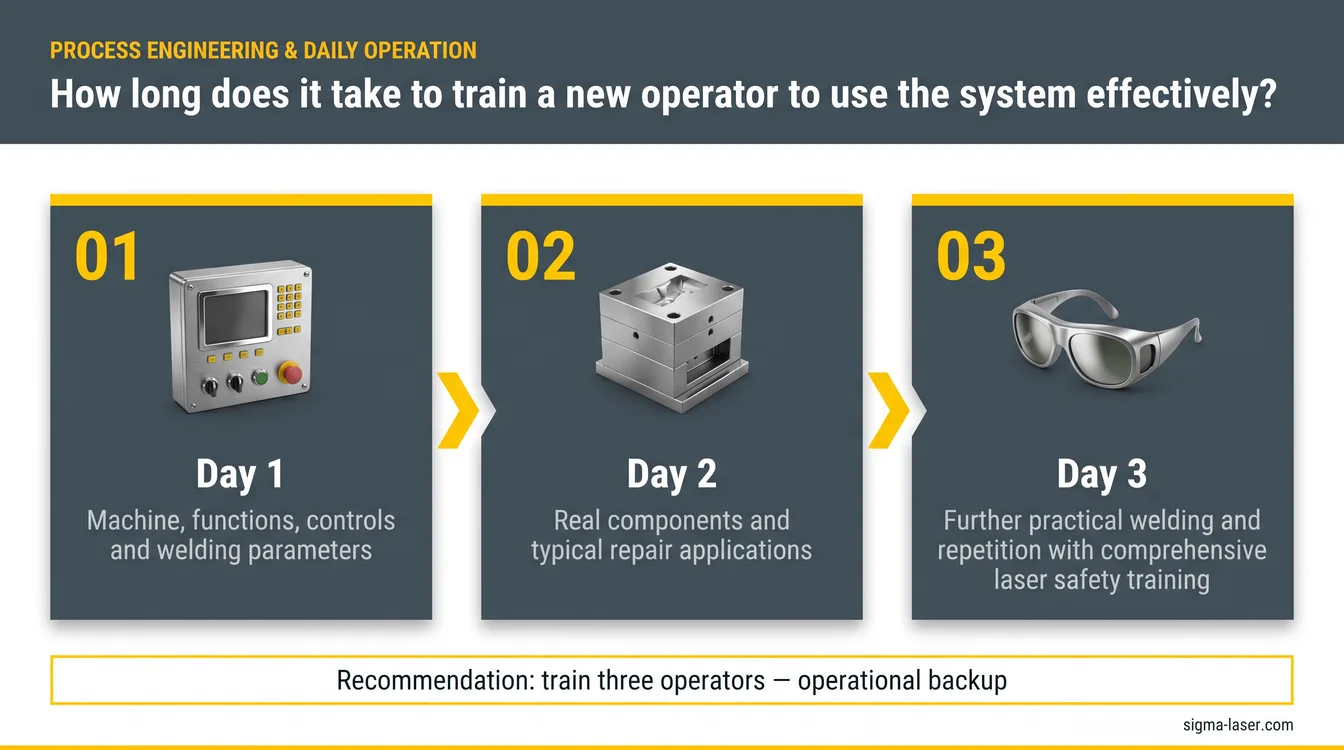
The second day shifts focus to hands-on application. Trainees work with real components and typical repair scenarios, applying what they have learned in a controlled but practical environment. This stage is crucial for bridging the gap between theory and practice, allowing operators to develop a feel for the process and to understand how parameter adjustments affect weld outcomes. Common challenges—such as joint preparation, fixturing, and adapting to different materials—are addressed through direct experience rather than abstract instruction.
On the third day, the training intensifies: operators continue with practical welding, reinforcing their skills through repetition and exposure to a wider range of scenarios. Importantly, this day also includes comprehensive laser safety training, ensuring that all participants understand the measures required to create and maintain a safe working environment. This includes the correct use of certified laser safety curtains and the procedures necessary to establish a laser-safe working area within the workshop. The combination of technical, practical, and safety-focused content ensures that new operators are well-prepared for independent work.
For a detailed walkthrough of setting up your first weld program and parameter selection, see Step-by-Step: Setting Up Your First Weld Program on Sigomatic.

| Operator | Typical Outcome After Training |
|---|---|
| Operator 1 | Develops into a highly skilled specialist |
| Operator 2 | Reaches a solid working level for most repair tasks |
| Operator 3 | Best suited to simpler or less critical welding jobs |
Training three operators provides redundancy and flexibility for production needs.
Why Sigma recommends training three operators
Laser welding is a skilled manual process, and operator aptitude can vary significantly even among technically qualified staff. Sigma’s experience shows that training a group of three operators at the outset offers distinct operational advantages. In a typical group, one individual will often develop into a highly skilled specialist, another will reach a solid working level suitable for most repair tasks, while the third may be best suited to simpler or less critical welding jobs. This distribution is not unusual given the demands of manual laser welding, which requires a blend of technical, manual, and cognitive skills.
Training multiple operators provides essential redundancy and flexibility. It reduces the risk of production bottlenecks if a key operator is unavailable and supports knowledge transfer within the team. Over time, this approach helps build a sustainable internal skill base, with experienced operators able to mentor new staff and maintain consistent process standards. For managers and supervisors, it also means that the company is less vulnerable to skill gaps or turnover, and can respond more flexibly to changes in workload or shift patterns.
From a risk management perspective, investing in the development of several operators is a prudent strategy. It increases the likelihood of having at least one highly capable laser welding specialist on staff, while also ensuring that day-to-day operations are not dependent on a single individual. For companies planning to use their laser welding system intensively or across multiple shifts, this approach is particularly important.
Which employees suit manual laser welding
Not every employee is equally suited to manual laser welding, even among those with strong technical backgrounds. The process demands more than technical knowledge and manual dexterity; it requires patience, concentration, and the ability to work calmly and precisely for extended periods. Operators must be comfortable with detailed, repetitive tasks and able to maintain focus and consistency throughout each job.
Successful laser welding operators typically combine a methodical approach with a steady hand and a keen eye for detail. They are able to interpret and respond to subtle changes in the welding process, adjusting parameters and technique as needed to achieve the desired result. These qualities are often found in individuals with backgrounds in toolmaking, precision machining, or other trades where fine manual work and process discipline are essential.
When selecting candidates for training, supervisors should consider not only technical qualifications but also temperament and work habits. Employees who demonstrate reliability, attention to detail, and a willingness to follow established procedures are likely to adapt well to the demands of manual laser welding. Conversely, those who prefer fast-paced or highly varied tasks may find the work less rewarding. Careful selection at the outset increases the effectiveness of training and the quality of results once operators are working independently.

What happens after the training
Completing the three-day training programme is only the beginning of an operator’s development. While the course provides a solid foundation, practical skill in manual laser welding continues to improve with real-world experience. For new operators, it is best practice to assign initial jobs that are important but forgiving—tasks where minor imperfections can be corrected in finishing, and where the operator can focus on mastering the process without undue pressure.
As operators gain confidence and consistency, they can take on more demanding repairs and contribute to process improvement. A key advantage of Sigma’s systems is the ability to store welding parameters that have been proven effective in practice. By recording the settings used for successful repairs, companies can create a library of reference parameters, supporting repeatable results across different operators and shifts. This approach reduces variability and accelerates setup for recurring applications.
Ongoing support and feedback are also important. Regular review of weld quality, shared learning among operators, and periodic refresher training help maintain high standards and address any emerging issues. For further guidance on maintaining consistent weld quality between operators and leveraging stored parameters, see How Do You Keep Laser Weld Quality Consistent Between Operators?.
Frequently Asked Questions
How long does it take to train a new laser welding operator?
Sigma Laser’s operator training programme is structured as a three-day practical course. Most participants reach a productive level within this timeframe, enabling them to operate the machine, adjust parameters, and perform typical repair tasks under real workshop conditions.
What topics are covered in the three-day training?
The training covers machine functions, controls, and welding parameters on day one; hands-on welding of real components and repair applications on day two; and further practical welding plus comprehensive laser safety training on day three.
Why should we train multiple operators at once?
Training at least three operators ensures operational flexibility and backup. Operator aptitude varies, so this approach increases the likelihood of developing at least one highly skilled specialist, while others provide solid support and coverage for different tasks and shifts.
How does operator skill develop after initial training?
Skill continues to improve with practical experience. It is best practice to assign new operators real but forgiving jobs initially and to store proven welding parameters. Regular feedback and shared learning help operators progress to more demanding tasks over time.
SYN · Sigma Laser appreciation event
You weld. We say thank you.
For everyone who brings great things together every day – on 17 December 2026 the prize wheel turns for you.
One photo at your laser welding machine, a quick verification – and you’re in. Registration is free and takes two minutes. On 17 December every verified participant gets one spin of the prize wheel.
- 1 spin of the prize wheel
- Gifts in 3 tiers
- Free, no purchase needed
Gifts ship free within DE · AT · CH · EU · verification usually within one business day