
- Why Upgrade Instead of Replace
- Accessory Upgrades That Open Applications
- Software Growth Path
- New Alloy, New Parameters
- Planning the Upgrade
- Frequently Asked Questions
- Can Sirius Light handle new high-strength or reflective alloys after upgrading?
- What is the typical downtime for a Sirius Light power or accessory upgrade?
- Do I need to retrain operators after upgrading Sirius Light?
- How should I verify weld quality after upgrading for a new alloy?
- Related Articles
Quick Answer: Upgrading the Sirius Light with modular power, advanced accessories, and software extensions enables effective welding of new alloys and applications—without full system replacement. By leveraging Sigma’s scalable platform and following best practices for parameter development, operators can adapt Sirius Light to evolving production needs while maintaining process reliability.
| Upgrade Aspect | Specification / Capability |
|---|---|
| Power Options | 60 / 120 / 160 / 220 / 330 / 420 / 500 W |
| Max Pulse Energy | up to 170 J |
| Peak Power | up to 13 kW |
| Load Capacity | unlimited |
| Reach | up to 1830 mm |
All values are as stated in the article and match Sigma Laser’s published specifications.
Why Upgrade Instead of Replace
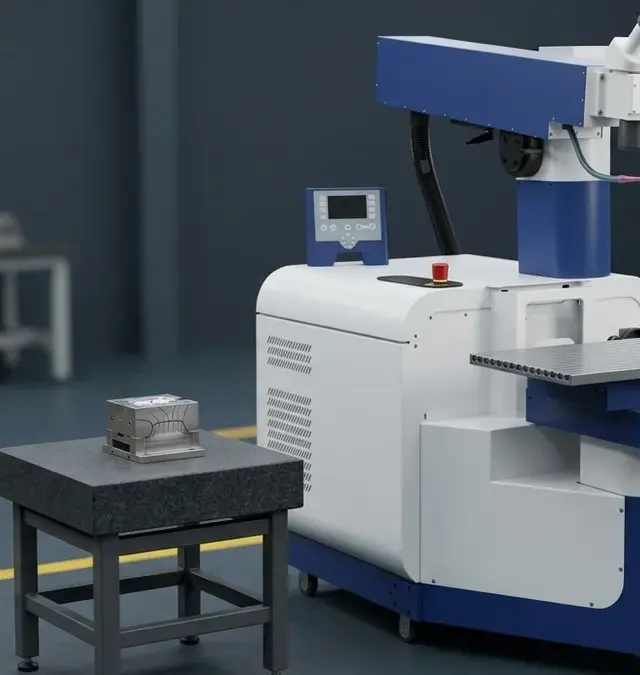
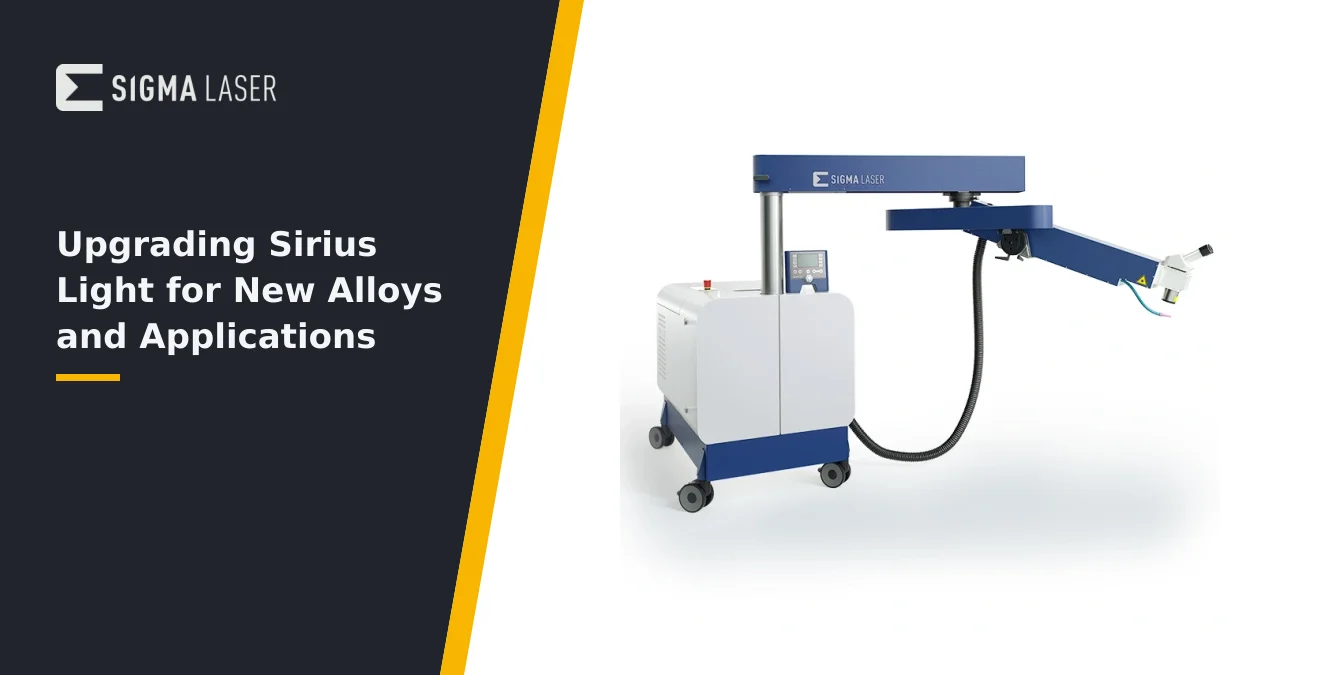
The Sirius Light is engineered as a modular, future-ready platform, making it uniquely suited for incremental upgrades rather than full replacement. Its power ladder design allows operators to scale from 60 W up to 500 W by adding modular power units, providing substantial headroom for demanding new alloys and thicker sections. This means you can address new application requirements—such as higher energy input for challenging materials—without the cost and disruption of sourcing an entirely new system.
With a maximum pulse energy of up to 170 J and peak power reaching 13 kW, Sirius Light is capable of handling a broad spectrum of metallic materials, including those with higher melting points or reflectivity. The ability to upgrade power modules on-site ensures minimal production downtime and preserves your initial investment in fixturing, automation, and operator training. The open-frame architecture, with unlimited load capacity and a reach of up to 1830 mm, further extends the platform’s utility for large molds, dies, or tooling components—even as your portfolio evolves.
Choosing to upgrade rather than replace also simplifies qualification and compliance processes. Existing safety protocols, operator certifications, and validated workflows remain in place, reducing the learning curve and risk associated with introducing a completely new machine. This approach aligns with lean manufacturing principles, maximizing asset utilization while adapting to new market demands or customer specifications.
- Modular power upgrades: 60–500 W
- Headroom: up to 170 J pulse energy / 13 kW peak power
- Unlimited load capacity; reach up to 1830 mm
- Preserves existing fixturing and workflows
| Accessory | Function / Application |
|---|---|
| Swivel Optics & Telescopic Lens | 360° beam deflection; adjustable working distance and focus for complex weld zones |
| Swivelling Wire Feed | Precise filler addition for alloy compatibility |
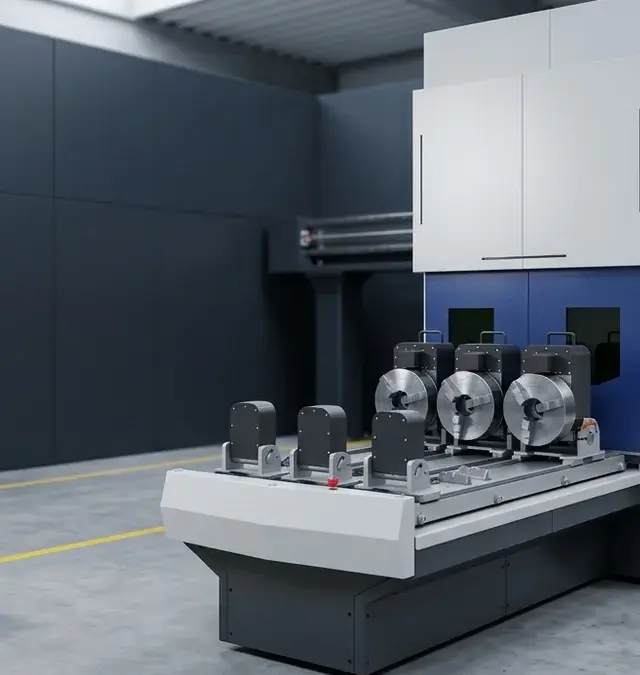
| Motor-Driven Rotary Device | Automated circumferential welding of round workpieces |
| Motor-driven Z/Y Axes | Enhanced multi-axis control for intricate weld paths |
Accessory functions are described as per the article. All listed accessories are genuine Sigma Laser modules.
Accessory Upgrades That Open Applications
Expanding the Sirius Light’s capabilities for new alloys and applications often hinges on the right accessory upgrades. Sigma’s modular accessory ecosystem enables operators to adapt the welding head, part handling, and process control to specific production challenges without overhauling the core system. Each accessory is designed for seamless integration, ensuring consistent performance and safety compliance.
The Swivel Optics module provides 360° beam deflection, allowing precise welding in hard-to-reach areas, vertical surfaces, or overhead positions. When paired with the Telescopic Lens option, operators can further adjust the working distance and focus, accommodating parts of varying geometries and thicknesses. For applications requiring filler material—such as joining dissimilar alloys or repairing worn edges—the Swivelling Wire Feed delivers controlled wire addition, with adjustable feed rates and synchronization for both pulsed operation and complex geometries.
Rotational welding tasks, such as circumferential seams on pipes, rings, or shafts, benefit from the Motor-Driven Rotary Device. This accessory secures round workpieces and provides programmable, continuous rotation, eliminating the need for custom fixtures and ensuring uniform weld quality. For multi-axis work or tall components, the Motor-driven Z Axis and Swivelling Y Axis modules extend the system’s reach and flexibility, supporting intricate weld paths and reducing manual repositioning.
- Swivel Optics & Telescopic Lens: access complex weld zones
- Swivelling Wire Feed: precise filler addition for alloy compatibility
- Motor-Driven Rotary Device: automated circumferential welding
- Motor-driven Z/Y Axes: enhanced multi-axis control
| Software/Service | Purpose / Benefit |
|---|---|
| Sigomatic | Teach-in programming for flexible setup; supports geometry primitives (lines, circles, splines, curves) |
| Sigomatic Pro | Advanced modules for series and complex parts; PC-based, extended functionality |
| Remote Diagnosis | Proactive system health monitoring; remote troubleshooting and parameter optimization |
All software and services listed are available for Sirius Light and described as per Sigma Laser’s offering.
Software Growth Path
Software upgrades are a critical enabler for adapting Sirius Light to new alloys and more complex applications. The system’s standard Sigomatic software provides intuitive, teach-in programming for four axes, supporting geometry primitives such as lines, circles, splines, and curves. This allows operators to quickly set up new weld paths and adjust parameters for different materials without the need for advanced programming skills.
For production environments facing increased complexity—such as series welding of intricate or multi-part assemblies—upgrading to Sigomatic Pro is a logical next step. This PC-based platform offers extended functionality, including installable modules tailored for specific tasks. Operators benefit from reduced setup times, advanced process monitoring, and the ability to handle complex, repeatable jobs with higher consistency. Sigomatic Pro also integrates seamlessly with Sigma’s automation modules, such as rotary devices and multi-axis extensions, ensuring coordinated control across all system components.
To support ongoing reliability and minimize downtime during upgrades or parameter development, Sigma provides a Remote Diagnosis capability. This internet-based service monitors all electronic modules, cooling systems, safety interlocks, and process-critical hardware. Remote Diagnosis enables rapid troubleshooting and parameter optimization, often eliminating the need for on-site service visits and accelerating the ramp-up of new alloy programs.
- Sigomatic: teach-in programming for flexible setup
- Sigomatic Pro: advanced modules for series and complex parts
- Remote Diagnosis: proactive system health monitoring
New Alloy, New Parameters
Introducing new alloys into your Sirius Light workflow requires a structured approach to parameter development and wire selection. The recommended method is a stepwise development ladder: begin with conservative pulse energy, duration, and spot size settings, then incrementally adjust based on weld appearance, penetration, and metallurgical requirements. Always reference your material parameter tables and consult with Sigma’s application support for guidance on starting values and process windows.
Wire selection is equally critical. For tool steels, select a wire with matching or slightly higher alloy content to maintain hardness and avoid dilution. For aluminum alloys, use compatible filler wire to address porosity and mitigate reflectivity challenges—fibre laser systems at 1070 nm are particularly effective for these materials, but Sirius Light’s Nd:YAG wavelength remains suitable for most standard alloys with proper shielding gas and parameter tuning.
When working with reactive or biocompatible metals (e.g., titanium, stainless), ensure high-purity argon shielding and monitor for oxidation colors as a quality cue. Always perform a test series on representative scrap or sample parts before moving to production. Document all parameter changes, and requalify the process with metallographic or mechanical testing as required by your quality standards.
- Stepwise parameter development: energy, duration, spot size
- Wire selection: match alloy family and application
- Shielding gas: argon for most alloys, especially reactive metals
- Test series: verify weld quality before production

Planning the Upgrade
Successful upgrades to the Sirius Light platform require careful planning and coordination with Sigma’s service team. Begin by defining the scope of the upgrade: identify which power modules, accessories, or software extensions are needed based on your new alloy or application requirements. Engage with Sigma’s technical support to confirm compatibility, installation requirements, and any necessary modifications to your existing setup or safety infrastructure.
Schedule the upgrade during a planned maintenance window to minimize production disruption. Sigma’s modular design allows most hardware upgrades—such as power modules or accessory installations—to be performed on-site, but always verify lead times and installation durations with your service representative. After hardware or software changes, update your risk assessments and ensure all operators are briefed on new procedures or safety measures.
Before returning to full production, conduct a requalification process using a dedicated test series. This should include visual inspection, dimensional checks, and, where applicable, metallurgical or mechanical testing to confirm that the upgraded system meets your process and quality requirements. Document all changes and update your process control plans accordingly. Ongoing support, including remote diagnostics and operator training, is available from Sigma to ensure a smooth transition and sustained performance.
- Define upgrade scope: power, accessories, software
- Coordinate with Sigma service for installation
- Requalify with a test series before production
- Update documentation and operator training
Frequently Asked Questions
Can Sirius Light handle new high-strength or reflective alloys after upgrading?
Yes. With modular power upgrades and appropriate accessories, Sirius Light can process a wide range of high-strength and reflective alloys. Parameter development and suitable wire selection are essential for optimal results. Consult Sigma’s application support for guidance on specific alloy families.
What is the typical downtime for a Sirius Light power or accessory upgrade?
Most upgrades are designed for on-site installation with minimal disruption. Actual downtime depends on the upgrade scope and site conditions. Coordinate scheduling with Sigma service to ensure efficient installation and rapid return to production.
Do I need to retrain operators after upgrading Sirius Light?
Operator retraining is recommended whenever new modules, accessories, or software are added. Sigma offers certified operator training to ensure safe and effective use of upgraded features, supporting both process reliability and compliance.
How should I verify weld quality after upgrading for a new alloy?
Always run a dedicated test series on representative material. Inspect welds visually and dimensionally, and perform metallurgical or mechanical tests as needed. Document all parameters and results before moving to production to ensure consistent quality.