
- Key Takeaways
- What is Laser Welding and How Does it Work?
- Principles of Laser Welding
- Components of a Laser Welding System
- How Does Laser Welding Affect the Properties of Stainless Steel?
- Heat-Affected Zones
- Microstructural Changes and Strength
- What are the Advantages of Laser Welding Over Traditional Welding?
- Precision and Speed
- Minimal Distortion and Heat Control
- Techniques for Achieving Precision Welds in Stainless Steel
- Selecting the Right Welding Grade
- Controlling Heat and Using Shielding Gas
- Case Studies: Laser Welding Applications in Different Industries
- Automotive Industry Applications
- Aerospace and Medical Device Applications
- Frequently Asked Questions
- What are the advantages of laser welding over traditional welding?
- How does laser welding affect the properties of stainless steel?
- Can laser welding be used for all types of stainless steel?
- What are the typical applications of laser welding in stainless steel fabrication?
- What are the key considerations when setting up a laser welding system for stainless steel?
- How does laser welding compare to TIG welding for stainless steel?
Quick Answer: Laser welding stainless steel involves using concentrated laser beams to achieve precision welds with minimal distortion. This technique is ideal for stainless steel due to its ability to produce clean, high-quality joints with excellent mechanical properties. Key methods include continuous wave and pulsed laser welding, each suited for different thicknesses and applications. Proper parameter settings, such as power, speed, and focus, are crucial for optimal results. Laser welding is particularly beneficial for stainless steel due to its high reflectivity and thermal conductivity, making it essential for industries requiring precise and durable welds.
Key Takeaways
Laser welding stainless steel offers precision, efficiency, and strength, making it a preferred method in modern manufacturing. Understanding the benefits and technical parameters involved can significantly enhance welding outcomes for stainless steel applications.
- Laser welding provides high precision and minimal distortion, ideal for stainless steel’s aesthetic and structural applications.
- The process achieves deep weld penetration, allowing for strong joints even in thin gauge materials.
- Laser welding can be automated, enhancing repeatability and reducing manual error for consistency in production.
- Optimal laser parameters, such as power density and focal position, are critical for achieving desired weld quality.
- Using a shielding gas like Argon or Nitrogen can prevent oxidation and improve weld appearance and strength.
- Cooling rate control is essential to prevent thermal cracking and maintain the mechanical properties of stainless steel.
- Laser welding reduces the need for post-weld finishing, saving time and cost in the manufacturing process.
These insights into the benefits and technical considerations of laser welding stainless steel can guide engineers in optimizing their welding processes. Delve deeper into the specifics to fully leverage laser technology in your applications.
What is Laser Welding and How Does it Work?
Laser welding is a high-precision technique used across various industrial applications, especially in fabricating stainless steel components. It employs a concentrated laser beam to fuse materials, resulting in minimal distortion and high precision. This method is particularly beneficial in sectors that demand stringent quality standards and intricate details, such as aerospace, automotive, and medical device manufacturing.
| Parameter | Typical Range / Value |
|---|---|
| Laser Type | Fiber laser |
| Power Output | 500 W – 6 kW |
| Wavelength | Around 1070 nm |
| Beam Quality (M²) | < 1.2 |
| Weld Depth | Up to 10 mm |
| Welding Speed | 1 – 10 m/min |
| Heat-Affected Zone (HAZ) | < 1 mm |
| Focal Length | 100 – 300 mm |
Values are general-industry ranges for stainless steel laser welding, not attributed to a specific Sigma Laser model.
Principles of Laser Welding
The core principle of laser welding involves the focused energy of a laser beam, which melts the material at the joint interface. Heat is generated through the absorption of laser light, carefully controlled to ensure a consistent and high-quality weld. The process features high energy density, allowing for deep penetration and rapid welding speeds, which are crucial for stainless steel welding. This method minimizes thermal distortion and delivers superior weld quality, meeting standards such as ISO 15614-11 and ISO 3834.
For stainless steel, laser welding typically uses fiber lasers with power outputs ranging from 500 W to 6 kW, operating at wavelengths around 1070 nm. The beam quality, often characterized by an M² value of less than 1.2, ensures precise focusing and deep penetration, achieving weld depths up to 10 mm depending on the material thickness and joint configuration. Welding speeds can range from 1 to 10 m/min, balancing penetration depth and thermal input to control the heat-affected zone (HAZ), which is typically kept under 1 mm to maintain material properties.
Components of a Laser Welding System
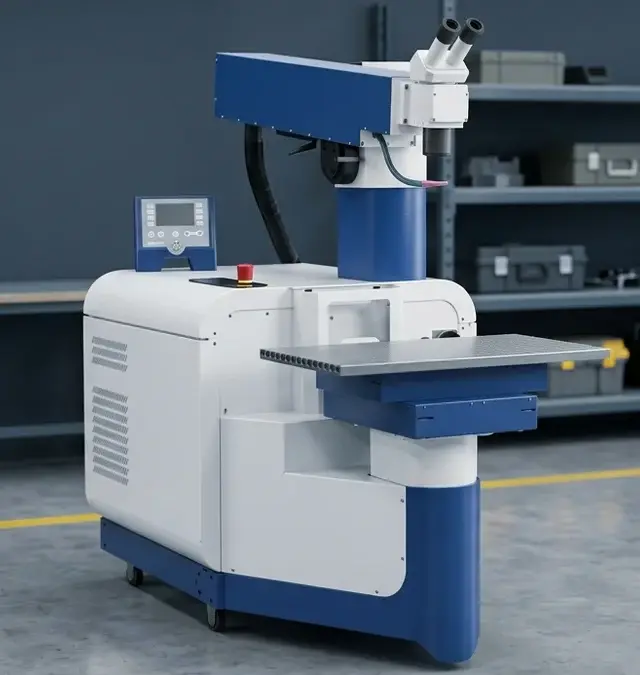
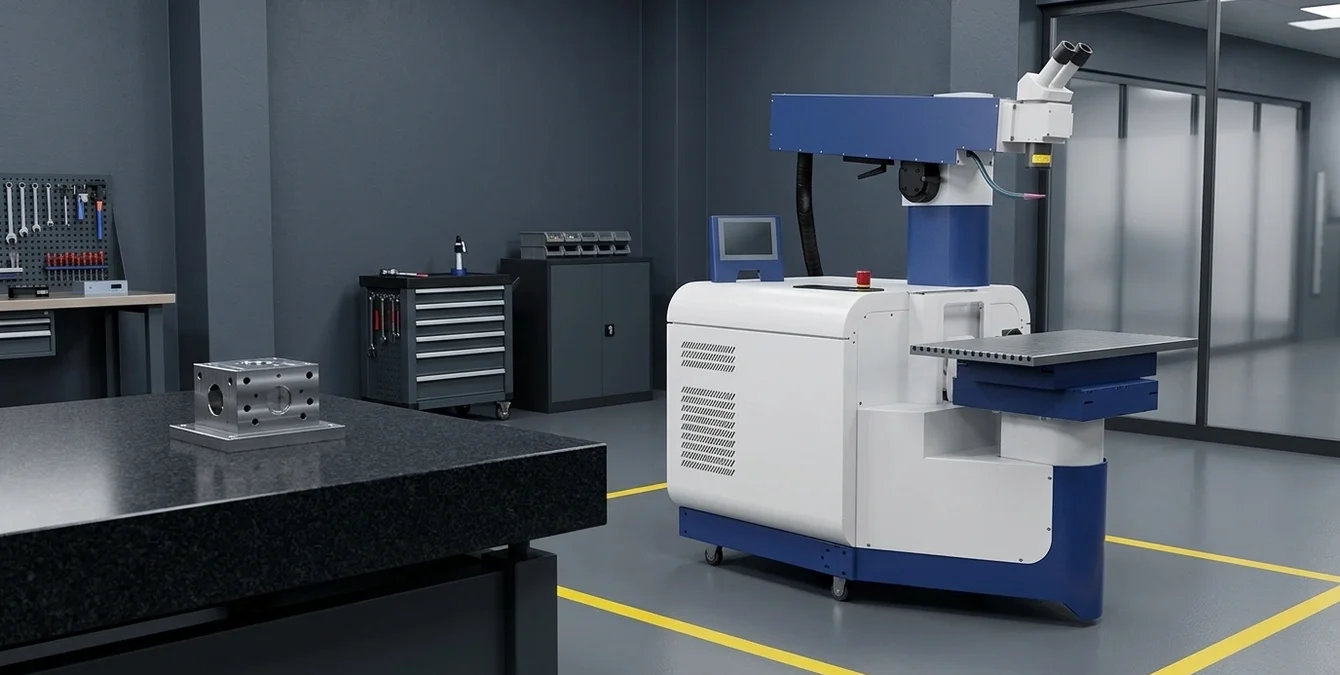
A typical laser welding system, like those engineered by Sigma Laser, includes several key components designed for optimal performance:
- Laser Source: This is the heart of the system, where fiber laser technology is often used for its efficiency and effectiveness in welding stainless steel. The system may operate at power levels suitable for both thin and thick sections, ensuring versatility across various applications.
- Beam Delivery System: Featuring advanced optics, such as Swivel Optics with Telescopic Lens, this system directs and focuses the laser beam precisely at the welding site. The focal length is typically adjustable, ranging from 100 mm to 300 mm, to accommodate different welding tasks.
- Workstation: Systems like the Simass Base Unit and Simass Rotate provide a stable platform with motor-driven turning devices to accommodate complex geometries. These workstations ensure repeatability within ±0.05 mm, critical for maintaining precision in high-tolerance applications.
- Control System: Ensures precise control over welding parameters, including power, speed, and focus, to achieve high-quality welds with minimal human intervention. The control system may integrate real-time monitoring and feedback mechanisms to adhere to standards such as AWS D17.1/D17.1M for aerospace applications.
In practice, laser welding stainless steel involves aligning the laser beam to the joint area, where it rapidly heats and melts the metal. The molten pool solidifies as the beam moves along the joint, forming a strong, durable weld. This process is crucial in manufacturing environments that demand rigorous adherence to quality and precision, such as those governed by the American Welding Society (AWS) and European Committee for Standardization (CEN).
Material compatibility is a key consideration, with common stainless steel grades like 304, 316, and 430 being frequently welded using this technique. The process must account for potential issues such as thermal expansion and chromium carbide precipitation, which can affect corrosion resistance if not properly managed.
| Aspect | Laser Welding | Traditional Arc Welding |
|---|---|---|
| Heat-Affected Zone (HAZ) | < 1 mm | 2–3 mm |
| Distortion | Minimal | Higher |
| Weld Penetration | Deep, precise | Variable |
| Post-Weld Finishing | Often not required | Frequently required |
Values are general-industry comparisons based on the article’s content.
How Does Laser Welding Affect the Properties of Stainless Steel?
In the realm of high precision welding, laser welding stainless steel offers unparalleled advantages in industrial applications. At Sigma Laser, our advanced laser welding systems, including the Sidanus Light and Sirius Light, are engineered to enhance the mechanical and metallurgical properties of stainless steel. Understanding the effects of laser welding on these properties is crucial for welding engineers seeking to optimize fabrication processes and ensure structural integrity.
Heat-Affected Zones
One of the critical factors in laser welding stainless steel is the heat-affected zone (HAZ). This region undergoes thermal cycles that can influence the material’s properties. Laser welding minimizes the size of the HAZ compared to traditional welding methods due to its concentrated heat source and rapid cooling rates. This results in reduced thermal distortion and preserves the mechanical properties of the stainless steel. The precision of Sigma Laser’s systems, such as the Siega Fibre, ensures minimal distortion welding, which is critical for applications demanding high dimensional accuracy.
Typically, laser welding systems operate with power ranges from 500 W to 6 kW and wavelengths around 1064 nm, with beam quality M² values often less than 1.5, ensuring high precision. The focal length of the optics is commonly between 100 mm to 200 mm, allowing for precise control over the beam spot size and energy distribution. The reduced HAZ is typically less than 1 mm, significantly lower than the 2-3 mm common in traditional arc welding methods.
Microstructural Changes and Strength
Laser welding induces microstructural changes in stainless steel, impacting its mechanical strength. The high energy density and controlled heat input result in finer grain structures within the weld zone. This refinement can enhance material properties such as toughness and hardness, crucial for components subjected to cyclic loads and harsh environments. Utilizing Sigma Laser’s Super Pulse Technology (SPT) further refines these microstructural characteristics, offering superior performance in demanding applications.
Real-world applications of laser welding stainless steel include the automotive industry, where components require both durability and precision. Additionally, in the aerospace sector, where weight reduction without compromising strength is paramount, laser welding provides a solution with its ability to produce lightweight yet robust joints.
- Enhanced mechanical strength due to refined grain structure.
- Reduced heat-affected zones minimize thermal distortion.
- Increased toughness and hardness for high-stress environments.
For welding engineers and technical buyers, selecting advanced laser welding systems from Sigma Laser ensures that stainless steel components meet stringent industrial standards, such as ISO 9001 and ISO 15614-11, while delivering exceptional performance and reliability.
Common stainless steel grades compatible with laser welding include 304, 316, and 430, which are frequently used due to their excellent corrosion resistance and mechanical properties. However, engineers must consider the presence of elements like sulfur and carbon, which can affect weldability and require adjustments in parameters such as welding speed, typically ranging from 1 m/min to 10 m/min, and penetration depth, which can reach up to 10 mm depending on the material thickness and laser power.

What are the Advantages of Laser Welding Over Traditional Welding?
In the realm of industrial fabrication, the choice of welding technique can significantly impact the quality and efficiency of production processes. For manufacturing engineers and technical buyers, understanding the advantages of laser welding over traditional methods such as TIG (Tungsten Inert Gas) and MIG (Metal Inert Gas) is crucial—especially when working with materials like stainless steel. Sigma Laser’s precision laser welding systems offer substantial benefits, enhancing both operational efficiency and product quality.
Precision and Speed
Laser welding, particularly when applied to stainless steel, delivers unmatched precision and speed compared to traditional TIG and MIG welding. The concentrated laser beam provides pinpoint accuracy, allowing for high precision welding even in complex assemblies. This precision is particularly advantageous in industries requiring tight tolerances, such as aerospace and medical device manufacturing. Additionally, laser welding processes are inherently faster, capable of significantly reducing cycle times. With Sigma Laser’s advanced systems like the Sidanus Fibre and Siega Fibre, manufacturers can enhance throughput without compromising on quality.
Typical laser welding systems for stainless steel operate at power levels ranging from 500 W to 6 kW, with beam quality (M²) values generally below 1.2, ensuring high focusability and deep penetration capabilities. The welding speed can reach up to 10 m/min, depending on the material thickness and desired penetration depth, which can be as deep as 8 mm for certain stainless steel grades like 304 and 316. These systems often use wavelengths around 1064 nm, which are optimal for metal absorption, enhancing the efficiency of the welding process.
Minimal Distortion and Heat Control
One of the standout advantages of laser welding is its ability to minimize thermal distortion and effectively control heat input. Traditional welding methods often result in significant heat-affected zones (HAZ), leading to warping and structural weaknesses in stainless steel components. However, the focused energy of laser beams ensures minimal distortion welding, preserving the integrity of the material. This characteristic is critical in applications where structural precision and material properties cannot be compromised, such as in the automotive and electronics sectors.
Moreover, the use of Sigma Laser’s Super Pulse Technology (SPT) enhances heat control, enabling precise energy delivery to the weld area. This results in cleaner welds with reduced post-processing requirements, ultimately lowering production costs and improving product quality. The integration of advanced features like Swivel Optics and the Motor-driven Turning Device further enriches the laser welding process, offering versatility and adaptability across various industrial applications.
In conclusion, for manufacturers seeking superior precision, speed, and minimal distortion in stainless steel welding, laser welding presents a compelling alternative to traditional methods. Sigma Laser’s comprehensive range of laser welding systems provides the tools necessary to optimize production processes, align with stringent industry standards such as ISO 15614-11:2002, and achieve outstanding results in high-demand sectors.
Techniques for Achieving Precision Welds in Stainless Steel
In the realm of industrial manufacturing, achieving high-precision welds in stainless steel is crucial for ensuring product durability and quality. Sigma Laser, renowned for engineering excellence with systems like Sidanus Light and Siega Fibre, offers robust solutions for laser welding stainless steel. Here, we explore specific techniques and best practices essential for manufacturing engineers aiming to optimize their welding processes.
Selecting the Right Welding Grade
Choosing the appropriate grade of stainless steel is essential for precision welding. Grades such as 304 and 316 are commonly used due to their excellent corrosion resistance and weldability. It’s important to select a grade that matches the mechanical properties required for the application. For instance, 316 stainless steel is preferred in environments exposed to corrosive elements, while 304 is suitable for general applications. Proper grade selection ensures weld integrity and longevity.
According to DIN EN ISO 4063:2010, the laser welding process is classified under process number 52, indicating its suitability for these grades due to the low thermal conductivity and high melting point characteristics of stainless steels.
Controlling Heat and Using Shielding Gas
One of the critical challenges in stainless steel welding is managing heat input to prevent warping and maintain structural integrity. Sigma Laser’s Super Pulse Technology (SPT) enables precise control over heat input, minimizing thermal distortion. Utilizing fiber laser technology, as seen in our Sineo Fibre systems, enhances energy efficiency and precision.
Shielding gas plays a vital role in preventing oxidation during the welding process. Argon is the most widely used gas, providing an inert atmosphere that protects the weld pool. In some cases, a mixture of argon and helium can be employed to increase heat input and penetration depth, especially in thicker materials.
- Heat Management: Utilizing laser systems with advanced heat control features helps in achieving minimal distortion welding. Typical power ranges for fiber lasers in stainless steel welding are between 1 kW to 4 kW, with beam quality M² values typically below 1.5, ensuring high precision.
- Shielding Gas: Proper selection and application of shielding gas ensure a clean, defect-free weld. For instance, an argon flow rate of 10-20 L/min is commonly used, while argon-helium mixtures may require adjustments based on material thickness.
These practices, when coupled with Sigma Laser’s state-of-the-art equipment, enable welding engineers to achieve unparalleled precision in stainless steel applications. By adhering to industry standards such as ISO 9001 and ISO 3834, and leveraging technologies like Swivel Optics with Telescopic Lens, engineers can drive high precision welding processes that meet rigorous quality demands.
Welding speed, a critical parameter, typically ranges from 0.5 to 2 m/min for stainless steel, depending on the thickness and desired penetration depth, which can reach up to 6 mm in single-pass operations. The heat-affected zone (HAZ) is minimized to less than 1 mm, ensuring structural integrity and minimal thermal distortion.
Case Studies: Laser Welding Applications in Different Industries
Laser welding of stainless steel has revolutionized several industrial sectors by offering unmatched precision and minimal distortion. Sigma Laser, a leader in precision laser welding systems, has enabled various industries to achieve superior results through state-of-the-art technology. Here, we explore case studies across the automotive, aerospace, and medical device sectors where high precision welding has led to remarkable enhancements in manufacturing processes.
Automotive Industry Applications
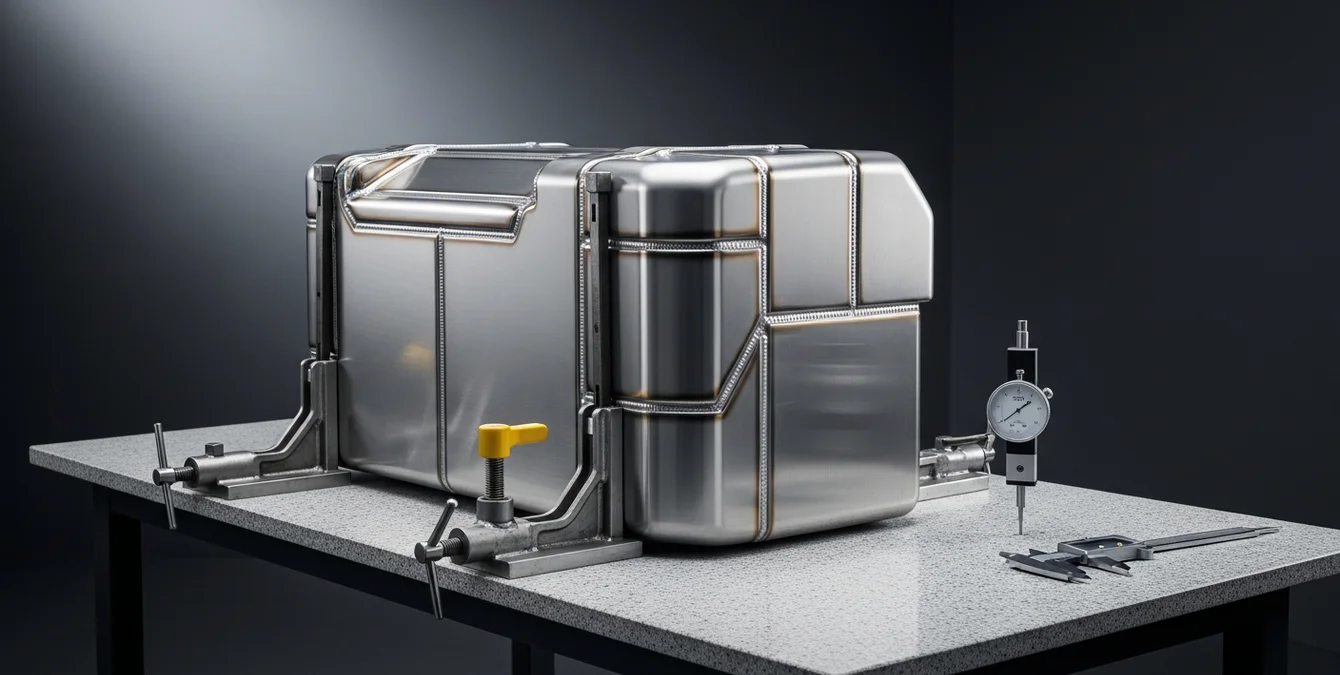
In the automotive industry, the demand for lightweight and high-strength materials has made stainless steel welding a critical process. Sigma Laser’s Sidanus Light and Sineo Fibre systems have been instrumental in the production of vehicle components, ensuring structural integrity and safety. A prominent European car manufacturer implemented our laser welding systems to join intricate stainless steel assemblies for electric vehicle battery compartments. The results were compelling:
- Production speed increased by 30% due to automated high precision welding processes.
- Material waste reduced by 15%, thanks to minimal distortion welding techniques.
- Enhanced strength and longevity of welded joints, meeting stringent DIN EN ISO 4063 standards.
- Typical laser parameters include power outputs ranging from 1 kW to 6 kW, with beam quality M² values typically less than 1.2, ensuring high precision.
- Welding speeds of up to 10 m/min have been achieved, with penetration depths typically reaching up to 5 mm for stainless steel grades such as 304 and 316.
This application showcases how laser welding can effectively meet the automotive industry’s evolving demands for efficiency and quality.
| Component | Description / Example |
|---|---|
| Laser Source | Fiber laser technology for efficiency and versatility |
| Beam Delivery System | Advanced optics (e.g., Swivel Optics with Telescopic Lens), adjustable focal length 100–300 mm |
| Workstation | Stable platforms (e.g., Simass Base Unit, Simass Rotate) with motor-driven turning devices |
| Control System | Precise parameter control, real-time monitoring, feedback mechanisms |
Descriptions reflect typical Sigma Laser system features as described in the article.
Aerospace and Medical Device Applications
The aerospace sector also benefits significantly from laser welding, particularly in the context of fabricating resilient and lightweight structures. Utilizing Super Pulse Technology (SPT), Sigma Laser’s Siega Fibre system has been deployed in the production of stainless steel fuel lines and hydraulic systems. This technology ensures precise welds that withstand extreme conditions:
- Weld cycle times reduced by 40% compared to traditional methods.
- Compliance with ISO 15614-11 welding procedure specifications.
- Typical operational constraints include maintaining a focal length of 150 mm to 300 mm to optimize the depth of focus and minimize the heat-affected zone (HAZ).
- Welding tolerances typically within ±0.1 mm, ensuring repeatability and precision critical for aerospace applications.
In the medical device industry, where precision and hygiene are paramount, Sigma Laser’s solutions have facilitated the manufacture of stainless steel surgical instruments. A prominent European medical device manufacturer adopted our Sirius Light system, leading to:
- Seamless and clean welds that meet ISO 3834 quality standards.
- Improved product reliability and patient safety through high precision welding.
- Compatibility with a range of stainless steel grades, including 316L, known for its corrosion resistance and biocompatibility.
These case studies demonstrate the transformative impact of laser welding on manufacturing processes across diverse sectors. As industries continue to push the boundaries of innovation, Sigma Laser remains at the forefront, delivering cutting-edge solutions tailored to meet the rigorous demands of modern manufacturing.
Frequently Asked Questions
What are the advantages of laser welding over traditional welding?
Laser welding offers high precision and minimal distortion, making it ideal for joining thin materials like stainless steel. It provides deep penetration with a narrow heat-affected zone, enabling high-speed welding and reducing the need for post-processing. Additionally, laser welding can be automated for increased efficiency and consistency.
How does laser welding affect the properties of stainless steel?
Laser welding maintains the corrosion resistance of stainless steel by minimizing heat input and preserving the material’s microstructure. The process results in a narrow heat-affected zone, reducing the risk of thermal distortion and maintaining the mechanical properties of the welded joint.
Can laser welding be used for all types of stainless steel?
Laser welding is versatile and can be used on various grades of stainless steel, including austenitic, ferritic, and martensitic types. However, parameters such as power level and speed must be optimized for each specific grade to achieve the best results and avoid defects like cracking or porosity.
What are the typical applications of laser welding in stainless steel fabrication?
Laser welding is commonly used in industries requiring precision and high-quality welds, such as aerospace, automotive, and medical device manufacturing. It is ideal for applications involving intricate components, thin-walled structures, and where minimal thermal distortion is critical.
What are the key considerations when setting up a laser welding system for stainless steel?
Key considerations include selecting the appropriate laser type (fiber, CO2, or Nd:YAG), optimizing beam parameters, and ensuring proper alignment and focus. Material preparation, such as surface cleanliness and joint fit-up, is crucial. Additionally, controlling the welding environment to prevent oxidation is important for achieving high-quality welds.
How does laser welding compare to TIG welding for stainless steel?
Laser welding offers faster processing speeds and lower heat input compared to TIG welding, resulting in less distortion and higher precision. While TIG welding allows for more manual control and is suitable for thicker sections, laser welding excels in automation and high-volume production environments.