
- Three Layers of an SPT Cell
- Where SPT Changes Automation
- Cycle Design with Low Heat
- An SPT-Capable Source in the Cell
- Validating the Automated Series
- Frequently Asked Questions
- What is SPT and how does it enhance automated workflows?
- Which Sigma Laser systems support SPT integration?
- How do I validate SPT processes in automated production?
- What should I consider when designing cycles with SPT?
Quick Answer: Integrating SPT into automated workflows involves combining microsecond fibre pulse control with Sigomatic Pro automation and Simass motion systems. This enables precise, low-heat welding cycles for sensitive and high-value parts, particularly in medical and electronics sectors. Proper integration ensures repeatable quality, minimized heat-affected zones, and validated production cycles.
| Layer | Role in SPT Integration | Key Features |
|---|---|---|
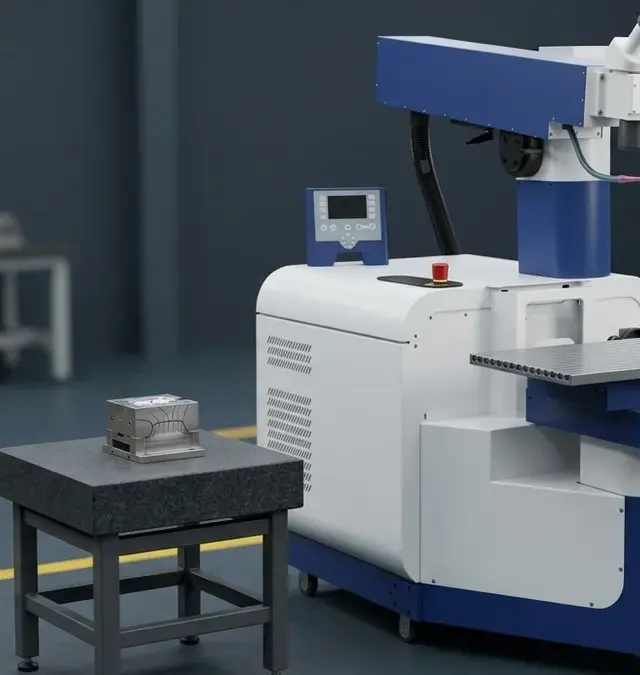
| SPT-Capable Laser Source | Foundation for ultra-fine pulse control; determines heat input and weld quality | Microsecond fibre laser pulse control; minimizes heat-affected zone; supports sensitive materials |
| Sigomatic Pro Automation Software | Orchestrates welding sequence, parameter management, and process monitoring | PC-based; stores/recalls validated recipes; supports complex SPT pulse regimes |
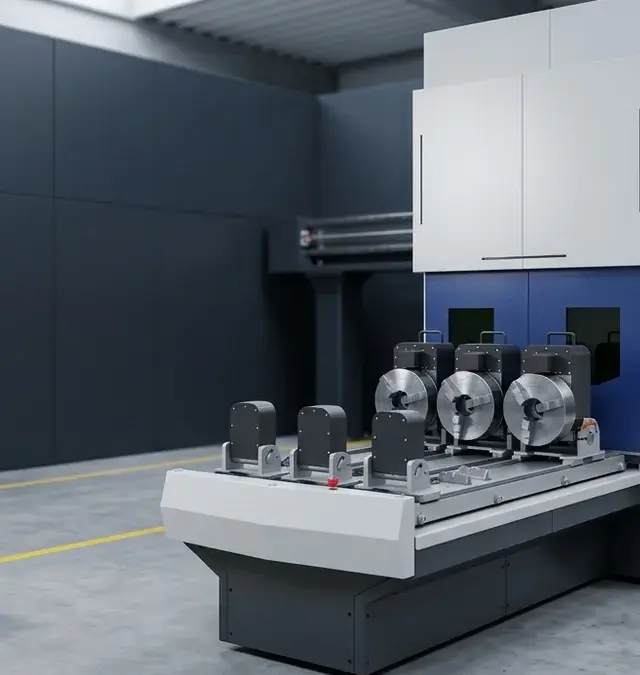
| Simass Motion Platform | Delivers precise multi-axis motion and part handling | Interchangeable modules (Rotate, Slide, Powder); adapts to various workpiece sizes/geometries |
Three Layers of an SPT Cell
Integrating SPT (microsecond fibre laser pulse control) into automated workflows requires a coordinated approach across three core layers: the laser source with SPT capability, the automation software (Sigomatic Pro), and the motion platform (Simass). Each layer plays a distinct role in achieving precise, repeatable, and high-quality results for demanding production environments.
The SPT-enabled fibre laser provides the foundation by allowing ultra-fine control over pulse duration and energy, directly influencing the heat input and weld quality. This is especially critical when working with heat-sensitive materials or geometries where conventional pulsed or CW modes may cause excessive heat-affected zones (HAZ) or distortion.
Sigomatic Pro serves as the automation backbone, orchestrating the welding sequence, parameter management, and process monitoring. Its modular, PC-based architecture supports the programming and execution of complex welding routines, including those tailored for SPT’s microsecond pulse regimes. Operators can configure, store, and recall validated process recipes, ensuring consistency across production runs.
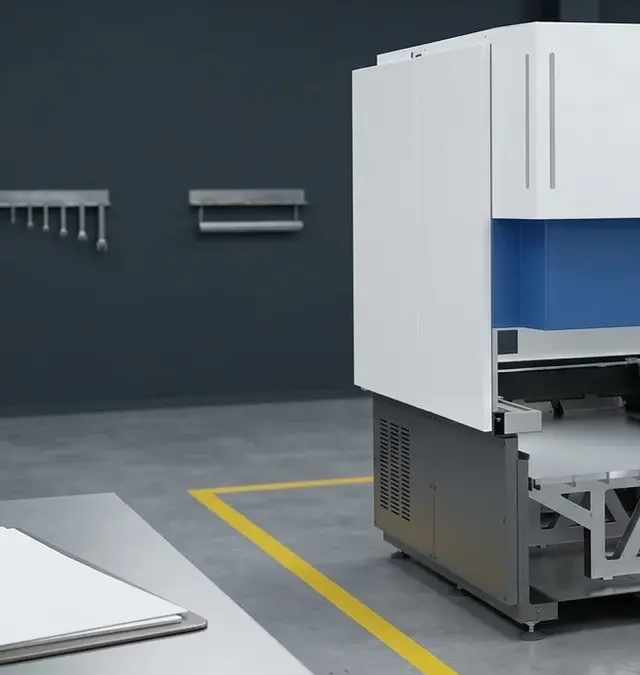
Simass, the modular automation platform, delivers precise multi-axis motion and part handling. Its interchangeable modules (Rotate, Slide, Powder) adapt to a wide range of workpiece sizes and geometries, supporting both batch and series production. The synergy of these three layers—SPT pulse control, Sigomatic Pro automation, and Simass motion—enables the reliable integration of SPT into automated manufacturing cells, supporting both flexibility and process stability.
| Aspect | SPT (Microsecond Pulse Control) | Conventional Pulsed/CW |
|---|---|---|
| Heat Input | Minimized; sharply reduces heat-affected zone (HAZ) | Higher; risk of excessive HAZ |
| Weld Precision | Enables joining of thin-walled, miniature, or temperature-sensitive parts | May cause warping, microcracking, or metallurgical changes |
| Throughput | Supports tighter part spacing and higher throughput | Cumulative heat limits part density |
| Material Range | Handles titanium, advanced stainless steels, and sensitive alloys | Limited by thermal management |
Where SPT Changes Automation
SPT fundamentally alters the automation landscape for applications where thermal management and weld precision are paramount. In sectors such as medical device manufacturing and electronics, components often feature delicate structures, biocompatible materials, or tight dimensional tolerances. Conventional pulsed or CW welding may introduce excessive heat, risking part warping, microcracking, or unwanted metallurgical changes.
By enabling microsecond-scale pulse shaping, SPT minimizes the heat input per weld, sharply reducing the size of the heat-affected zone. This allows automation engineers to confidently design workflows for joining thin-walled, miniature, or temperature-sensitive parts—such as implantable devices, sensor housings, or microelectronic assemblies—without compromising integrity or compliance.
In high-cycle production, SPT’s precise energy delivery supports tighter part spacing and higher throughput, as the risk of cumulative heat buildup is mitigated. Automated cells equipped with SPT can handle a broader range of materials, including titanium and advanced stainless steels, which are common in regulated industries. The result is a significant expansion of what can be reliably automated, opening new possibilities for process validation and regulatory approval in demanding sectors.
Operators and engineers should assess each application’s thermal sensitivity and required weld profile during cell design. SPT’s advantages become most evident when conventional processes approach their thermal or quality limits, making it a strategic enabler for next-generation automated workflows.

Cycle Design with Low Heat
Designing automated welding cycles with SPT requires a shift in approach compared to traditional pulsed or CW methods. The ability to deliver energy in precisely controlled microsecond pulses means that each weld can be optimized for minimal heat input, reducing the risk of distortion, discoloration, or microstructural changes in the base material.
Operators should leverage SPT’s fine pulse control to shorten thermal recovery times between welds. This enables tighter part spacing on fixtures or conveyors, as adjacent components are less likely to experience heat soak from neighboring welds. In practice, this can translate to increased throughput and more compact cell layouts, provided that part handling and cooling are adequately managed.
When programming cycles in Sigomatic Pro, it is essential to match pulse parameters to the specific material and joint geometry. Reference your validated material parameter tables and conduct initial test welds to confirm that the selected settings achieve the desired penetration and appearance without excessive HAZ. Monitoring part temperature and weld bead quality during early runs helps establish safe minimum intervals and maximum part densities for sustained production.
Cycle design should also account for cumulative effects in multi-pass or series welding. Even with SPT, repeated energy input can gradually raise the base temperature, especially in low-mass or highly conductive parts. Incorporate process monitoring and, where necessary, interleaved cooling steps or staggered weld sequencing to maintain quality and consistency throughout the series.
| Simass Module | Primary Function | Supported Applications |
|---|---|---|
| Rotate | Precision rotary table operations | Cylindrical parts, rotary welding, multi-zone loading/unloading |
| Slide | Linear motion for large/long parts; three independent slides | Batch/series production, large pipes, parallel loading/unloading |
| Powder | Automated powder application for repair welding | Surface repair, additive processes |
An SPT-Capable Source in the Cell
For automated workflows requiring SPT, selecting the correct laser source is critical. Within the Sigma Laser portfolio, SPT is available on all six welding machines, including both Nd:YAG and fibre laser models. When configuring a Simass automation cell, ensure that the chosen laser source supports both the required power range and SPT pulse control. Simass systems can be equipped with either pulsed or CW fibre lasers, depending on the application’s needs.
The integration of an SPT-capable fibre laser into the cell architecture allows for seamless coordination with Sigomatic Pro and Simass modules. This ensures that advanced pulse shaping, rapid parameter switching, and real-time process control are available throughout the automated sequence. The modularity of Simass—whether using Slide for large pipes, Rotate for rotary table operations, or Powder for repair welding—means that SPT’s benefits can be leveraged across a wide variety of production scenarios.
Operators should verify that all process recipes and motion programs are compatible with SPT operation. This includes confirming that the laser’s pulse parameters are accessible and adjustable via the Sigomatic Pro interface and that the automation logic accounts for the unique thermal characteristics of microsecond pulse welding. Proper commissioning and validation of the SPT-capable source within the cell are essential for reliable, repeatable performance in automated workflows.
When planning upgrades or retrofits, consult Sigma’s technical documentation to determine compatibility and required integration steps. This ensures that the full capabilities of SPT are realized within your automated production environment.
Validating the Automated Series
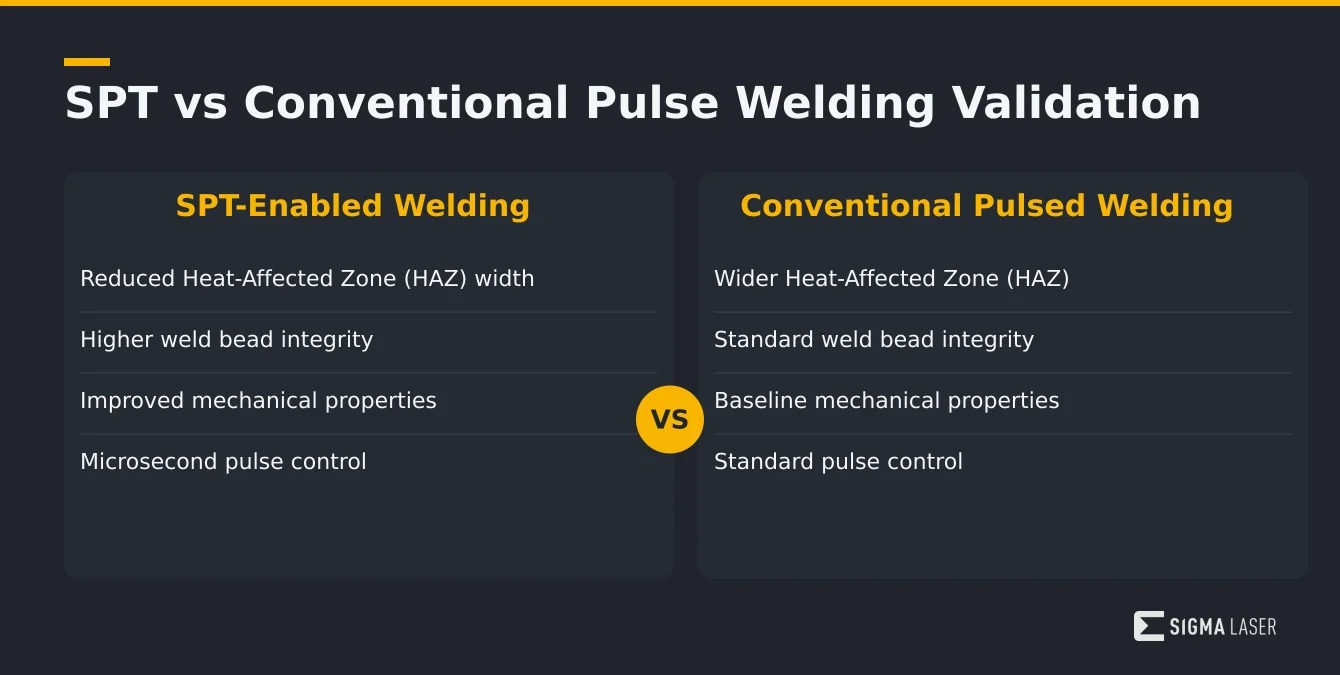
Validation is a critical phase in integrating SPT into automated workflows, particularly for regulated industries or high-value components. The process begins with a direct comparison of SPT-enabled welding against conventional pulsed methods, focusing on key quality metrics such as heat-affected zone (HAZ) width, weld bead integrity, and mechanical properties.
Operators should conduct controlled test series using both SPT and standard pulse settings, documenting outcomes with metallographic analysis, tensile testing, or other relevant inspection techniques. The goal is to quantify the reduction in HAZ and any improvements in joint strength or appearance attributable to SPT’s microsecond pulse control. These results form the basis for process qualification and customer or regulatory approval.
Once optimal parameters are established, they should be locked into Sigomatic Pro as validated process recipes. This ensures that every cycle in automated production uses the exact settings proven during validation, supporting traceability and repeatability. For series production, it is best practice to implement periodic quality checks—such as sampling or in-line monitoring—to verify ongoing conformity.
- Compare SPT and conventional pulse results on representative parts.
- Document weld quality, HAZ, and any observed defects.
- Lock validated parameter sets in Sigomatic Pro.
- Implement periodic checks to maintain process integrity.
By rigorously validating and controlling the automated series, operators can fully leverage SPT’s benefits while meeting the demanding standards of modern production environments.
Frequently Asked Questions
What is SPT and how does it enhance automated workflows?
SPT (microsecond fibre laser pulse control) enables ultra-fine energy delivery, reducing heat-affected zones and improving weld quality. In automated workflows, this allows for tighter part spacing, faster cycles, and reliable processing of sensitive or high-value materials.
Which Sigma Laser systems support SPT integration?
SPT is available on all six Sigma welding machines, including both Nd:YAG and fibre laser models. When configuring automated cells with Simass, ensure the selected fibre laser source supports SPT for full integration and process control.
How do I validate SPT processes in automated production?
Begin by comparing SPT and conventional pulse welds on sample parts, focusing on HAZ and joint quality. Lock validated parameters in Sigomatic Pro and implement periodic quality checks to ensure ongoing conformity in series production.
What should I consider when designing cycles with SPT?
Leverage SPT’s low-heat pulses to shorten recovery times and enable tighter part spacing. Monitor for cumulative heating in multi-pass operations and adjust cycle timing or cooling steps as needed to maintain consistent weld quality.