
- Key Takeaways
- What Are the Benefits of Automated Laser Welding?
- Increased Productivity
- Enhanced Precision and Quality
- Improved Safety Measures
- How Does Manual Welding Compare to Automated Welding in Terms of Cost?
- Initial Investment Costs
- Operational and Maintenance Expenses
- Long-term Financial Benefits
- Why Choose Automated Welding for Your Production Line?
- Scalability and Flexibility
- Efficiency in High-Volume Production
- Integration with Industry 4.0
- Case Studies: Companies Using Both Welding Methods
- Case Study 1: Automotive Industry
- Case Study 2: Aerospace Sector
- Can Automated Welding Improve Labor Efficiency?
- Reduction in Labor Costs
- Training and Workforce Adaptation
- Impact on Skilled Labor Demand
- Frequently Asked Questions
- What are the benefits of automated laser welding?
- How does manual welding compare to automated welding in terms of cost?
- What are the key differences in quality between automated and manual welding?
- Can automated welding systems handle complex geometries?
- What are the safety implications of automated vs. manual welding?
- How does the setup time compare between manual and automated welding?
- What is the impact of automated welding on workforce requirements?
- Related Articles
Key Takeaways
As production managers face increasing pressure to enhance efficiency and reduce costs, the decision between automated and manual welding becomes crucial. Understanding the advantages, disadvantages, and financial implications of each method can significantly impact your production line’s performance and profitability.
- Automated welding offers consistent quality and precision, reducing the likelihood of defects and rework compared to manual welding.
- While upfront costs for automation equipment can be high, the long-term savings in labor and material waste often outweigh initial investments.
- Manual welding provides flexibility for complex and small-batch projects where automation may not be feasible or cost-effective.
- Automation reduces the dependency on skilled labor, addressing the challenge of skilled welder shortages in the industry.
- Implementing automated welding can significantly increase production speed, allowing for higher throughput and meeting tight deadlines.
- Energy consumption in automated systems is generally lower due to optimized operation, contributing to cost savings and sustainability goals.
- Evaluate your specific production requirements and volume to determine the most cost-effective welding solution for your operation.
As you delve into the article, you will gain a deeper understanding of how automated welding can transform your production processes and bottom line. Explore the detailed analysis to make an informed decision that aligns with your operational goals.
What Are the Benefits of Automated Laser Welding?
In the realm of industrial manufacturing, automated laser welding marks a significant transformation from traditional methods. Leveraging advanced automation technologies, like those in Sigma Laser’s precision systems, automated laser welding — enabled on Sigma systems by software such as Sigomatic Pro — enhances production capabilities considerably. Unlike manual welding, which can vary in quality, automated welding systems deliver consistent, repeatable results, thereby boosting the productivity and precision of your production line.
Increased Productivity
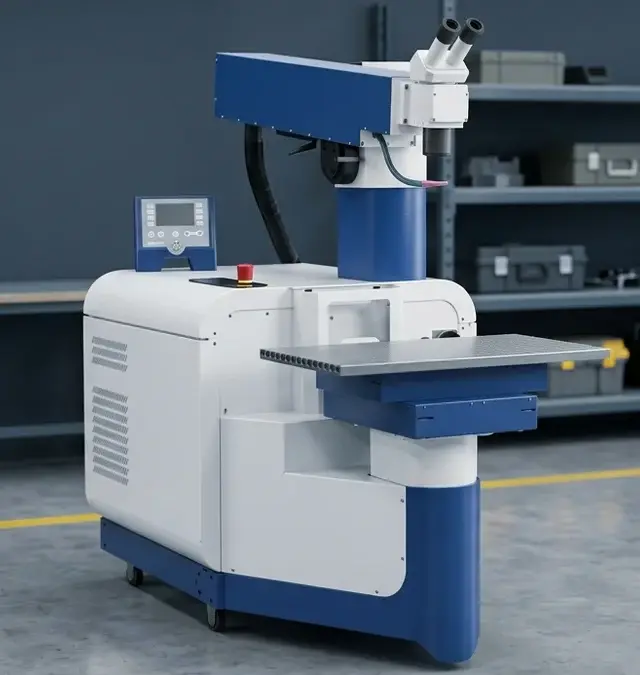
Automated laser welding systems, such as Sigma Laser’s Sidanus Light and Sirius Light, are designed to operate continuously with minimal downtime. This capability significantly increases production rates compared to manual welding. Automated laser welding systems can handle complex tasks at higher speeds, integrating smoothly with existing workflows. This leads to reduced cycle times and increased output, enabling facilities to meet stricter deadlines and enhance their competitiveness in the market.
Typically, these systems operate at welding speeds ranging from 1 to 10 meters per minute, depending on the material and thickness, which is significantly higher than manual welding speeds. They can achieve penetration depths of up to 10 mm in a single pass for certain steel grades, optimizing the overall welding process.
Enhanced Precision and Quality
Precision is crucial in welding, where even minor inconsistencies can compromise structural integrity. Sigma Laser’s automated laser welding systems, equipped with Super Pulse Technology (SPT) and Swivel Optics, ensure exceptional accuracy. These systems minimize human error, providing uniform welds across large batches. The Swivel Optics with Telescopic Lens further enhance the precision of laser welding, ensuring that each joint meets stringent quality standards, such as ISO 9001 and DIN EN ISO 4063.
The beam quality, often characterized by an M² value of less than 1.5, ensures a concentrated energy delivery, which is essential for maintaining a small heat-affected zone (HAZ) and reducing thermal distortion. These systems can maintain positional repeatability within ±0.05 mm, crucial for high-precision applications.
Improved Safety Measures
Safety is paramount in industrial environments. Automated laser welding significantly reduces the risks associated with manual welding by minimizing human exposure to hazardous conditions. Sigma Laser’s automated welding systems incorporate advanced safety features, such as the Z-Axis Module and Swivelling Y Axis, which protect operators from fumes, sparks, and intense heat. This shift towards automation not only enhances safety but also aligns with international standards like ISO 14731, promoting a safer workplace.
In conclusion, the transition from manual to automated laser welding offers considerable advantages in productivity, precision, and safety. By adopting Sigma Laser’s state-of-the-art automated systems, production managers can achieve superior operational efficiency and consistently deliver high-quality products.
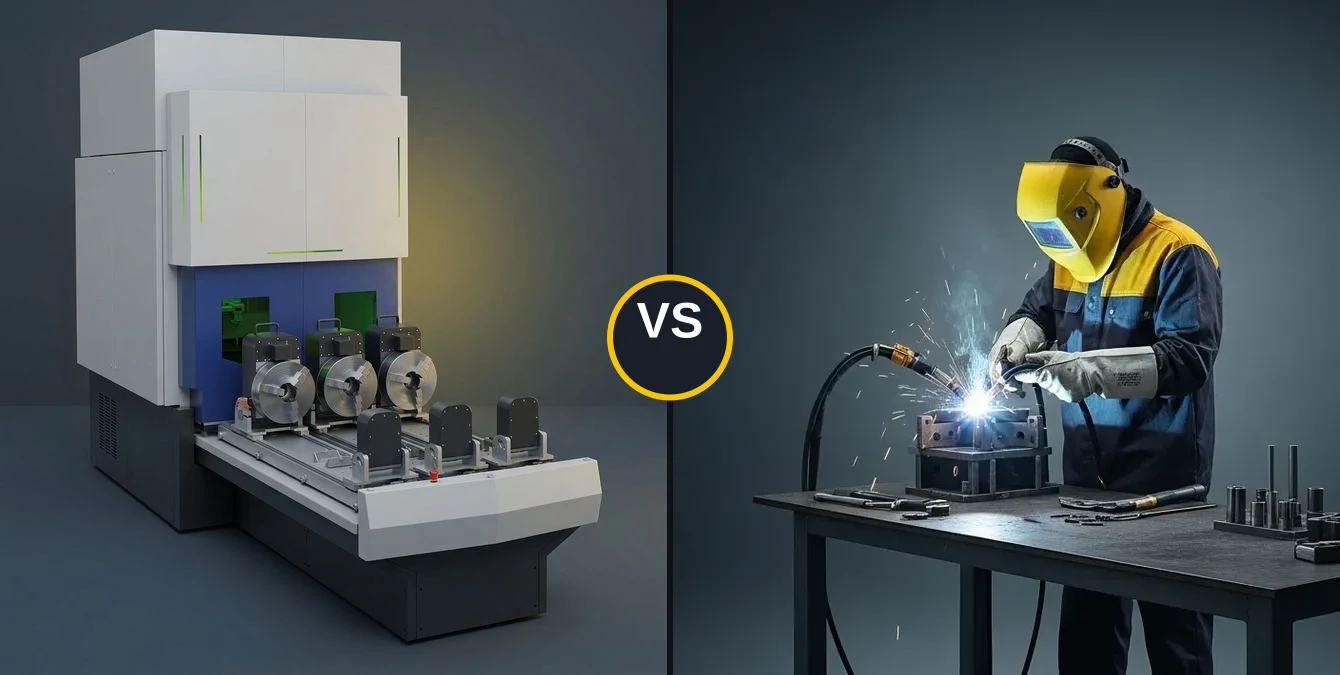
| Dimension | Manual welding | Automated laser welding |
|---|---|---|
| Throughput / productivity | Lower, operator-paced | High, continuous operation |
| Consistency & quality | Varies with operator skill | Consistent, repeatable |
| Precision | Depends on the craftsman | High, tightly controlled |
| Upfront cost | Low (torch, PPE, consumables) | Higher (equipment + integration) |
| Labour cost | High (skilled welders) | Reduced |
| Safety | Direct exposure to fumes & heat | Operators shielded (enclosed cell) |
| Best suited for | Custom, intricate, small-batch work | Repetitive, high-volume production |
How Does Manual Welding Compare to Automated Welding in Terms of Cost?
In the fast-paced world of industrial manufacturing, choosing between manual welding and automated welding systems is a critical decision that can significantly impact operational costs and efficiency. Both methods have distinct cost implications and financial benefits, which are crucial for production managers to consider. This section provides a detailed cost comparison of manual and automated welding, focusing on initial investment costs, operational and maintenance expenses, and long-term financial benefits.
Initial Investment Costs
The initial setup costs for manual welding are typically lower than those for automated systems. Manual welding requires basic equipment such as welding torches, protective gear, and consumables. However, the labor costs associated with skilled welders can quickly add up. In contrast, automated welding systems, such as Sigma Laser’s Sidanus Light and Sirius Light, involve a higher upfront investment due to the cost of automation technology and integration into existing production lines. Despite this, the advanced capabilities of automated systems, including precision and consistency, can justify the initial expense.
For instance, laser welding systems often operate at power levels ranging from 500 watts to 6 kilowatts, with beam quality M² values typically below 1.2, ensuring high precision and minimal heat-affected zones. The initial investment in such technology can be offset by the reduced need for post-processing and rework, commonly required in manual processes.
Operational and Maintenance Expenses
Manual welding operations incur ongoing costs related to labor, training, and equipment maintenance. Skilled welders are essential, and their wages form a significant portion of production expenses. Additionally, manual equipment requires regular maintenance to ensure safety and effectiveness. On the other hand, automated welding systems like those offered by Sigma Laser, equipped with Super Pulse Technology (SPT) and Swivel Optics, reduce labor dependency and are designed for minimal maintenance. Although automated laser welding systems require periodic technical servicing, their automated nature reduces the frequency and cost associated with human error and equipment wear.
Automated systems typically achieve welding speeds of up to 10 meters per minute, with penetration depths adjustable from 0.1 mm to several millimeters, depending on the material and application. This level of control and repeatability, often within ±0.1 mm, ensures consistent quality and reduces material waste.
Long-term Financial Benefits
While manual welding provides flexibility and is suited for custom, small-batch projects, automated welding offers substantial long-term financial benefits for high-volume production. The use of automated laser welding enhances throughput, reduces waste, and ensures high-quality welds consistently. Systems like Sigma Laser’s Sineo Fibre and Simass Rotate can operate continuously, maximizing output with minimal downtime. Over time, the efficiency and precision of automated welding result in significant cost savings, making it a more viable option for large-scale manufacturing operations.
Automated laser welding systems are compatible with a range of materials, including carbon steels, stainless steels, and aluminum alloys, adhering to standards such as EN ISO 15614 for welding procedure qualifications. This versatility further enhances their applicability across diverse industrial sectors.
In conclusion, when evaluating automated vs manual welding, production managers must weigh the initial investment against the potential for sustainable operational savings. Automated welding systems, while requiring a more substantial initial outlay, offer unmatched reliability and efficiency, making them a strategic investment for manufacturers aiming for long-term growth and competitiveness.
| Cost factor | Manual welding | Automated laser welding |
|---|---|---|
| Initial investment | Lower | Higher |
| Labour | High — skilled-welder wages | Lower |
| Rework / post-processing | Commonly required | Reduced |
| Long-term ROI | Slower | Faster in high-volume production |
Why Choose Automated Welding for Your Production Line?
In today’s fast-paced industrial environment, optimizing production processes is crucial. Automated welding, compared to manual welding, offers significant advantages in precision, consistency, and adaptability, making it an essential component for modern manufacturing lines. At Sigma Laser, our advanced laser welding systems, such as the Sidanus Light and Sirius Light, provide unparalleled scalability and efficiency for diverse industrial applications.
Automated systems typically operate with laser powers ranging from 500 watts to 6 kilowatts, depending on the material and thickness, and use wavelengths around 1064 nm for Nd:YAG lasers or 1070 nm for fiber lasers. Beam quality, often denoted by the M² factor, is typically less than 1.5 for high-quality welding applications, ensuring precise energy delivery.
Scalability and Flexibility
Automated welding systems, including automated laser welding, offer unmatched scalability and flexibility. These systems can be tailored to handle a wide range of tasks, from small batch production to large-scale manufacturing. The adaptability of our Sigomatic Pro and Swivel Optics technologies ensures that changes in production demand are met without compromising quality or efficiency.
These systems are compatible with a variety of materials, including carbon steels (up to grade S355), stainless steels (such as 304 and 316), and aluminum alloys (such as 6061 and 7075), providing versatility across different industrial sectors. Typical welding speeds can range from 2 to 10 meters per minute, with penetration depths up to 10 mm, depending on the material and thickness.
Efficiency in High-Volume Production
Efficiency is a key factor in high-volume production settings. Automated welding systems from Sigma Laser significantly reduce cycle times and improve throughput. For instance, integrating our Super Pulse Technology (SPT) can enhance welding speed without sacrificing precision, making it ideal for sectors requiring rapid production rates while maintaining stringent quality standards.
With repeatability often within ±0.1 mm, these systems ensure consistent weld quality, reducing the need for rework and enhancing overall production efficiency. The heat-affected zone (HAZ) is minimized, typically less than 1 mm, preserving the mechanical properties of the base materials.
Integration with Industry 4.0
As manufacturing shifts towards Industry 4.0, the integration of automated welding systems becomes increasingly vital. Sigma Laser’s advanced automated laser systems easily integrate with existing production lines, leveraging data analytics and IoT for real-time monitoring and optimization. This seamless integration supports continuous improvement and innovation, aligning with modern manufacturing demands and standards such as ISO 9001 and DIN EN ISO 4063.
Our systems are designed to comply with international standards, including ISO 11145 for laser equipment and ISO 11146 for laser beam measurements, ensuring high-quality and reliable welding processes. This compliance guarantees that our solutions meet global benchmarks for safety, quality, and performance.
Case Studies: Companies Using Both Welding Methods
In the dynamic landscape of manufacturing, strategically deploying welding technologies can greatly enhance production efficiency and quality. This section explores case studies from the automotive and aerospace sectors, where companies have effectively integrated both manual and automated welding processes to optimize their operations.
Case Study 1: Automotive Industry
The automotive industry exemplifies a sector that benefits from both manual and automated welding processes. A leading European car manufacturer, known for its precision engineering and ISO 9001 certification, chose to integrate automated laser welding alongside traditional manual techniques.
Their challenge was to maintain high-quality standards while increasing production throughput. By implementing Sigma Laser’s Sidanus Light and Sineo Fibre systems, the company achieved remarkable results. Automated laser welding stations handled repetitive, high-volume tasks, while manual welding was reserved for custom, intricate work requiring skilled craftsmanship.
Automated systems like the Sidanus Light typically operate with laser power outputs ranging from 2 kW to 6 kW, providing sufficient energy to achieve weld penetration depths of up to 10 mm in mild steel, while maintaining a beam quality M² of less than 1.2 for precision. The Sineo Fibre systems are optimized for high-speed welding applications, with welding speeds reaching up to 5 meters per minute on thin gauge materials.
- Challenges Faced: Balancing the cost of new technology with existing production budgets and training personnel to operate advanced systems.
- Outcomes Achieved: A 30% increase in production efficiency, reduced error rates, and improved weld consistency.
Case Study 2: Aerospace Sector
In the aerospace sector, where precision and safety are paramount, a European aerospace manufacturer adopted a hybrid welding approach. Adhering to DIN EN ISO 4063 standards, they incorporated Sigma Laser’s Simass Base Unit and Super Pulse Technology (SPT) to enhance their manual welding operations.
The complex geometries and material diversity in aerospace applications presented unique challenges. The manufacturer’s objective was to enhance weld precision while maintaining production flexibility. By utilizing automated systems for standard components and manual welding for bespoke parts, they achieved a harmonious balance.
Materials such as titanium alloys and Inconel, commonly used in aerospace, require precise control of heat input to minimize the heat-affected zone (HAZ). The Super Pulse Technology allows for pulse durations as short as 0.1 milliseconds, reducing thermal distortion and ensuring a weld tolerance typically within ±0.1 mm.
- Challenges Faced: Managing the integration of automated laser systems with existing manual workflows and ensuring compliance with stringent aerospace quality standards.
- Outcomes Achieved: Enhanced weld precision, significant reduction in production time, and strengthened compliance with industry standards.
These case studies clearly demonstrate that a thoughtful combination of automated and manual welding processes can lead to substantial operational improvements. As manufacturing engineers and procurement managers weigh the benefits of automated versus manual welding, these examples offer valuable insights into practical applications and strategic advantages.
Can Automated Welding Improve Labor Efficiency?
In the realm of modern industrial manufacturing, the shift from manual welding to automated welding systems, such as the advanced technologies offered by Sigma Laser, is revolutionizing labor efficiency. Automated welding involves using automated laser welding technologies that perform tasks with high precision and consistency, reducing the margin for human error. This transition not only enhances production quality but also significantly impacts labor dynamics in the manufacturing sector.
Automated laser welding systems typically operate with power ranges from 500W to 10kW, depending on the application requirements. The beam quality, often denoted by the M² factor, is crucial for precision applications and typically ranges from 1.1 to 1.5 for high-quality systems. The wavelength for industrial laser welding is commonly around 1064 nm for fiber lasers, which is optimal for processing various metals.
Reduction in Labor Costs
The implementation of automated welding systems like Sigma Laser’s Simass Base Unit and Sidanus Light can lead to substantial reductions in labor costs. By automating repetitive tasks, companies can decrease the need for manual labor, particularly in high-volume production environments. This shift allows manufacturers to reallocate resources and optimize their workforce. Automation minimizes downtime and increases throughput, translating to cost savings and improved profit margins.
Typical process parameters for automated laser welding include welding speeds of 1 to 10 meters per minute and penetration depths of up to 10 mm, depending on the material and thickness. The heat-affected zone (HAZ) is minimized, which is critical for maintaining material properties, especially in high-strength steels and aluminum alloys. Tolerances for automated systems can achieve repeatability within ±0.1 mm, ensuring high-quality joints.
Training and Workforce Adaptation
While automated welding systems reduce the need for manual labor, they introduce a new requirement for skilled technicians capable of operating and maintaining such advanced machinery. Training programs are essential to upskill current employees, ensuring a seamless transition to automation. Sigma Laser’s technical training programs are designed to equip workers with the necessary skills to manage and troubleshoot automated laser welding systems, fostering an adaptable and future-ready workforce.
In addition to operational training, understanding standards such as ISO 11145 for laser equipment and ISO 11146 for laser beam measurements is crucial for technicians to ensure compliance and optimize system performance.
Impact on Skilled Labor Demand
Despite concerns that automation might reduce the demand for skilled labor, the reality is more nuanced. Automated welding technologies increase the demand for skilled labor in new areas, such as programming, machine maintenance, and quality assurance. This shift is particularly evident in industries adhering to stringent standards like ISO 9001 and DIN EN ISO 4063, where precision and reliability are paramount. Therefore, while the nature of the work may change, the demand for skilled labor remains robust, albeit in different capacities.
In conclusion, the transition from manual to automated welding offers significant benefits in terms of labor efficiency. By embracing automated laser welding technologies, such as those developed by Sigma Laser, manufacturers can optimize labor costs, enhance workforce capabilities, and maintain a competitive edge in the dynamic industrial landscape.
Frequently Asked Questions
What are the benefits of automated laser welding?
Automated laser welding offers increased precision, consistency, and speed compared to manual welding. It reduces human error and fatigue, enhancing overall productivity. Automation also allows for better quality control and traceability, essential for industries requiring high standards, such as aerospace and automotive manufacturing.
How does manual welding compare to automated welding in terms of cost?
Manual welding has lower initial equipment costs but higher long-term labor expenses. Automated welding systems require significant upfront investment but result in reduced labor costs and increased throughput, offering a faster return on investment, especially in high-volume production environments.
What are the key differences in quality between automated and manual welding?
Automated welding provides consistent weld quality by minimizing human error and variability, leading to fewer defects and rework. Manual welding, while flexible, relies heavily on the welder’s skill, which can result in variable quality and increased inspection requirements.
Can automated welding systems handle complex geometries?
Advanced automated welding systems, equipped with multi-axis CNC motion systems and sophisticated programming, can efficiently handle complex geometries and intricate weld paths. They are ideal for applications requiring precision in challenging configurations, such as aerospace components.
What are the safety implications of automated vs. manual welding?
Automated welding reduces the exposure of workers to hazardous environments, decreasing the risk of injuries from fumes, heat, and UV radiation. Manual welding poses more safety risks, requiring stringent safety protocols and personal protective equipment to mitigate hazards.
How does the setup time compare between manual and automated welding?
Automated welding involves a longer initial setup time due to programming and calibration requirements, but once operational, it significantly reduces changeover times. Manual welding setups are quicker but less efficient for repetitive tasks, impacting overall production efficiency.
What is the impact of automated welding on workforce requirements?
Automated welding reduces the need for skilled welders but increases demand for technicians skilled in programming and maintaining automated laser systems. It shifts the workforce focus from manual labor to technical expertise, necessitating retraining and upskilling of personnel.