
- Key Takeaways
- What is the Maximum Thickness a Laser Welder Can Handle?
- Factors Influencing Maximum Thickness
- Comparing Fiber and CO2 Lasers
- How Does Material Type Affect Laser Welding Capabilities?
- Material Properties and Laser Interaction
- Challenges with Reflective Materials
- Understanding the Thickness-to-Parameter Relationship in Laser Welding
- Key Parameters in Laser Welding
- Adjusting Parameters for Thickness Variations
- Which Laser Welding Techniques are Best for Various Materials?
- Keyhole vs. Conduction Welding
- Technique Suitability for Material Types
- Case Studies: Laser Welding Across Different Industries
- Automotive Industry Applications
- Aerospace and Electronics Case Studies
- Frequently Asked Questions
- What is the maximum thickness a laser welder can handle?
- How does material type affect laser welding capabilities?
- What factors influence the quality of laser welds on thick materials?
- Can laser welding be used for dissimilar materials?
- What are the challenges of laser welding high-reflectivity materials?
- How does welding speed affect the penetration depth in laser welding?
- What role does beam focus play in laser welding thick materials?
- Related Articles
- Sources
Key Takeaways
Understanding the capabilities and limitations of laser welding concerning material thickness is crucial for welding engineers aiming to optimize their welding processes. This article delves into the specificities of handheld and fiber laser welding, providing insights into how different materials respond to varying thicknesses under laser application.
- Handheld laser welding typically supports material thicknesses ranging from 0.5 mm to 4 mm, making it ideal for thin sheet applications where precision and speed are paramount.
- Fiber laser welding can efficiently handle a broader range of thicknesses, from as thin as 0.2 mm up to 25 mm, depending on the power output and focal length adjustments.
- The absorption rate of the laser by the material significantly influences weld quality; metals like aluminum and copper require specific wavelength adjustments for optimal penetration.
- Proper parameter settings, such as beam focus, travel speed, and power density, are critical in achieving defect-free welds, particularly in thicker materials.
- For materials thicker than 10 mm, pre-heating and multi-pass techniques may be necessary to ensure complete penetration and minimize thermal stress.
- Material reflectivity and conductivity should be considered when selecting laser type and parameters, as these factors affect energy absorption and weld consistency.
- Advancements in adaptive optics and real-time monitoring systems are enhancing the precision and adaptability of laser welding across varying material thicknesses.
These insights provide a foundation for understanding how laser welding can be tailored to specific material thicknesses and applications. Continue reading to explore detailed strategies and best practices for optimizing your laser welding processes.
What is the Maximum Thickness a Laser Welder Can Handle?
In industrial applications, understanding the limits of laser welding material thickness is crucial for selecting the right equipment for your production needs. Laser welding technology, such as those engineered by Sigma Laser, offers diverse solutions for handling various materials and thicknesses. Key factors influencing maximum material thickness include laser type, power output, and beam quality.
Factors Influencing Maximum Thickness
Several factors determine the ability of a laser welder to handle different material thicknesses:
- Laser Power Output: Higher power output allows greater penetration depth, enabling the welding of thicker materials. However, excessive power can lead to overheating and distortion. Industrial laser systems typically range from 60 W to 600 W (Nd:YAG) and 300 W to 600 W (fibre), with peak powers up to 13 kW (Nd:YAG) and 6 kW (fibre), depending on the application requirements.
- Beam Quality: The focus and energy density of the laser beam are critical. A high-quality beam with excellent focus, such as those produced by Sigma Laser’s Super Pulse Technology (SPT), ensures precise and efficient welding. Beam quality is often quantified by the M² value, with values close to 1 indicating superior beam quality.
- Material Type: Different materials, such as steel, aluminum, or titanium, have unique thermal and reflective properties that affect how they absorb laser energy, influencing achievable thickness. For instance, stainless steel grades like 304 and 316L are commonly welded with lasers due to their favorable absorption characteristics.
- Welding Speed and Penetration Depth: The welding speed, typically ranging from 0.5 to 5 meters per minute, affects the heat input and penetration depth. The heat-affected zone (HAZ) is minimized in laser welding, typically less than 1 mm, which is crucial for maintaining material properties.
Comparing Fiber and CO2 Lasers
Fiber and CO2 lasers are the two predominant types used in industrial laser welding. Each has its strengths and limitations regarding material thickness.
- Fiber Lasers: Known for their high efficiency and superior beam quality, fiber lasers, like Sigma Laser’s Siega Fibre, are optimal for welding thinner materials. They typically handle up to 5 mm in thickness with precision, making them ideal for applications requiring fine, detailed work. The wavelength of fiber lasers, around 1.064 micrometers, allows for efficient energy absorption in metals.
- CO2 Lasers: CO2 lasers are capable of welding thicker materials, often up to 20 mm, due to their longer wavelength of 10.6 micrometers. This makes them suitable for heavy-duty applications such as automotive or aerospace manufacturing where thicker materials are common. The longer wavelength is beneficial for cutting and welding non-metallic materials as well.
- Operational Constraints: The choice between fiber and CO2 lasers also depends on operational constraints such as available space, cooling requirements, and maintenance considerations. CO2 lasers generally require more maintenance due to their optical components and gas medium.
In conclusion, selecting the appropriate laser welding system requires a comprehensive understanding of your specific material and thickness requirements. Sigma Laser’s range of products, including the Sidanus Light and Sirius Light, are engineered to meet diverse industrial needs, ensuring high precision and quality in every weld. Compliance with standards such as ISO 15614-11:2002 for welding procedure qualification ensures that the welding processes meet industry benchmarks for quality and safety.
How Does Material Type Affect Laser Welding Capabilities?
In industrial manufacturing, understanding how different materials respond to laser welding is essential for optimizing precision and efficiency. Laser welding, especially when using advanced systems like Sigma Laser’s Sidanus Fibre or Sirius Light, can significantly influence the quality and speed of the welding process. This section explores the interaction between material types and laser technologies, focusing on steel, aluminum, and titanium.
Material Properties and Laser Interaction
The success of laser welding is greatly influenced by the intrinsic properties of materials. For instance, steel, known for its robustness, generally responds well to laser welding. Its moderate thermal conductivity and reflectivity make it ideal for achieving consistent welds across varying material thicknesses. Sigma Laser’s systems, employing Super Pulse Technology (SPT), ensure precision even with thick sections of steel, maintaining structural integrity without excessive thermal distortion.
Steel grades such as AISI 304 and 316 are commonly used in laser welding applications due to their favorable welding characteristics. The typical laser power for welding steel ranges from 1 to 10 kW, with beam quality M² values generally below 1.5 to ensure high precision.
Aluminum presents different challenges due to its high thermal conductivity and reflectivity. This material requires careful management of laser parameters to prevent heat dissipation that can lead to incomplete penetration. Sigma Laser’s fiber laser welding solutions are particularly effective here, offering precise control over energy input to accommodate aluminum’s unique characteristics.
Common aluminum alloys like 6061 and 7075 require laser systems with wavelengths around 1 µm for effective absorption. Welding speeds for aluminum can range from 1 to 10 m/min, depending on the thickness and alloy type, while maintaining a focused spot size typically around 50 to 100 µm.
Titanium, while less common, is valued in aerospace and medical industries for its strength-to-weight ratio. Its low thermal conductivity and reactivity necessitate a controlled environment, which Sigma Laser’s enclosed systems provide, ensuring the welds meet stringent standards such as ISO 15614-11.
For titanium alloys, such as Ti-6Al-4V, laser welding requires inert gas shielding, typically argon, to prevent oxidation. The heat-affected zone (HAZ) is minimized due to the low thermal conductivity, with penetration depths typically up to 5 mm in a single pass.
Challenges with Reflective Materials
Reflectivity poses significant challenges in laser welding, particularly with materials like aluminum and copper. These materials tend to reflect laser energy, reducing efficiency and requiring higher power outputs. Sigma Laser’s innovative Swivel Optics with Telescopic Lens are engineered to optimize focus and minimize reflection losses, ensuring effective energy transmission.
Moreover, precise control over laser parameters is vital when dealing with reflective surfaces to avoid defects such as porosity or cracking. Sigma Laser’s Sigomatic Pro offers advanced monitoring and control capabilities, allowing welding engineers to fine-tune processes based on material reflectivity and laser welding thickness requirements.
For reflective materials, laser systems often operate at power levels up to 6 kW, with beam delivery systems designed to handle the high reflectivity and thermal input. The use of shorter wavelengths, such as those provided by green lasers, can enhance absorption in copper and similar materials.
In conclusion, the selection of laser welding systems should consider material properties and their interaction with laser technologies. By leveraging Sigma Laser’s cutting-edge solutions, manufacturing engineers can overcome the challenges posed by diverse materials, enhancing productivity and maintaining high-quality standards in industrial applications.
| Material | Common alloys | Key consideration | Typical parameters |
|---|---|---|---|
| Steel | AISI 304 / 316(L) | Favourable absorption, stable welds | 1–10 kW*, M² < 1.5 |
| Aluminium | 6061 / 7075 | High conductivity & reflectivity → tight control | λ ~1 µm, 1–10 m/min, spot 50–100 µm |
| Titanium | Ti-6Al-4V | Needs inert-gas (argon) shielding | Penetration up to 5 mm/pass, low HAZ |
| Copper / gold (reflective) | — | High reflectivity → poor absorption | up to 6 kW, shorter λ (green) helps, down to 0.2 mm |
* Typical general laser-welding industry values, not Sigma Laser-specific machine ratings.
Understanding the Thickness-to-Parameter Relationship in Laser Welding
In precision engineering, grasping the interaction between material thickness and laser welding parameters is vital for achieving top-notch weld quality. At Sigma Laser, our advanced systems like the Sidanus Light and Siega Fibre are crafted to offer unmatched precision. However, their true effectiveness hinges on correctly adjusting parameters such as speed, power, and focus based on the material’s thickness.
Key Parameters in Laser Welding
For welding engineers, the primary laser welding parameters to consider include:
- Laser Power: The laser’s energy output must be sufficient to penetrate the material without causing excessive melting. Thicker materials typically require higher power settings. For instance, welding stainless steel with a thickness of 6 mm may require laser power in the range of 4-6 kW, depending on the laser type and beam quality (M² typically ≤ 1.2 for fiber lasers).
- Welding Speed: The rate at which the laser traverses the workpiece affects the heat input and stability of the weld pool. Slower speeds may be needed for thicker materials to ensure full penetration. For example, welding speeds can range from 0.5 to 3 m/min for materials up to 10 mm thick.
- Focus Position: The laser’s focal point should be adjusted to align with the material’s surface or slightly below it, especially for fiber laser welding, to ensure effective energy delivery. The focal length of the optics typically ranges from 100 to 200 mm, depending on the application.
Adjusting Parameters for Thickness Variations
Adapting these parameters to accommodate variations in material thickness is essential for maintaining weld integrity and quality. Here are some guidelines:
- For Thin Materials: Use lower laser power and higher welding speeds to prevent burn-through. The focus should be set precisely on the surface for exact energy targeting. Thin materials, such as those less than 1 mm thick, may require power settings as low as 500 W with speeds up to 5 m/min.
- For Medium Thickness: A balanced approach with moderate laser power and medium welding speed is recommended. Adjust the focus slightly below the surface to optimize penetration. For instance, materials around 3 mm thick may require 2-3 kW of power and speeds around 2 m/min.
- For Thick Materials: Increase laser power and reduce welding speed to ensure adequate heat input. The focus position should be deeper to facilitate full penetration. For materials exceeding 10 mm in thickness, power levels might reach 8-10 kW, with speeds reduced to 0.5-1 m/min to ensure complete fusion.
By carefully calibrating these parameters, manufacturers can achieve consistent and high-quality welds across various thicknesses. Sigma Laser’s solutions, such as the Super Pulse Technology (SPT) and Swivel Optics, are designed to adapt seamlessly to these adjustments, offering precision and reliability in challenging industrial applications.
It is crucial to adhere to industry standards such as ISO 15614-11:2002 for qualification of welding procedures, ensuring compliance and quality assurance across different materials and thicknesses.
| Material thickness | Laser power | Welding speed | Focus position | Notes |
|---|---|---|---|---|
| < 1 mm (thin) | ~500 W | up to 5 m/min | On the surface | Prevents burn-through |
| ~3 mm (medium) | 2–3 kW* | ~2 m/min | Slightly below surface | Balanced approach |
| 6 mm (stainless) | 4–6 kW* | — | Below surface | M² ≤ 1.2 (fibre) |
| up to 10 mm | — | 0.5–3 m/min | Below surface | — |
| > 10 mm (thick) | 8–10 kW* | 0.5–1 m/min | Deeper | Pre-heat + multi-pass |
Optics focal length: 100–200 mm. * Typical general laser-welding industry values, not Sigma Laser-specific machine ratings.
Which Laser Welding Techniques are Best for Various Materials?
Keyhole vs. Conduction Welding
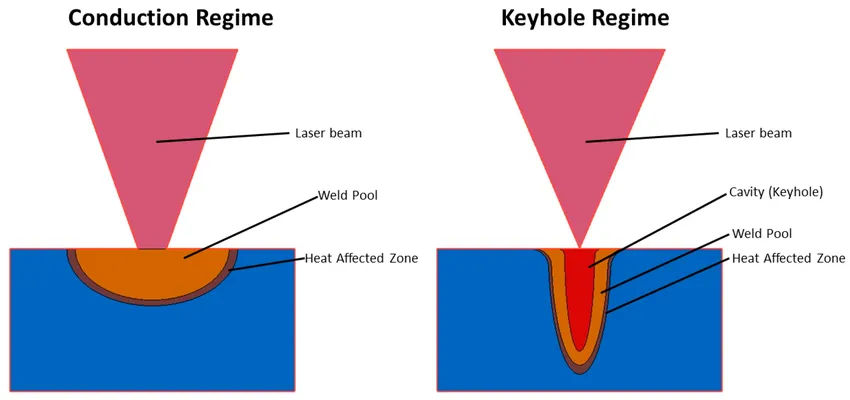
In precision engineering, understanding the differences between keyhole and conduction laser welding techniques is crucial for optimal application. Keyhole welding, often used when deep penetration is needed, employs a high-intensity laser beam to create a deep, narrow cavity, or ‘keyhole’, in the material. This method is particularly effective for materials with significant thickness, providing robust joint strength in industries like aerospace and automotive manufacturing. Conduction welding, in contrast, operates at lower power densities and relies on the thermal conduction of the material to form the weld. This technique is ideal for thin materials and applications where an aesthetic surface finish is critical, such as in consumer electronics or medical devices.
Keyhole welding typically utilizes laser power ranges from 1 kW to 10 kW with wavelengths around 1070 nm for fiber lasers, achieving penetration depths up to 25 mm in steel alloys. The beam quality, often characterized by an M² value of less than 1.2, ensures precision and minimal heat-affected zones (HAZ), typically less than 1 mm. Conduction welding, on the other hand, operates at lower power levels, generally between 100 W and 500 W, with a focus on minimizing thermal distortion and maintaining surface aesthetics.
| Aspect | Keyhole welding | Conduction welding |
|---|---|---|
| Laser power | 1–10 kW* | 100–500 W |
| Best for | Thick sections, deep penetration | Thin sheet, clean surface finish |
| Penetration | Up to 25 mm in steel* | Shallow |
| Beam quality / HAZ | M² < 1.2, HAZ < 1 mm | Minimal thermal distortion |
| Suitable materials | Steel, titanium, nickel alloys | Aluminium, copper |
| Fibre wavelength | ~1070 nm | — |
* Typical general laser-welding industry values, not Sigma Laser-specific machine ratings.
Technique Suitability for Material Types
The selection of laser welding techniques must align with specific material properties and desired outcomes. Keyhole welding is suitable for metals like steel, titanium, and nickel alloys, where substantial material thickness is involved. Sigma Laser’s Sidanus Fibre system, equipped with advanced fiber laser welding capabilities, offers exceptional penetration and control, ensuring that even the most challenging metallurgical compositions are seamlessly joined.
For materials such as aluminum or copper, which have high thermal conductivity, conduction welding is often more effective. The Sineo Light series, with its precise control over laser parameters, ensures superior weld quality on thin sheets, optimizing the balance between heat input and material integrity. Industries that require intricate, precision welds without compromising material properties benefit significantly from this approach.
Furthermore, Sigma Laser’s commitment to innovation, demonstrated through our Swivel Optics technology, provides unmatched flexibility in addressing diverse welding scenarios, adhering strictly to ISO 9001 and DIN EN ISO 4063 standards. By leveraging the right technique for the right material, engineers can achieve unparalleled efficiency and reliability in their manufacturing processes, highlighting the importance of informed selection in laser welding applications.
It is crucial to consider the specific alloy grades, such as 304 and 316 stainless steels or 6061 and 7075 aluminum alloys, to ensure compatibility with the selected laser welding technique. Additionally, maintaining a welding speed between 1 m/min and 10 m/min is often necessary to balance penetration depth and thermal input, as outlined in ISO 15614-11:2002. Engineers must also account for operational constraints, such as beam alignment tolerances typically within ±0.1 mm, to achieve consistent weld quality.
Case Studies: Laser Welding Across Different Industries
Laser welding is a pivotal technology in industrial manufacturing, offering precision and versatility across a range of applications. At Sigma Laser, we recognize that managing various laser welding material thicknesses is critical to achieving optimal results. Our products, such as the Sidanus Light and Siega Fibre, are engineered to meet the stringent requirements of diverse industries, from automotive to aerospace and electronics.
Automotive Industry Applications
In the automotive sector, laser welding plays a key role in joining different materials like steel and aluminum, essential for manufacturing lightweight yet durable vehicle components. For instance, a renowned European automotive manufacturer used Sigma Laser’s Sidanus Fibre system to weld high-strength steel with thicknesses ranging from 0.8 mm to 3 mm. This application not only improved production efficiency but also ensured stronger weld integrity and reduced overall vehicle weight.
Despite these successes, challenges such as managing heat input and distortion remain. By utilizing Super Pulse Technology (SPT), our client was able to mitigate these issues, achieving a fine balance between speed and precision, enhancing the overall structural quality of the welds.
Typically, the laser systems employed in these applications operate at power levels ranging from 2 kW to 6 kW, with beam quality M² values below 1.2, ensuring focused energy delivery and minimal heat-affected zones. These systems are often configured with focal lengths of 150 mm to 200 mm to accommodate varying material thicknesses and maintain high precision. The process adheres to standards such as ISO 15614-11:2002 for welding procedure qualification.
Aerospace and Electronics Case Studies
The aerospace industry demands stringent precision standards, particularly when dealing with complex geometries and diverse material properties. A case study involving our Sirius Light laser system demonstrated significant advancements in welding aircraft components with disparate material thicknesses. The system’s advanced fiber laser welding material handling capabilities allowed for seamless integration of thin aluminum and titanium sheets, crucial for maintaining structural integrity while reducing weight.
In aerospace applications, typical welding speeds range from 1 m/min to 5 m/min, with penetration depths up to 4 mm, depending on the material and thickness. The precision required often necessitates compliance with standards like DIN EN ISO 4063:2011, ensuring repeatability and reliability in demanding environments.
In the electronics sector, laser welding is leveraged for its precision and minimal heat-affected zones. A leading electronics manufacturer utilized our Sineo Fibre system to weld intricate copper and gold connectors with laser welding thickness as thin as 0.2 mm. This application underscored the importance of fiber laser welding material technology in achieving reliable and high-quality joins, critical for maintaining the performance of electronic devices.
These case studies not only highlight the adaptability of Sigma Laser’s solutions across different industries but also emphasize the importance of understanding laser welding material thickness to optimize welding processes. As industries continue to push the boundaries of material science and engineering, Sigma Laser remains committed to delivering cutting-edge solutions that meet evolving industrial needs.
| Industry | Material / thickness | Laser power | Speed / focus |
|---|---|---|---|
| Automotive | High-strength steel 0.8–3 mm | 2–6 kW* | Focal 150–200 mm, M² < 1.2 |
| Aerospace | Aluminium + titanium, penetration up to 4 mm | — | 1–5 m/min |
| Electronics | Copper / gold from 0.2 mm | — | Minimal HAZ |
* Typical general laser-welding industry values, not Sigma Laser-specific machine ratings.
Frequently Asked Questions
What is the maximum thickness a laser welder can handle?
The maximum thickness a laser welder can handle depends on the laser power and material type. Typically, fiber lasers with power levels around 10 kW can weld steel up to 30 mm thick. However, the ability to weld thicker materials requires precise control of laser parameters and may involve pre-heating or multi-pass techniques.
How does material type affect laser welding capabilities?
Material type significantly impacts laser welding capabilities. Metals like aluminum and copper, with high reflectivity and thermal conductivity, require higher laser power and specialized techniques compared to steel. Additionally, alloys with high carbon content may need pre-heating to prevent cracking during welding.
What factors influence the quality of laser welds on thick materials?
The quality of laser welds on thick materials is influenced by laser power, beam focus, welding speed, and material properties. Proper alignment and clamping are crucial to prevent distortion, and the use of assist gases like argon or helium can improve weld penetration and quality.
Can laser welding be used for dissimilar materials?
Laser welding can join dissimilar materials, but it requires careful selection of laser parameters and filler materials to manage differences in thermal expansion and melting points. Techniques such as pulse shaping and beam modulation may be employed to optimize the weld quality.
What are the challenges of laser welding high-reflectivity materials?
High-reflectivity materials like copper and gold pose challenges due to their tendency to reflect laser light, reducing efficiency. To overcome this, higher laser power, shorter wavelengths, or specialized coatings may be used to enhance absorption and improve weld quality.
How does welding speed affect the penetration depth in laser welding?
Welding speed is inversely related to penetration depth in laser welding. Slower speeds allow more heat to be absorbed by the material, increasing penetration. However, excessively slow speeds can lead to overheating and weld defects, necessitating a balance between speed and power.
What role does beam focus play in laser welding thick materials?
Beam focus is critical when welding thick materials, as it determines the concentration of laser energy at the weld site. A tightly focused beam increases the energy density, allowing deeper penetration and more efficient welding. Adjusting the focal position can optimize the weld profile.
Sources
- ISO 15614-11:2002 — Specification and qualification of welding procedures for metallic materials – Part 11: Electron and laser beam welding
- DIN EN ISO 4063:2011 — Welding and allied processes – Nomenclature of processes and reference numbers
- Journal of Laser Applications — Peer-reviewed journal covering the latest research in laser applications, including welding
- Welding Journal — Monthly publication by the American Welding Society focusing on welding technology and research
- Optics and Lasers in Engineering — Journal focusing on the research and development of laser technology in engineering applications