
- Key Takeaways
- What Are the Cost Implications of Laser Welding Compared to MIG Welding?
- Initial Investment and Equipment Costs
- Maintenance and Operational Expenses
- How Does the Learning Curve of Laser Welding Compare to MIG Welding?
- Training Requirements for Laser Welding
- Skill Levels and Labor Availability for MIG Welding
- Which Method Offers Better Speed and Efficiency: Laser or MIG Welding?
- Welding Speed and Setup Time
- Automation and Production Throughput
- Why Is Laser Welding Known for Precision and MIG Welding for Versatility?
- Technical Precision in Laser Welding
- Versatility and Application Scenarios in MIG Welding
- What Is the Environmental Impact of Laser Welding vs MIG Welding?
- Energy Consumption and Emissions
- Waste Management and Sustainability
- Frequently Asked Questions
- What are the cost implications of laser welding compared to MIG welding?
- How does the learning curve of laser welding compare to MIG welding?
- What are the key advantages of laser welding over MIG welding?
- In what applications is laser welding preferred over MIG welding?
- Can laser welding handle thicker materials as effectively as MIG welding?
- What maintenance is required for laser welding systems compared to MIG welding?
- How does energy consumption differ between laser welding and MIG welding?
- Sources
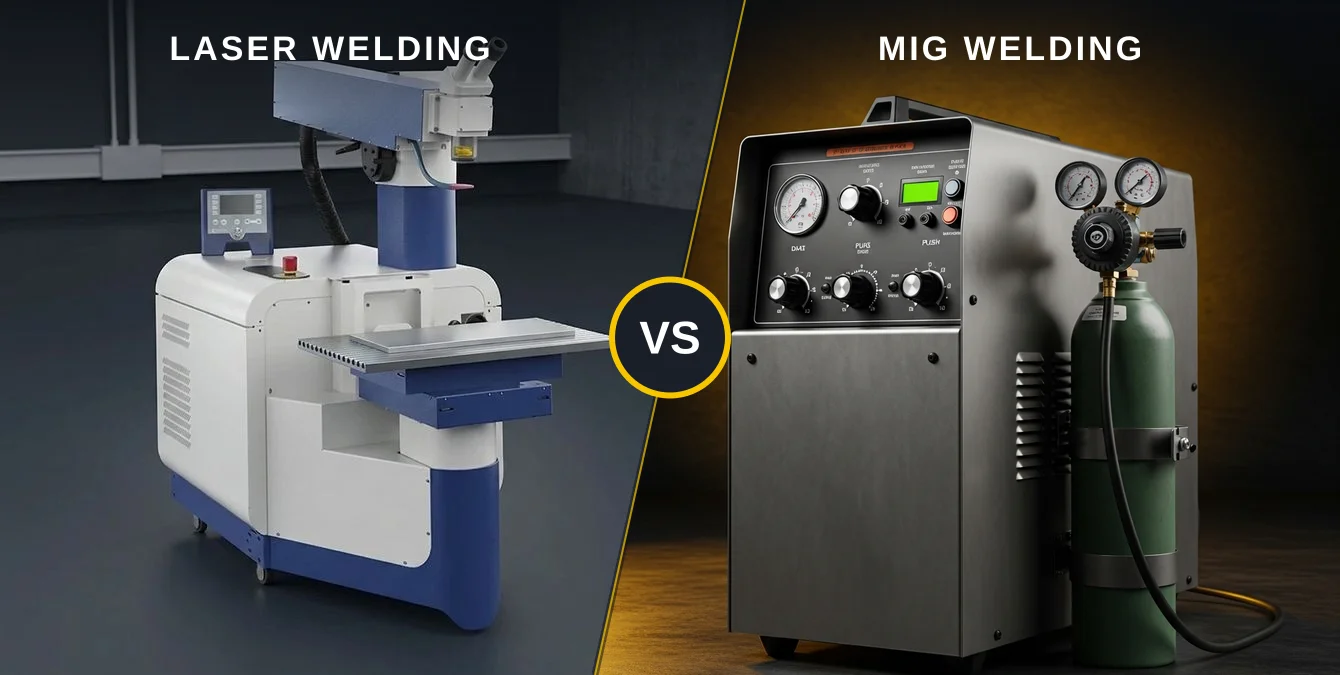
Quick Answer: Laser welding vs MIG welding presents distinct advantages for production managers to consider. Laser welding offers precision, minimal distortion, and high-speed processing, making it ideal for intricate and high-volume tasks. Although the initial investment is higher, the long-term cost efficiency and superior quality often justify it. Conversely, MIG welding is more cost-effective upfront and versatile for thicker materials but may result in more waste and slower processing times. Ultimately, the choice depends on specific project requirements, budget, and desired quality outcomes.
Key Takeaways
In the realm of welding technologies, production managers are often tasked with choosing between laser welding and MIG welding to optimize their manufacturing processes. Understanding the distinct advantages of each method is crucial in making an informed decision that aligns with production goals, particularly in terms of precision, speed, versatility, and ease of learning.
- Laser welding offers exceptional precision, allowing for tighter tolerances and minimal distortion in high-stakes applications such as aerospace and medical device manufacturing.
- The speed of laser welding significantly reduces cycle times, enhancing throughput and efficiency in high-volume production environments.
- MIG welding is renowned for its versatility, accommodating a wide range of materials and thicknesses, making it suitable for general fabrication and repair work.
- Operators can quickly become proficient in MIG welding due to its straightforward setup and operation, reducing training time and associated costs.
- Laser welding’s non-contact process minimizes wear and tear on equipment, potentially lowering maintenance costs compared to traditional methods.
- Advanced automation capabilities in laser welding support integration into smart manufacturing systems, aligning with Industry 4.0 initiatives.
- MIG welding remains a cost-effective option for projects where precision and speed are less critical, but flexibility is paramount.
By weighing the precision and speed advantages of laser welding against the versatility and ease of learning offered by MIG welding, production managers can strategically position their operations for future growth. Dive deeper into each method’s specific benefits and challenges to determine the most suitable upgrade path for your production line.
| Parameter | Typical Value / Range |
|---|---|
| Power Levels | 100 W to several kilowatts |
| Wavelength | 1064 nm (Nd:YAG), 1070 nm (fibre laser) |
| Beam Quality (M²) | < 1.5 |
| Welding Speed | Up to several meters per minute |
| Penetration Depth | Up to 10 mm (for thicker sections) |
| Heat-Affected Zone (HAZ) | Minimized |
| Material Compatibility | Steels, aluminum alloys, titanium, nickel-based superalloys |
These are general industry values, not attributed to a specific Sigma Laser product. Source: ScienceDirect – Journal of Manufacturing Processes.
What Are the Cost Implications of Laser Welding Compared to MIG Welding?
Initial Investment and Equipment Costs
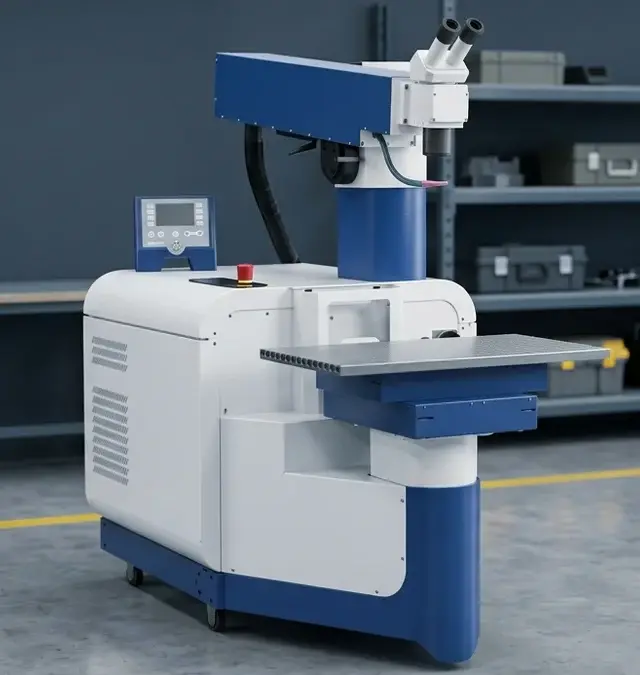
When evaluating the cost implications of laser welding vs MIG welding, it’s crucial to consider the initial investment and equipment costs. Laser welding systems, like Sigma Laser’s Sidanus Light and Sirius Light, require a substantial upfront investment due to their advanced technology and precision capabilities. These systems are designed to offer high repeatability and come with features such as Super Pulse Technology (SPT) and Swivel Optics, enhancing welding precision and adaptability for complex industrial applications.
In contrast, MIG welding equipment is generally more affordable in terms of initial purchase price. Known for its versatility, MIG welding is widely used across industries from automotive to construction. However, the lower initial cost can be misleading when considering the total cost of ownership over time.
Laser welding typically operates at power levels ranging from 100 W to several kilowatts, with wavelengths around 1064 nm for Nd:YAG lasers and 1070 nm for fibre lasers. The beam quality, often characterized by an M² value, generally remains below 1.5, offering superior focusability and precision. Welding speeds can reach up to several meters per minute, depending on the material and thickness, with penetration depths typically up to 10 mm for thicker sections ScienceDirect – Journal of Manufacturing Processes. The heat-affected zone (HAZ) is minimized due to the concentrated energy input, which is a significant advantage over MIG welding.
Maintenance and Operational Expenses
The ongoing maintenance and operational expenses of laser welding systems are typically lower compared to MIG welding. Laser systems, with their non-contact nature, experience less wear and tear, reducing the need for frequent maintenance. Moreover, the precision of laser welding minimizes material waste and rework, leading to cost savings in production runs.
MIG welding, on the other hand, may incur higher operational costs due to consumables such as gas and wire, as well as more frequent maintenance requirements. The necessity for consistent quality checks and potential rework can further add to operational expenses, impacting long-term financial planning.
Laser welding systems are compatible with a wide range of materials, including various steel grades (e.g., stainless steel, carbon steel), aluminum alloys, and special alloys such as titanium and nickel-based superalloys. This versatility is essential for industries requiring high precision and minimal distortion, such as aerospace and automotive manufacturing Welding Journal. For production managers, understanding these cost dynamics is crucial. While laser welding demands a higher initial investment, its long-term benefits in precision and reduced maintenance can lead to significant cost efficiencies. Conversely, MIG welding’s lower upfront costs might be offset by higher long-term operational expenses, making it essential to evaluate specific production needs and volume when choosing between the two welding technologies.
| Aspect | Laser Welding | MIG Welding |
|---|---|---|
| Training Required | Specialized training in laser technology and equipment (e.g., Sigma Laser Sidanus Light, Sineo Fibre) | Basic welding principles; hands-on experience |
| Certification | Often requires ISO 9001, ISO 3834, ISO 15614-11:2002 | Not always required |
| Learning Curve | Steep; higher initial investment in training | Shorter; operators can become proficient quickly |
| Precision Achievable | Tolerances ±0.1 mm; repeatability often better than ±0.05 mm | Lower precision; depends on operator skill |
| Material Range | Wide (steels, aluminum, titanium, etc.) | Wide (various metals and thicknesses) |
Laser welding precision and certification requirements are general process values and not attributed to a specific Sigma Laser model.
How Does the Learning Curve of Laser Welding Compare to MIG Welding?
Training Requirements for Laser Welding
Laser welding, renowned for its precision, demands a thorough understanding of laser technology and its industrial applications. Operators must be well-acquainted with equipment like the Sidanus Light and Sineo Fibre, engineered by Sigma Laser for high-precision tasks. Training programs often highlight crucial aspects such as laser settings, beam alignment, and the integration of technologies like Super Pulse Technology (SPT) to achieve optimal outcomes. Certification in standards like ISO 9001 and ISO 3834 is typically required to ensure consistent quality and safety. Although the initial investment in training is significant, the precision and efficiency of laser welding can lead to substantial productivity gains over time.
Industrial laser welding typically operates at power levels ranging from a few hundred watts to several kilowatts, with wavelengths around 1064 nm for Nd:YAG lasers and 1070 nm for fibre lasers. The beam quality, often measured by the M² factor, is crucial for achieving high precision, with values typically less than 1.5 for fibre lasers. Welding speeds can reach up to several meters per minute, depending on the material and thickness, while penetration depths are commonly in the range of a few millimeters to over 10 mm for thicker materials. The heat-affected zone (HAZ) is generally minimal, ensuring minimal distortion and high-quality welds ScienceDirect – Journal of Manufacturing Processes.
Laser welding is compatible with a wide range of materials, including various steel grades, aluminum alloys, and special alloys like titanium. The process is governed by standards such as ISO 15614-11:2002, which specifies the qualification of welding procedures for metallic materials ISO 15614-11:2002. The precision of laser welding systems, such as those offered by Sigma Laser, can achieve tolerances in the range of ±0.1 mm, with repeatability often better than ±0.05 mm, depending on the specific application and system configuration.
Skill Levels and Labor Availability for MIG Welding
MIG welding, widely recognized for its versatility, is often preferred in industries requiring flexibility across various materials. Operators generally need a solid understanding of welding principles and practical skills developed through hands-on experience. Training programs are more accessible, and certifications from bodies like the American Welding Society (AWS) or the European Committee for Standardization (CEN) are common. The broader availability of skilled labor for MIG welding can be attributed to its long-standing presence in the industry. However, the more extensive skill set required can impact productivity, especially during the initial phases of workforce development.
MIG welding is typically governed by standards such as AWS D1.1/D1.1M:2020, which provides guidelines for structural welding of steel, ensuring that welders are proficient in handling a variety of base metals and filler materials AWS D1.1/D1.1M:2020. While MIG welding offers flexibility, it often requires more extensive post-weld processing to address spatter and heat-related distortions, which can affect overall productivity and quality.
Overall, when comparing laser welding vs MIG welding, production managers must consider the specific requirements and long-term benefits of each method. The choice between the precision of laser welding and the versatility of MIG welding often depends on the nature of the application and the availability of trained personnel. Sigma Laser’s advanced welding systems, such as the Simass Rotate and Swivel Optics, provide solutions that address complex industrial challenges, enhancing both precision and operational efficiency.
| Parameter | Laser Welding | MIG Welding |
|---|---|---|
| Precision | Exceptional; allows tight tolerances and minimal distortion | Good, but less precise than laser welding |
| Speed | High-speed processing; reduces cycle times | Slower processing times |
| Initial Investment | Higher upfront cost (e.g., Sigma Laser Sidanus Light, Sirius Light) | Lower upfront cost |
| Long-term Cost Efficiency | Lower maintenance, less material waste, reduced rework | Higher operational costs due to consumables and maintenance |
| Versatility | Ideal for intricate and high-volume tasks; compatible with many materials | Highly versatile for a wide range of materials and thicknesses |
| Ease of Learning | Requires specialized training and certification | Operators can become proficient quickly |
| Automation | Advanced automation; supports Industry 4.0 integration | Less advanced automation |
| Heat-Affected Zone (HAZ) | Minimized due to concentrated energy input | Larger HAZ; more distortion possible |
All values are general process comparisons as described in the article. No numeric specs are attributed to specific Sigma Laser models.
Which Method Offers Better Speed and Efficiency: Laser or MIG Welding?
In the realm of industrial fabrication, choosing between laser welding and MIG welding is crucial for optimizing production processes. Understanding the welding speed and efficiency of each method can significantly impact operational effectiveness, particularly in high-demand sectors such as automotive, aerospace, and heavy machinery. This section explores key factors like setup time, automation compatibility, and production throughput to help production managers make informed decisions.
Welding Speed and Setup Time
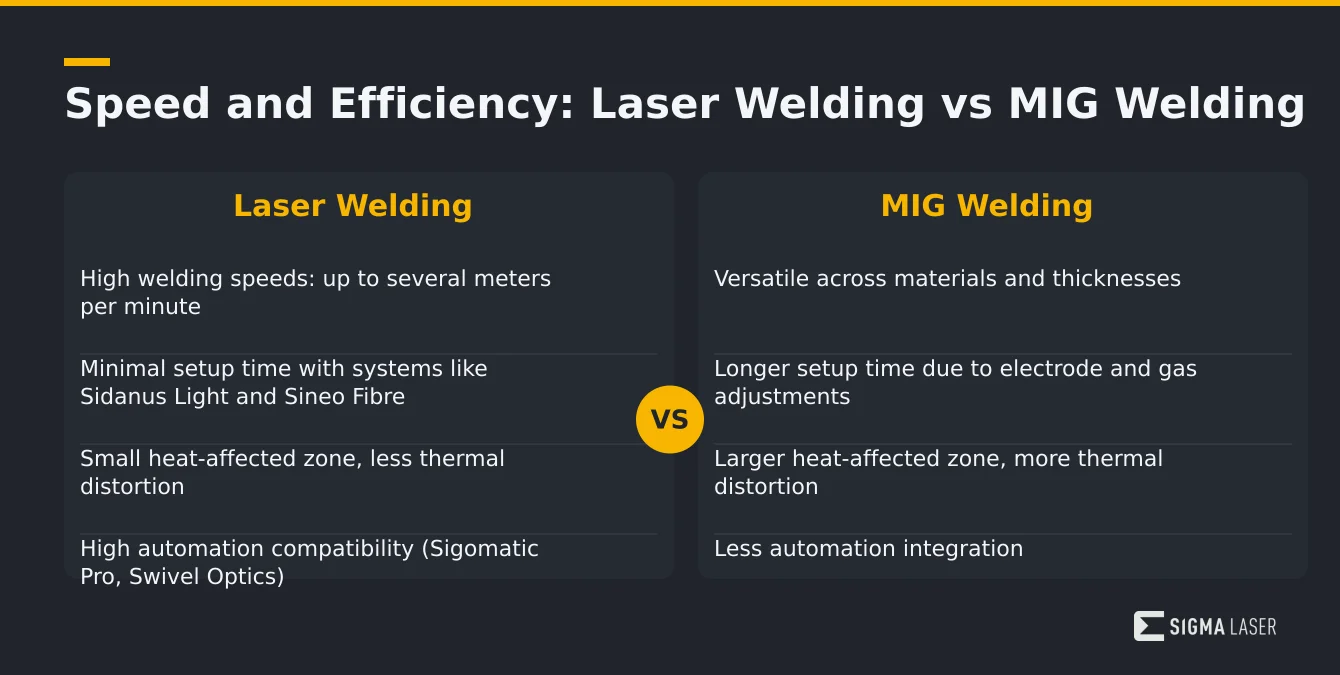
Laser welding, known for its precision and minimal heat-affected zones, offers a distinct advantage in speed. The precision of laser welding systems, such as those engineered by Sigma Laser, allows for rapid, high-quality welds that are especially beneficial in high-volume production environments. Systems like the Sidanus Light and Sineo Fibre are designed to minimize setup time, allowing for quick transitions between different welding jobs, thereby enhancing productivity.
Laser welding typically operates with power levels ranging from a few hundred watts to several kilowatts, with wavelengths commonly around 1064 nm for Nd:YAG and 1070 nm for fibre lasers. This allows for welding speeds of up to several meters per minute, depending on the material and thickness ScienceDirect – Journal of Manufacturing Processes. The heat-affected zone is considerably smaller compared to MIG welding, often resulting in less thermal distortion and higher precision.
On the other hand, MIG welding, or Metal Inert Gas welding, is traditionally valued for its versatility across various materials and thicknesses. While it can handle diverse welding tasks, the setup time for MIG welding can be considerably longer due to the need for electrode and gas adjustments, particularly when switching between different materials or welding conditions.
Automation and Production Throughput
Automation plays a pivotal role in modern manufacturing, and laser welding systems are at the forefront of this trend. Sigma Laser’s advanced options, such as the Sigomatic Pro and Swivel Optics, integrate seamlessly into automated production lines, allowing for continuous operation with minimal human intervention. This capability not only enhances production throughput but also maintains consistent quality, crucial for industries adhering to standards like ISO 9001 and ISO 3834.
Laser welding systems are particularly well-suited for automation due to their ability to maintain high precision and repeatability, often within tolerances of ±0.1 mm, which is essential for applications requiring stringent quality control Welding Journal. This precision is critical when working with advanced materials like high-strength steel alloys and aerospace-grade aluminum.
In contrast, while MIG welding can be automated, its integration into highly automated systems often requires more complex configurations and maintenance. The inherent versatility of MIG welding offers flexibility but can also lead to inconsistencies in production throughput when compared to the streamlined process of laser welding.
Ultimately, when considering laser welding vs MIG welding, the choice boils down to specific production needs. Laser welding offers unmatched speed and automation capabilities, ideal for industries prioritizing high efficiency and precision. Meanwhile, MIG welding provides versatility and adaptability, suited for varied fabrication requirements.
Why Is Laser Welding Known for Precision and MIG Welding for Versatility?
In industrial manufacturing, the choice between laser welding and MIG welding often hinges on the specific requirements of precision and versatility. Sigma Laser’s advanced welding systems, such as the Sidanus Light and Siega Fibre, exemplify the meticulous accuracy achievable through laser welding. Meanwhile, the adaptability of MIG welding makes it a staple in various industrial applications, including those governed by standards from the European Committee for Standardization (CEN) and the American Welding Society (AWS). This section delves into the unique attributes of these welding technologies, highlighting where each excels.
Technical Precision in Laser Welding
Laser welding is synonymous with precision due to its ability to focus energy into a small, concentrated spot. This characteristic is ideal for tasks requiring high accuracy and minimal thermal distortion, such as in the aerospace and medical device industries. Sigma Laser’s Super Pulse Technology (SPT) further enhances this precision by allowing for controlled energy delivery, ensuring consistent weld quality across various materials.
- Material Compatibility: Laser welding is highly effective with metals like aluminum, titanium, and stainless steel, offering superior joint strength and minimal post-processing. It is particularly adept at welding high-strength steel grades and aerospace alloys, where minimal heat-affected zones are critical.
- Joint Types: Capable of welding complex geometries, laser welding is optimal for butt joints, lap joints, and T-joints, providing robust solutions for intricate assemblies. The precision of laser welding allows for tolerances as tight as ±0.1 mm, which is critical in high-precision applications.
- Application Scenarios: Industries such as automotive and electronics leverage laser welding for its precision in manufacturing components where tolerances are tight and repeatability is critical. Laser welding typically achieves penetration depths up to 10 mm depending on the material and power settings.
- Industry Standards: Laser welding processes often comply with standards such as ISO 15614-11:2002, which outlines the qualification of welding procedures for metallic materials ISO 15614-11:2002.
Versatility and Application Scenarios in MIG Welding
MIG welding, known for its versatility, caters to a broad range of materials and thicknesses, making it the preferred choice for diverse welding tasks. Its adaptability is especially beneficial in construction and heavy equipment manufacturing, where different workpiece sizes and joint configurations are common.
- Material Compatibility: MIG welding can effectively join metals like mild steel, stainless steel, and aluminum, accommodating varying thicknesses without compromising weld integrity. It is particularly useful for joining thicker sections where multiple passes might be required.
- Joint Types: Suitable for various joint configurations, including fillet and groove welds, MIG welding offers flexibility in assembly design and execution. It is often used in applications where joint accessibility is limited.
- Application Scenarios: Commonly used in sectors such as shipbuilding and pipeline construction, MIG welding’s ability to handle large-scale projects underlines its practicality and efficiency. The process is governed by standards such as AWS D1.1/D1.1M:2020, which sets the requirements for structural steel welding AWS D1.1/D1.1M:2020.
In conclusion, the decision between laser and MIG welding should be guided by project-specific needs. While laser welding offers unmatched precision, particularly for high-value and high-complexity components, MIG welding provides the versatility required for broader industrial applications. By understanding these distinctions, production managers can make informed decisions that align with their manufacturing objectives.

What Is the Environmental Impact of Laser Welding vs MIG Welding?
In industrial applications, understanding the environmental impact of welding methods is crucial for production managers focused on enhancing sustainability. This section examines the energy consumption, emissions, and waste management associated with laser welding versus MIG welding, offering insights into their environmental considerations.
Energy Consumption and Emissions
Laser welding, known for its precision and efficiency, generally consumes less energy compared to MIG welding. This is due to its focused energy delivery, which minimizes heat input and reduces power requirements. Typically, laser welding systems operate within power ranges of 100 W to several kilowatts, with wavelengths around 1064 nm for Nd:YAG lasers and 1070 nm for fibre lasers. The focused beam quality (M² typically <1.5) allows for high welding speeds of up to 10 m/min, depending on material and thickness, while maintaining a narrow heat-affected zone (HAZ) of less than 1 mm, which reduces thermal distortion. In contrast, MIG welding, appreciated for its versatility, often involves higher energy consumption due to its continuous arc process. Additionally, laser welding produces fewer emissions, as it requires no filler materials and generates minimal spatter. MIG welding, however, can produce significant emissions from shielding gases and spatter, necessitating additional ventilation systems to maintain air quality Welding Journal.
Waste Management and Sustainability
Regarding waste management, laser welding offers distinct advantages. The process is highly efficient, resulting in minimal material waste. This efficiency is further enhanced with Sigma Laser’s advanced technologies like Super Pulse Technology (SPT) and Swivel Optics, which ensure optimal resource utilization. For instance, the Sidanus Fibre model, with its Ytterbium fibre laser, provides high precision and minimal waste due to its spot size variability from 0.1 to 2.0 mm. Conversely, MIG welding generates more waste due to spatter and the consumption of consumables such as wire and shielding gases. These by-products require proper disposal and recycling processes to mitigate environmental impact. By adopting laser welding, manufacturers can better align with sustainability goals by reducing waste and lowering their overall environmental footprint ScienceDirect – Journal of Manufacturing Processes.
In conclusion, laser welding emerges as the more environmentally friendly option compared to MIG welding. With advancements in laser welding precision, manufacturers can achieve both operational efficiency and sustainability, meeting the demands of modern industrial standards like ISO 9001 and ISO 3834 ISO 15614-11:2002.
Frequently Asked Questions
What are the cost implications of laser welding compared to MIG welding?
Laser welding systems typically have higher initial capital costs than MIG welding setups. However, laser welding offers reduced operational costs due to higher precision, lower material waste, and faster processing speeds. Over time, these efficiencies can offset the initial investment, especially in high-volume production environments.
How does the learning curve of laser welding compare to MIG welding?
Laser welding requires more specialized training due to its precision and the technology involved. Operators need to understand laser parameters, material interactions, and safety protocols. MIG welding is generally easier to learn, with a shorter training period, making it more accessible for operators with basic welding experience.
What are the key advantages of laser welding over MIG welding?
Laser welding offers superior precision, minimal heat-affected zones, and high-speed processing. It is ideal for thin materials and complex geometries. Additionally, laser welding can be automated more easily, enhancing repeatability and reducing labor costs in high-volume production.
In what applications is laser welding preferred over MIG welding?
Laser welding is preferred in industries requiring high precision and minimal distortion, such as aerospace, automotive, and electronics. It excels in applications involving thin materials, complex joints, and where aesthetic weld quality is critical.
Can laser welding handle thicker materials as effectively as MIG welding?
While laser welding is highly effective for thin materials, advancements in laser technology, such as hybrid laser-MIG systems, have improved its capability to handle thicker materials. However, for very thick sections, traditional MIG welding may still be more suitable due to its deep penetration capabilities.
What maintenance is required for laser welding systems compared to MIG welding?
Laser welding systems require regular maintenance of optical components, cooling systems, and laser sources to ensure consistent performance. MIG welding systems generally require less frequent maintenance, focusing on consumables like electrodes and gas supplies.
How does energy consumption differ between laser welding and MIG welding?
Laser welding generally consumes less energy per weld due to its efficiency and precision, resulting in reduced energy costs over time. MIG welding, while less efficient, may not significantly impact energy costs in operations where precision and speed are less critical.
Sources
- ISO 15614-11:2002 — Specification and qualification of welding procedures for metallic materials – Welding procedure test – Part 11: Electron and laser beam welding
- AWS D1.1/D1.1M:2020 — Structural Welding Code – Steel, covering MIG welding standards
- DIN EN ISO 4063:2010 — Welding and allied processes – Nomenclature of processes and reference numbers
- Journal of Laser Applications — Peer-reviewed articles on laser applications, including welding technologies
- Welding Journal — Monthly publication by the American Welding Society covering various welding technologies
- ScienceDirect – Journal of Manufacturing Processes — Research articles on manufacturing processes, including welding techniques