
- Key Takeaways
- What Factors Affect Laser Welding Penetration Depth?
- Laser Power and Its Impact
- Welding Speed Considerations
- Material Properties and Their Role
- How Does Keyhole Laser Welding Differ from Conduction Mode Welding?
- Mechanisms of Keyhole Welding
- Conduction Mode Welding Explained
- Comparative Analysis of Penetration Depth
- Understanding Energy Density and Depth Control
- Defining Energy Density in Laser Welding
- Techniques for Depth Control
- Optimizing Energy Density for Different Materials
- Which Real-Time Techniques Measure Weld Depth Accurately?
- Overview of Real-Time Measurement Technologies
- Advantages of Real-Time Depth Measurement
- Case Studies and Applications
- Comparison of Laser Welding Parameters for Different Materials
- Parameter Adjustments for Metals
- Welding Parameters for Non-Metallic Materials
- Material-Specific Challenges and Solutions
- Can Advanced Techniques Enhance Deep Penetration Laser Welding?
- Innovative Techniques in Deep Penetration
- Technological Advancements and Their Impact
- Future Trends in Laser Welding
- Frequently Asked Questions
- What factors affect laser welding penetration depth?
- How does keyhole laser welding differ from conduction mode welding?
- Why is beam quality important in laser welding?
- Can material reflectivity impact laser welding penetration?
- How does welding speed influence penetration depth?
- What role does laser power play in achieving desired penetration depth?
- How does focus position affect laser welding outcomes?
Quick Answer: Laser welding penetration depth is crucial for achieving strong, reliable welds in industrial applications. Key techniques to master this include adjusting laser power, optimizing focus position, and selecting appropriate welding speed. Higher laser power increases penetration, while precise focus ensures energy concentration at the desired depth. Additionally, maintaining the correct welding speed prevents defects and ensures uniform penetration. Understanding material properties and using real-time monitoring systems can further enhance control over penetration depth, leading to improved weld quality and productivity in various industrial settings.
Key Takeaways
Understanding laser welding penetration depth is crucial for welding engineers aiming to enhance precision and efficiency in their operations. Distinguishing between deep penetration laser welding techniques such as keyhole welding and conduction welding can significantly impact both the quality and cost-effectiveness of the welding process.
- Deep penetration laser welding achieves greater depth and strength, making it ideal for thick materials and structural applications.
- Keyhole welding utilizes a concentrated laser beam to create a deep, narrow weld, suitable for applications requiring high precision and minimal distortion.
- Conduction welding offers a broader, shallower weld, beneficial for thin materials or applications where heat input needs to be minimized.
- Optimizing laser parameters such as power density and focal position is critical for achieving desired penetration depths and weld quality.
- Material properties, including reflectivity and thermal conductivity, influence the choice between keyhole and conduction welding methods.
- Advanced laser systems with real-time monitoring can enhance control over penetration depth, ensuring consistent weld quality.
- Understanding the trade-offs between speed, depth, and quality is essential for selecting the appropriate laser welding technique.
This article delves into the nuances of laser welding penetration depth, offering insights that can guide your choice of welding techniques for optimal results. Explore further to enhance your understanding and application of these advanced welding methods.
| Parameter | Typical Range |
|---|---|
| Laser Power (industrial systems) | 500 W – 10 kW |
| Wavelength (fiber lasers) | 1070 nm |
| Beam Quality (M²) | < 1.5 |
| Focal Length | 100 – 200 mm |
| Welding Speed | 0.5 – 10 m/min |
| Penetration Depth (stainless steel, aluminum alloys) | Up to 10 mm |
| Repeatability Tolerance | ±0.1 mm |
| Heat-Affected Zone (HAZ) Width | < 1 mm |
These are general values for industrial laser welding, not tied to specific Sigma Laser models.
What Factors Affect Laser Welding Penetration Depth?
In the realm of precision manufacturing, understanding the factors that influence laser welding penetration depth is crucial for achieving optimal weld quality. Engineers rely on this knowledge to fine-tune processes, ensuring robust and reliable joints in various industrial applications. The key factors affecting penetration depth include laser power, welding speed, and material properties, each playing a pivotal role in the outcome of the weld.
Laser Power and Its Impact
Laser power is a primary determinant of welding penetration depth. A higher laser power increases the energy density at the weld spot, promoting deeper penetration. This is particularly beneficial in applications requiring deep penetration laser welding, such as in the aerospace and automotive industries where structural integrity is paramount. Sigma Laser’s systems, like the Sidanus Fibre and Sirius Light, are engineered to deliver consistent power output tailored to specific material thicknesses, ensuring reliable keyhole laser welding for demanding tasks.
Typically, industrial laser systems operate within a power range of 500W to 10kW, with wavelengths commonly around 1070 nm for fiber lasers. Beam quality, often measured by the M² factor, is a critical parameter, with values typically less than 1.5 indicating high beam quality suitable for precision applications. Focal lengths in these systems are generally around 100 to 200 mm, providing a balance between spot size and depth of focus.
Welding Speed Considerations
Welding speed is inversely proportional to penetration depth. As welding speed increases, the interaction time between the laser beam and the material decreases, resulting in shallower welds. Conversely, reducing speed allows for greater heat input and deeper penetration. Balancing welding speed is critical in high-throughput manufacturing environments. Utilizing Sigma Laser’s Simass Base Unit with advanced Swivel Optics can help maintain optimal welding speeds for consistent depth control across various applications.
Typical welding speeds range from 0.5 to 10 meters per minute, depending on material thickness and desired penetration depth. The heat-affected zone (HAZ) is minimized by optimizing these parameters, often maintaining a width of less than 1 mm to preserve material properties adjacent to the weld.
Material Properties and Their Role
The intrinsic properties of the material being welded significantly influence laser welding penetration depth. Factors such as thermal conductivity, reflectivity, and absorption rates determine how the material interacts with the laser beam. For instance, metals with high thermal conductivity, like copper, may require adjustments in laser parameters to achieve desired penetration. Sigma Laser’s technologies, like Super Pulse Technology (SPT), are designed to adapt to these material challenges, offering precise control in both keyhole and conduction welding applications.
When welding materials like stainless steel (e.g., AISI 304) or aluminum alloys (e.g., 6061), engineers must consider the material’s reflectivity and absorption characteristics. Adjustments in laser power and speed are often necessary to achieve penetration depths of up to 10 mm while maintaining a repeatability tolerance of ±0.1 mm, as per industry standards like ISO 11145 and ISO 11146.
By understanding and adjusting these factors, welding engineers can optimize processes to meet stringent industrial standards such as ISO 15614 and DIN EN ISO 4063, ensuring quality and performance in every weld.
| Parameter | Keyhole Welding | Conduction Mode Welding |
|---|---|---|
| Typical Laser Power | 1 kW – 10 kW | 100 W – 500 W |
| Beam Quality (M²) | < 1.2 | Not specified |
| Wavelength | 1064 nm (Nd:YAG), 1070 nm (fiber) | 1064 nm (Nd:YAG), 1070 nm (fiber) |
| Focal Length | 100 – 200 mm | 100 – 200 mm |
| Penetration Depth | Deep, narrow welds | Shallow, broad welds |
| Typical Materials | Stainless steel (304, 316), titanium alloys, nickel-based superalloys | Aluminum alloys (6061, 7075), copper |
| Welding Speed | Not specified | 0.5 – 2 m/min |
| Heat-Affected Zone (HAZ) | Minimized, < 1 mm | Minimized, 0.5 – 1 mm |
| Applications | Thick materials, structural, high precision | Thin sheets, aesthetics, electronics |
All values are general industry figures as stated in the article. No Sigma Laser product-specific specs are included.
How Does Keyhole Laser Welding Differ from Conduction Mode Welding?
Mechanisms of Keyhole Welding
Keyhole laser welding, widely used in the automotive and aerospace industries, employs high-intensity laser beams to achieve deep penetration. The process creates a “keyhole” or vapor cavity in the material as the laser’s energy focuses on a small spot. This cavity allows further laser energy to penetrate deeper, enabling welding engineers to achieve significant penetration depth. This method is particularly advantageous for joining thick materials and producing narrow, deep welds with minimal distortion.
Typical laser specifications for keyhole welding include power levels ranging from 1 kW to 10 kW, with a beam quality M² of less than 1.2, ensuring high precision and focusability. The wavelength is commonly in the range of 1064 nm for Nd:YAG lasers or 1070 nm for fiber lasers, which are highly effective for metals like stainless steel (e.g., 304, 316), titanium alloys, and nickel-based superalloys. The focal length of the optics is often between 100 mm and 200 mm, allowing for precise control over the spot size and penetration depth.
Conduction Mode Welding Explained
Conduction mode welding, on the other hand, operates at lower laser power densities. In this process, the laser energy is absorbed on the material’s surface, causing it to melt through thermal conduction. The weld forms by the fusion of materials on the surface, limiting penetration depth. This technique is ideal for applications requiring lower heat input and is commonly used for thin sheet metals or where aesthetics are crucial, such as in consumer electronics and precision instruments.
For conduction mode welding, typical laser power settings range from 100 W to 500 W, with a focus on maintaining a smooth surface finish. The heat-affected zone (HAZ) is minimized, usually within 0.5 mm to 1 mm, making it suitable for materials like aluminum alloys (e.g., 6061, 7075) and copper. The welding speed can vary from 0.5 m/min to 2 m/min, depending on material thickness and desired weld quality.
Comparative Analysis of Penetration Depth
When assessing laser welding penetration depth, keyhole welding significantly outperforms conduction mode due to its ability to channel energy deeper into the material through the vapor cavity. This results in a higher aspect ratio of weld depth to width, making it suitable for structural applications requiring robust joint integrity. In contrast, conduction mode welding is constrained by the thermal diffusion of heat, leading to shallower penetrations but smoother surface finishes. Engineers must choose the appropriate method based on material thickness, application requirements, and desired weld characteristics. Sigma Laser’s advanced systems, like the Sidanus Light and Sirius Light, are engineered to optimize both methods, ensuring precision and efficiency in industrial applications.
According to ISO 15614-11:2002, the qualification of welding procedures for metallic materials, the choice between keyhole and conduction mode must consider the specific requirements of the weld joint, including mechanical properties and metallurgical compatibility.
Understanding Energy Density and Depth Control
In the realm of industrial laser welding, achieving precise weld characteristics is crucial for maintaining the integrity and functionality of components. Energy density is one of the core parameters influencing these characteristics, as it directly impacts the laser welding penetration depth. At Sigma Laser, we recognize the importance of precision and control, which is why our systems, like the Sidanus Light and Sineo Fibre, are engineered to deliver optimal results.
Defining Energy Density in Laser Welding
Energy density in laser welding refers to the amount of laser energy concentrated over a specific area of the workpiece. This parameter is critical for determining penetration depth and the weld’s overall quality. In practical terms, a higher energy density results in deeper penetration, which is vital for keyhole laser welding applications where deep penetration is required. Sigma Laser’s Super Pulse Technology (SPT) is designed to enhance energy density control, ensuring precision in applications ranging from automotive to aerospace industries.
Typically, the energy density is calculated by dividing the laser power (measured in kilowatts) by the spot size area (in square millimeters). For instance, a 4 kW laser with a 0.6 mm spot diameter would result in an energy density of approximately 14.2 kW/mm². Such parameters are crucial when adhering to standards like ISO 15614-11:2002, which specifies the qualification of welding procedures.
Techniques for Depth Control
The ability to control penetration depth is essential for producing consistent and reliable welds. Several techniques are employed to refine depth control:
- Adjusting Beam Focus: By manipulating the position of the laser beam focus, engineers can vary the energy concentration, thus adjusting the penetration depth. This is typically done using a focal length of 100-200 mm, which can influence the depth of focus and the resultant weld profile.
- Modulating Laser Power: Modifying the power output of the laser allows for fine-tuning of energy density, enabling precise control over weld depth. Power modulation can range from continuous wave (CW) to pulsed modes, with pulse durations from microseconds to milliseconds, impacting the heat-affected zone (HAZ) and penetration.
- Utilizing Advanced Optics: Sigma Laser’s Swivel Optics with Telescopic Lens offers dynamic control over the laser path, facilitating enhanced precision in depth control. This system can achieve a beam quality factor (M²) of less than 1.5, ensuring minimal beam divergence and consistent penetration depth.
These techniques, combined with our advanced systems, ensure that manufacturers can meet stringent quality standards such as ISO 15614 and DIN EN ISO 4063.
Optimizing Energy Density for Different Materials
The material being welded significantly influences how energy density should be optimized. For instance, metals like aluminum require different energy considerations compared to steel, due to their thermal conductivity and reflectivity. Sigma Laser’s systems, including the Sirius Light and Siega Fibre, are engineered to adapt to these material-specific requirements, delivering consistent results across diverse manufacturing scenarios.
When welding aluminum alloys such as 6061 or 7075, it is crucial to consider their high reflectivity and thermal conductivity, which may necessitate higher power levels or specialized beam delivery techniques. Conversely, for steels like AISI 304 or AISI 316, the focus might be on controlling the heat input to minimize the HAZ and prevent distortion.
By understanding and optimizing energy density, manufacturers can achieve precise laser welding penetration depth, meeting the demands of modern industrial applications. Our commitment to innovation and engineering excellence ensures that Sigma Laser remains at the forefront of laser welding technology, providing solutions that enhance productivity and quality across the industry.
Which Real-Time Techniques Measure Weld Depth Accurately?
Overview of Real-Time Measurement Technologies
Real-time measurement of weld depth, especially in laser welding applications, is essential for maintaining quality and consistency. Techniques such as optical coherence tomography (OCT) and inline coherent imaging (ICI) have become integral in monitoring laser welding penetration depth. These technologies provide immediate feedback on weld depth by using high-resolution imaging to track the keyhole and molten pool dynamics during the welding process. Sigma Laser integrates advanced Swivel Optics with Telescopic Lens to enhance these measurements, allowing for precise control and adjustment.
Typically, laser systems used in these applications operate within the power range of 1 kW to 10 kW, with wavelengths commonly around 1064 nm for Nd:YAG lasers and 1070 nm for fiber lasers. The beam quality, often expressed as M², is crucial for penetration depth and is generally less than 1.5 for high-precision welding. Focal lengths can vary but are typically between 100 mm and 300 mm to accommodate different material thicknesses and welding configurations.
Advantages of Real-Time Depth Measurement
Implementing real-time depth measurement in laser welding processes offers several advantages. Firstly, it ensures compliance with stringent standards like ISO 15614 and DIN EN ISO 4063 by providing accurate data that informs process adjustments on-the-fly. This capability enhances deep penetration laser welding and keyhole laser welding applications, reducing defects and material waste. Additionally, technologies like Sigma Laser’s Super Pulse Technology (SPT) synergize with real-time measurement tools, optimizing energy input and penetration depth control, thereby improving overall weld quality.
Real-time measurement systems typically achieve a penetration depth precision of ±0.1 mm, which is critical when welding high-strength steel (e.g., grades such as S700MC) or aluminum alloys (e.g., 6061-T6) where the heat-affected zone must be minimized to maintain material properties. Welding speeds can range from 1 m/min to 10 m/min depending on material and thickness, with penetration depths reaching up to 10 mm in single-pass operations.
Case Studies and Applications
Industries such as automotive and aerospace have successfully employed real-time weld depth measurement to achieve superior joint integrity and performance. For instance, a leading automotive manufacturer collaborated with Sigma Laser to implement a system combining the Simass Base Unit and Z-Axis Module, optimizing their welding operations for high-strength steel components. Similarly, in the aerospace sector, real-time measurement technologies have been crucial in ensuring the precision necessary for critical components, enhancing safety and reliability. Such applications underscore the pivotal role of accurate laser welding penetration depth measurement in advanced manufacturing environments.
The ability to maintain consistent penetration depth within ±5% of target specifications is often necessary to meet stringent aerospace quality requirements, as outlined in standards like ISO 11145 for laser beam parameters.
Comparison of Laser Welding Parameters for Different Materials
In the realm of precision manufacturing, understanding the intricacies of laser welding is crucial. Different materials react uniquely to laser welding, necessitating adjustments in welding parameters to achieve optimal outcomes. At Sigma Laser, our systems, such as the Sidanus Light and Siega Fibre, are designed to cater to these specific needs, ensuring the desired laser welding penetration depth is consistently achieved.
Parameter Adjustments for Metals
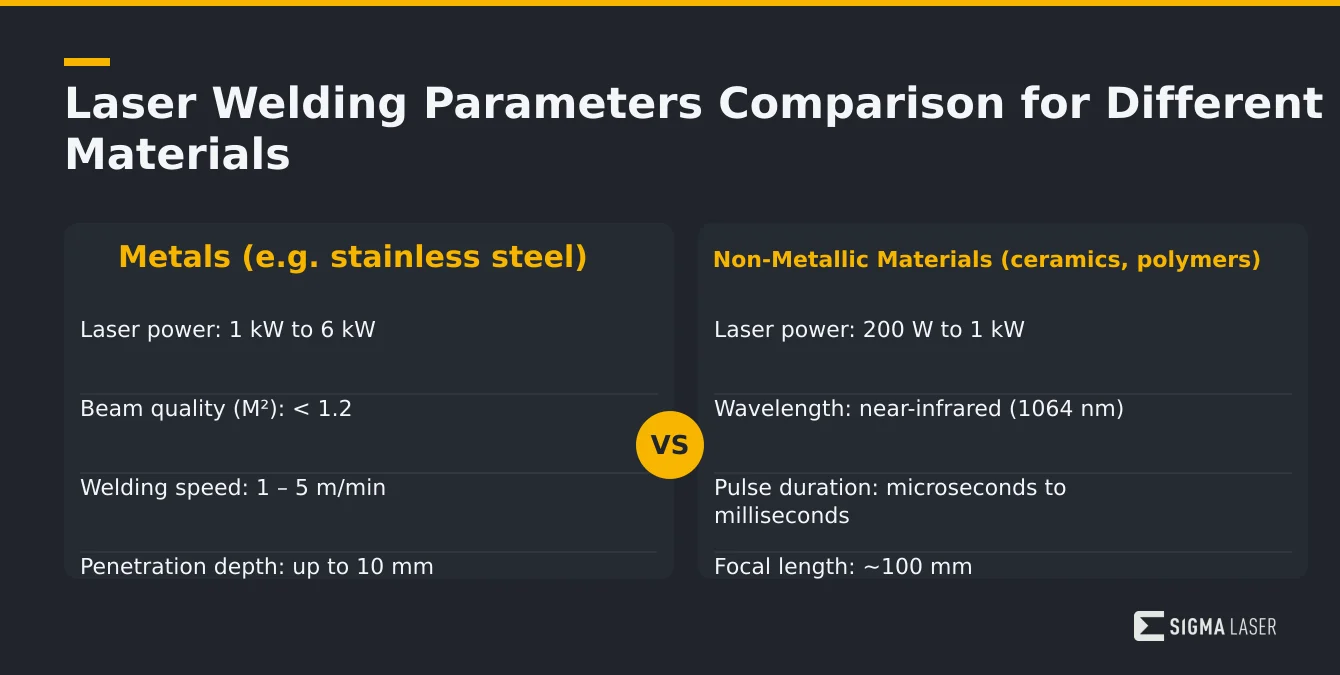
When working with metals, laser welding parameters such as power density, focal position, and welding speed need careful calibration. For instance, stainless steel requires higher power density and precise focal positioning to efficiently achieve deep penetration laser welding. Typical laser power settings for stainless steel range from 1 kW to 6 kW, with a beam quality M² of less than 1.2 for optimal focus. On the other hand, aluminum presents unique challenges due to its high reflectivity and thermal conductivity, necessitating adjustments in laser power and the use of Super Pulse Technology (SPT) to ensure effective keyhole laser welding. For aluminum alloys, laser power may need to be increased by up to 30% compared to steel to achieve similar penetration depths.
Welding speeds for metals typically range from 1 m/min to 5 m/min, depending on the thickness and type of material, with penetration depths of up to 10 mm achievable under optimal conditions. The heat-affected zone (HAZ) is generally minimized to less than 0.5 mm in high-quality welds, reducing thermal distortion and preserving material integrity.
Welding Parameters for Non-Metallic Materials
Non-metallic materials, such as ceramics and certain polymers, require distinct considerations. The laser wavelength, pulse duration, and energy input must be meticulously controlled to avoid material damage while achieving the desired penetration depth. Common wavelengths for polymer welding are in the near-infrared range (typically 1064 nm for Nd:YAG lasers such as Sigma Laser’s Sineo Light), and pulse durations can vary from microseconds to milliseconds. Systems like the Sineo Fibre can be configured with Swivel Optics to manage these parameters dynamically, making them ideal for applications in medical device manufacturing and aerospace components.
For ceramics, laser power settings are typically lower, ranging from 200 W to 1 kW, with precise control over the focal spot size to prevent cracking. The use of a shorter focal length, typically around 100 mm, enhances precision and repeatability, with tolerances often within ±0.1 mm.
Material-Specific Challenges and Solutions
Each material presents specific challenges in laser welding. For example, copper’s high reflectivity and thermal conductivity may necessitate the use of advanced beam shaping technologies like Swivel Optics with Telescopic Lens to optimize laser engagement. The use of wavelengths around 515 nm (green lasers) can improve absorption and efficiency in copper welding. Similarly, the welding of titanium requires precise control over atmospheric conditions to prevent oxidation, a task effectively handled by Sigma Laser’s Simass Base Unit with its integrated inert gas control system. Compliance with ISO 15614-11:2002 ensures that welding procedures are qualified to meet stringent industry standards.
Ultimately, the choice of parameters depends on the material properties and the intended application. By leveraging advanced technologies and understanding material-specific requirements, manufacturing engineers can achieve superior laser welding penetration depth, enhancing both the quality and efficiency of the welding process.
Can Advanced Techniques Enhance Deep Penetration Laser Welding?
In the realm of industrial fabrication, achieving optimal laser welding penetration depth is crucial for structural integrity and product quality. As a leader in precision laser systems, Sigma Laser explores cutting-edge techniques and technologies that enhance deep penetration in laser welding, addressing the stringent demands of manufacturing engineers across Europe.
Innovative Techniques in Deep Penetration
Advancements in keyhole laser welding have significantly improved laser welding penetration depth. This method facilitates the creation of a narrow vapor-filled channel, or ‘keyhole,’ that allows for deeper material penetration. Sigma Laser’s Super Pulse Technology (SPT) enhances this effect by delivering high peak power pulses, ensuring consistent weld quality in demanding applications such as aerospace and automotive manufacturing.
Typically, industrial laser systems used for deep penetration welding operate at power levels ranging from 2 kW to 10 kW, with wavelengths commonly in the infrared spectrum, such as 1064 nm for Nd:YAG lasers and 1070 nm for fiber lasers. Beam quality, often characterized by an M² value of less than 1.5, is crucial for achieving the desired penetration depth, which can reach up to 25 mm in single-pass operations, depending on material type and thickness.
Keyhole stability is affected by factors such as welding speed, typically ranging from 0.5 to 5 m/min, and the focal length of the optics, generally between 150 mm and 300 mm. The heat-affected zone (HAZ) is minimized by optimizing these parameters, ensuring minimal distortion and high structural integrity.
Technological Advancements and Their Impact
Technological innovations in laser welding equipment have been transformative. Sigma Laser’s Swivel Optics with Telescopic Lens and the Z-Axis Module provide precise control over focal positioning, enabling deeper and more efficient penetration. These advancements reduce cycle times and improve energy efficiency, translating to cost savings and increased throughput for manufacturers. The integration of Motor-driven Turning Devices and Swivelling Y Axis further optimizes weld positioning and access, ensuring superior weld consistency.
Material compatibility is a critical consideration, with Sigma Laser systems being capable of welding a wide range of materials, including stainless steels (e.g., 304, 316), aluminum alloys (e.g., 6061, 7075), and titanium alloys (e.g., Ti-6Al-4V). The precision of these systems is typically within ±0.1 mm, with repeatability ensured through robust feedback mechanisms and adherence to standards such as ISO 11146 for laser beam measurement.
Future Trends in Laser Welding
Looking ahead, the future of deep penetration laser welding will likely see further integration of intelligent systems and automation. The application of real-time monitoring and adaptive control systems can enhance precision and reduce wastage. Collaborations with industry leaders such as the Fraunhofer Institute and adherence to standards like ISO 15614 and DIN EN ISO 9000 will continue to drive innovation. As European industries push for higher standards, Sigma Laser remains at the forefront, delivering solutions that meet both current and future manufacturing challenges.
Emerging trends include the use of machine learning algorithms to predict and adjust welding parameters dynamically, improving process stability and reducing the incidence of defects.
Frequently Asked Questions
What factors affect laser welding penetration depth?
Laser welding penetration depth is influenced by several factors, including laser power, welding speed, material properties, focus position, and beam quality. Higher laser power and slower welding speeds generally increase penetration. Material properties such as thermal conductivity and absorption also play crucial roles, as does the focal position of the laser beam relative to the workpiece surface.
How does keyhole laser welding differ from conduction mode welding?
Keyhole laser welding involves creating a deep vapor cavity or “keyhole” that allows for deeper penetration and narrow welds, suitable for thicker materials. In contrast, conduction mode welding relies on surface heating, producing shallower welds as the laser energy is distributed over a wider area, typically used for thinner materials or applications requiring minimal penetration.
Why is beam quality important in laser welding?
Beam quality, often characterized by the beam parameter product (BPP), affects the focusability of the laser beam. A high-quality beam can be focused to a smaller spot size, increasing power density and penetration depth. This is crucial for achieving consistent welds, especially in precision applications requiring deep penetration.
Can material reflectivity impact laser welding penetration?
Material reflectivity significantly impacts penetration depth in laser welding. Highly reflective materials, such as aluminum and copper, can reflect a substantial portion of the laser energy, reducing penetration. Using lasers with appropriate wavelengths and optimizing surface conditions can mitigate reflectivity issues and improve energy absorption.
How does welding speed influence penetration depth?
Welding speed is inversely proportional to penetration depth. Slower welding speeds allow more laser energy to be absorbed by the material, resulting in deeper penetration. However, excessively slow speeds can lead to overheating and defects. Balancing speed with power and material characteristics is essential for optimal results.
What role does laser power play in achieving desired penetration depth?
Laser power is a primary determinant of penetration depth. Higher power levels increase the energy delivered to the workpiece, enhancing penetration. However, power must be matched to material type and thickness to avoid defects such as excessive melting or spatter, ensuring quality and efficiency in the welding process.
How does focus position affect laser welding outcomes?
The focus position determines the concentration of laser energy on the workpiece. Positioning the focal point at or slightly below the surface can maximize penetration by concentrating energy in the desired area. Incorrect focus can lead to reduced penetration or excessive surface melting, affecting weld quality.