Sigma Laser GmbH is a trusted manufacturer of high-performance laser welding systems for industrial applications. Since 2005, we have been delivering precision, innovation, and reliability to industries worldwide.
Die Sigma Laser GmbH ist ein vertrauenswürdiger Hersteller von Hochleistungs-Laserschweißsystemen für industrielle Anwendungen. Seit 2005 stehen wir weltweit für Präzision, Innovation und Zuverlässigkeit.
A Sigma Laser GmbH é uma fabricante confiável de sistemas de soldagem a laser de alto desempenho para aplicações industriais. Desde 2005, somos reconhecidos mundialmente por nossa precisão, inovação e confiabilidade.
Sigma Laser GmbH es un fabricante de confianza de sistemas de soldadura láser de alto rendimiento para aplicaciones industriales. Desde 2005, hemos proporcionado precisión, innovación y fiabilidad a industrias de todo el mundo.
Contacts
Location
Pfaffenbrunnen Str. 158, 63456 Hanau-Steinheim
Germany
Find the Right Laser Welding System for Your Application — Not Just Specifications
From mold repair to high-precision manufacturing, Sigma Laser helps you identify the optimal welding solution based on your materials, geometry, and production requirements , with engineering-level accuracy.
🗸 No obligation 🗸 Response within 24 hours 🗸 Your data stays confidential
airbus logo customer
siemense logo customer
kopp logo customer
opel logo customer
diehl logo customer
vossloh schwabe logo customer
gruner logo customer
continental logo customer
saint gobain logo customer
Find the Right Laser Welding Solution for Your Industry
Sigma Laser systems are engineered to solve highly specific industrial welding challenges, from micro-scale precision welding to large-scale component repair.
Explore key applications below to identify the optimal laser welding technology based on your materials, geometry, and production requirements.
Mold & Tool Making and Repair
Challenges:
Heat-sensitive tool steels (e.g. 1.2379, H13)
Risk of distortion and cracking
High cost of downtime in injection molding environments
Laser Welding Solution: Pulsed Nd:YAG systems with high pulse peak power enable localized energy input, minimizing thermal impact while maintaining metallurgical integrity. With Super Pulse Technology (SPT), heat input is precisely controlled at microsecond scale, significantly reducing microcracks and residual stress.
Laser Welding Solution: Fibre laser systems provide extremely small focus diameters and stable beam quality, enabling high-precision welds with minimal thermal distortion. Ideal for micro welding applications requiring repeatability and clean seams.
Recommended Systems:
Sidanus Fibre → precision and efficiency in controlled environments
Aerospace & High-Performance Materials
Challenges:
Welding of high-performance alloys (e.g. Inconel, titanium)
Strict structural integrity requirements
Sensitivity to heat input and cracking
Laser Welding Solution: Advanced pulsed systems with SPT-controlled energy input enable stable welding of difficult materials. Controlled cooling rates (t8/5) ensure optimal microstructure and mechanical properties.
Laser Welding Solution: Compact and mobile laser systems with extended reach allow in-position welding without dismantling components. Ensures reduced downtime and increased operational efficiency.
Laser Welding Solution: Combination of fibre laser systems (cw mode) for production and pulsed systems for tooling repair. Supports both mass production and maintenance workflows.
Not Sure Which Laser Welding System Fits Your Application?
Get an expert-backed recommendation tailored to your exact welding needs — from repair to production.
Match Your Application with the Right Laser Welding System
Choosing the right laser welding system is not about specifications alone — it’s about aligning the system architecture with your application requirements, material behavior, and production environment.
The matrix below provides a clear, application-driven overview of the most suitable Sigma Laser systems.
Not Sure Which Laser Welding System Fits Your Application?
Get an expert-backed recommendation tailored to your exact welding needs — from repair to production.
Engineering the Difference in Laser Welding Performance
Not all laser welding systems are built the same. At Sigma Laser, performance is not defined by power alone, but by how precisely energy is controlled, delivered, and adapted to the material.
Our systems are engineered around three core technological pillars:
Twin Lamp Cavity (TLC)
Higher Pulse Peak Power with Improved Stability
The Challenge: Conventional single-lamp systems suffer from:
Uneven energy distribution
Thermal gradients in the melt pool
Increased mechanical stress on optical components
Sigma Laser Solution: The Twin Lamp Cavity (TLC) design uses two synchronized flash lamps to generate the laser beam.
Key Advantages:
Higher pulse peak power at the same average power
Homogeneous energy distribution in the laser crystal
Reduced thermal stress and longer component lifetime
Result:
More stable welding process
Improved repeatability
Enhanced system durability
Super Pulse Technology (SPT)
Microsecond-Level Control of Heat Input
The Challenge: In laser welding, excessive or poorly controlled heat input leads to:
Grain coarsening
Reduced toughness
Hot cracking and residual stress
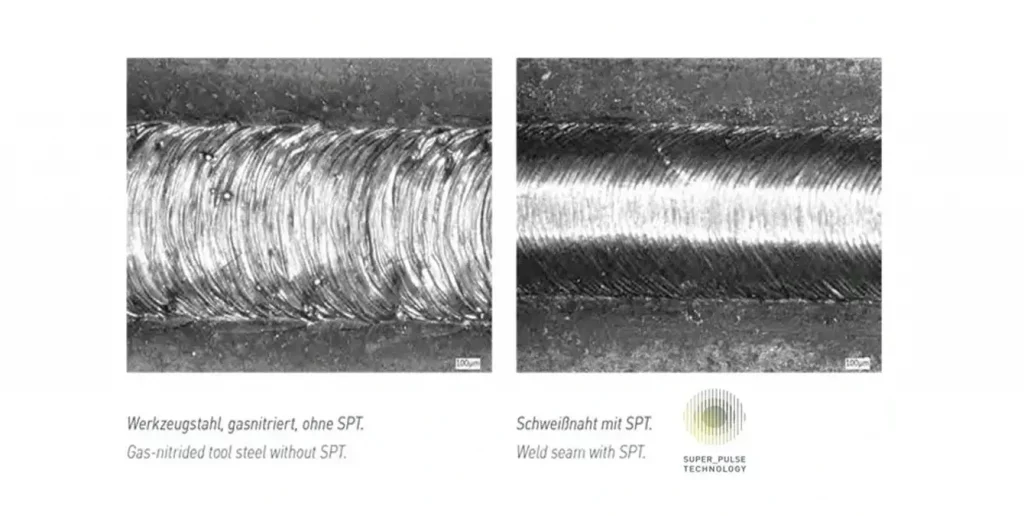
Sigma Laser Solution: Super Pulse Technology (SPT) enables dynamic modulation of each individual pulse at microsecond scale.
This allows:
Precise control of energy input per unit length
Optimization of cooling behavior (t8/5 time)
Stable weld pool dynamics
Result:
Finer microstructure
Higher ductility
Significantly reduced crack formation
Superior weld seam quality — even in difficult materials (e.g. Inconel, tool steels)
Fiber Laser Technology
Efficiency, Precision, and Continuous Operation
The Challenge: Industrial production environments require:
High throughput
Low maintenance
Consistent weld quality
Sigma Laser Solution: Fibre laser systems provide:
High electrical-to-optical efficiency (>20%)
Extremely small focus diameters
Stable beam quality for automation
Capabilities:
Continuous wave (cw) mode for deep penetration and speed
Pulsed mode for precision applications
Integration into automated production lines
Result:
Reduced operating costs
Increased productivity
Reliable performance in serial manufacturing
Instead of forcing a single technology across all applications, Sigma Laser provides application-specific optimization:
Repair & critical materials → Pulsed systems with SPT
The best laser welding system for mold repair is typically a pulsed Nd:YAG laser system, as it allows precise control over heat input. Systems like Sineo Light are ideal for repairing crack-sensitive tool steels with minimal distortion.
Choosing the right system depends on three key factors: material type, application environment, and production requirements. For example, fibre laser systems are ideal for high-speed production, while pulsed systems are better for precision repair and delicate materials.
Fibre laser systems offer high efficiency, low maintenance, and fast processing speeds, making them suitable for production environments. Nd:YAG pulsed systems provide better control over heat input, making them ideal for repair applications and high-alloy materials.
For medical and micro welding applications, fibre laser systems are typically preferred due to their small focus diameter and high precision, allowing clean welds on thin and delicate components.
Yes, laser welding is highly suitable for aerospace materials such as titanium and Inconel. Advanced pulsed systems with precise energy control ensure high-quality welds with minimal risk of cracking or distortion.
Yes, mobile laser welding systems are specifically designed for on-site repair of large or immovable components, reducing downtime and eliminating the need for disassembly.
Laser welding is one of the most precise welding methods available, with high control over energy input and weld geometry, making it ideal for applications requiring tight tolerances and high-quality seams.