
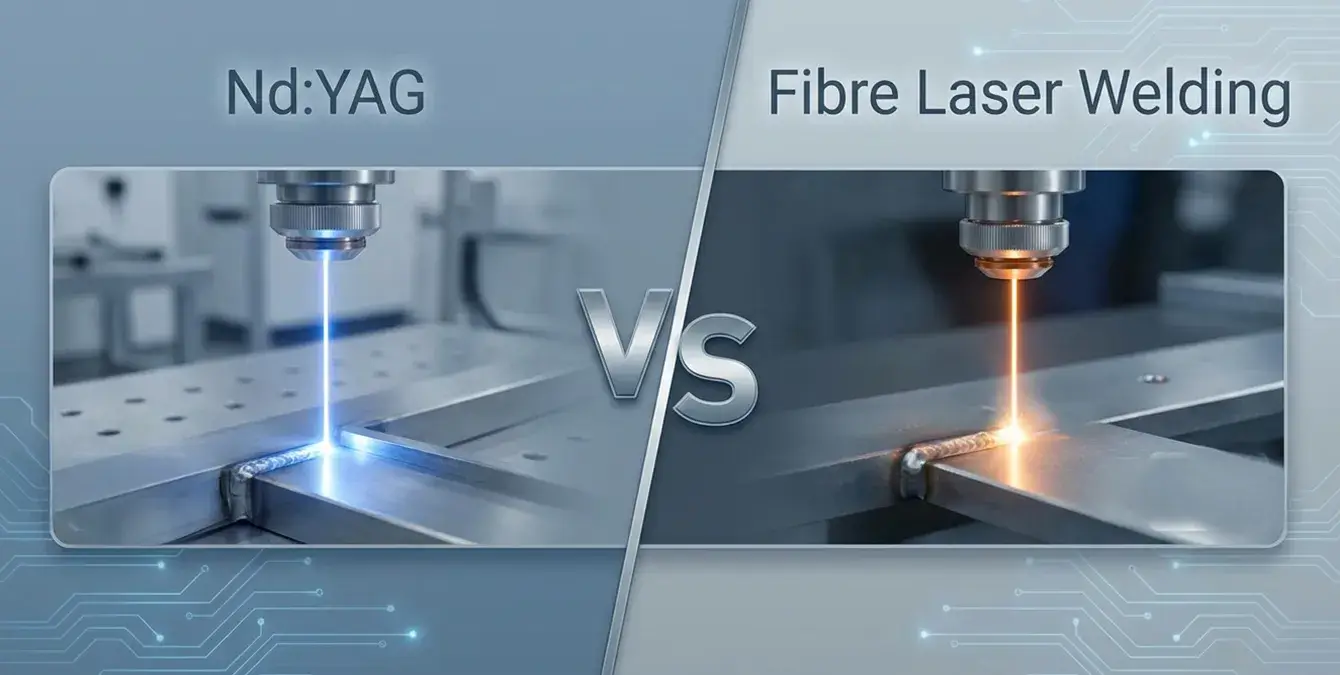
Unraveling the Complexities of Nd:YAG vs Fibre Laser Welding
In the realm of industrial laser welding, distinguishing between Nd:YAG and fibre lasers demands a keen understanding of technical nuances and long-term economic implications. As manufacturers face the evolving landscape of laser welding applications, choosing the optimal laser type is not merely a matter of preference but a critical business decision. This choice centers around not only the quality and speed of welds but also cost-efficiency and maintenance needs over time.
As industries steadily lean towards more sustainable and efficient practices, the spotlight often falls on laser technology. Fibre lasers have become increasingly prominent, celebrated for their speed and energy efficiency, making them ideal for high-volume production settings. In contrast, the precision offered by Nd:YAG lasers continues to find favor in applications demanding meticulous detail, such as micro welding. This juxtaposition highlights the specialized strengths each laser type brings to the table, creating a dynamic tapestry of options for industrial professionals.
This comprehensive analysis ventures into the nuanced intricacies of Nd:YAG vs fibre laser welding. Readers will gain insights into how energy efficiency transforms operational strategies, the trade-offs in welding speed and quality, and the maintenance demands intrinsic to each laser type. Additionally, uncovering the real-world implications of these factors will illuminate the path toward making informed, strategic decisions that resonate with the specific needs of diverse industrial landscapes.
markdown
In the domain of industrial welding, the choice between Nd:YAG and fibre lasers hinges on a complex interplay of technical specifications, welding performance, and long-term costs. This article delves into a detailed comparison of these two laser types, providing critical insights for industry professionals seeking cost-effective and efficient solutions.
- Technical prowess differs significantly: Nd:YAG lasers excel in precision and are preferred for micro welding applications, while fibre lasers offer superior beam quality and are better suited for high-speed welding of thicker materials.
- Welding speed and quality trade-offs: Fibre lasers generally provide faster welding speeds and improved quality for many industrial applications, though Nd:YAG lasers still hold an edge in specific niche uses requiring pinpoint precision.
- Cost-effectiveness lies in the details: Though initial investment may be higher for fibre lasers, their lower maintenance requirements and reduced energy consumption make them more cost-effective over the long term in industrial settings.
- Energy efficiency transforms operational dynamics: Fibre lasers typically consume less energy than Nd:YAG lasers, offering significant savings on operational costs and a smaller environmental footprint.
- Application-specific suitability: Each laser type excels in different contexts—Nd:YAG lasers are unrivaled in achieving high accuracy in challenging conditions, whereas fibre lasers are optimal for high-volume production thanks to their rapid processing capabilities.
- Maintenance considerations impact feasibility: Fibre lasers’ solid-state nature entails less maintenance and downtime, unlike Nd:YAG lasers, which require regular servicing due to their complex setup and flashlamp replacements.
- Long-term investment implications: While Nd:YAG lasers may provide a lower initial cost, fibre lasers’ durability and efficiency contribute to greater overall investment returns and sustainability.
This analysis of Nd:YAG and fibre lasers in industrial welding showcases not just the mechanical and technological dynamics at play, but also underscores the importance of considering long-term cost and efficiency impacts. Exploring these factors will guide your decision-making toward selecting the optimal laser technology for your specific industrial needs.
Technical Characteristics of Nd:YAG Lasers
Precision and Detail in Micro Welding
Nd:YAG lasers are renowned for their precision in micro welding applications, a critical requirement in industries where fine detail and accuracy are paramount. The solid-state nature of Nd:YAG lasers ensures a tightly concentrated beam, allowing for intricate welding tasks that demand meticulous precision. This capability is particularly advantageous in the electronics and medical device sectors, where the weld seams must maintain strict tolerances.
Moreover, the high pulse energy characteristic of Nd:YAG lasers enhances welding accuracy, while reducing thermal distortion and ensuring minimal impact on surrounding materials. This ability to execute precision welding with superior control has established the Nd:YAG laser as a preferred tool for projects requiring exacting detail.
Technical Specifications and Applications
The efficiency of Nd:YAG vs fibre laser welding largely depends on the specific industrial application. Nd:YAG lasers operate at a wavelength of 1064 nm, which is particularly well-suited for welding reflective metals such as copper and aluminum. This versatility in handling diverse materials is one of the significant Nd:YAG laser efficiencies, making it indispensable for various industrial applications.
In terms of energy consumption, Nd:YAG lasers typically exhibit higher energy requirements compared to fibre lasers, which can impact operational costs. However, their capability to deliver peak power in pulsed modes makes them ideal for applications where concentrated bursts of power are necessary.
Nd:YAG lasers also retain a robust ability to perform at different scales, from delicate micro welding to more substantial industrial tasks. The laser’s adaptability is further enhanced by its proven integration into automated processes, which increases productivity while maintaining high welding quality.
For those considering the best laser for industrial welding, the choice between Nd:YAG and fibre lasers should consider both initial investment and operational efficiency. Extensive industrial laser welding comparisons suggest that Nd:YAG lasers offer unique advantages in applications demanding precision and versatility.

Fibre Lasers: A Paradigm Shift in Industrial Welding
Beam Quality and High-Speed Capabilities
Fibre lasers have revolutionized the field of industrial welding due to their superior beam quality and high-speed capabilities. The high beam quality of fibre lasers allows for precise and consistent welding, which is paramount for applications requiring high precision, such as micro welding applications. This precision offers a significant advantage over other laser types, including Nd:YAG lasers, particularly when there is a need for detailed work in confined spaces.
The high-speed capabilities of fibre lasers make them ideal for high-volume production environments. With their ability to operate at greater speeds without compromising quality, fibre lasers enhance productivity and reduce cycle times, an essential factor in competitive industrial settings. Moreover, their adaptability to different welding materials and conditions further underlines the fiber laser welding advantages in modern manufacturing processes.
Energy Efficiency and Production Benefits
One of the key benefits of fibre lasers in the industrial welding sector is their exceptional energy efficiency. Unlike traditional Nd:YAG lasers, fibre lasers convert more electrical energy into laser light, thereby minimizing energy loss. This efficiency translates into lower operational costs and reduced environmental impact, crucial considerations in today’s energy-conscious manufacturing environments.
Moreover, the efficient energy use of fibre lasers supports sustainable production practices without sacrificing performance. The decreased energy consumption not only leads to cost savings but also aligns with global sustainability goals, making fibre lasers a preferred choice in many industries. For readers seeking an in-depth analysis, refer to efficiency of Nd:YAG vs fibre lasers.
These production benefits highlight the role of fibre lasers as a transformative force in industrial welding, offering a competitive edge through their unparalleled efficiency and flexibility. This makes them particularly suitable for companies aiming to enhance their manufacturing processes while maintaining high standards of welding precision and quality.
Welding Speed and Quality: Nd:YAG vs Fibre Lasers
Comparative Analysis of Welding Speed
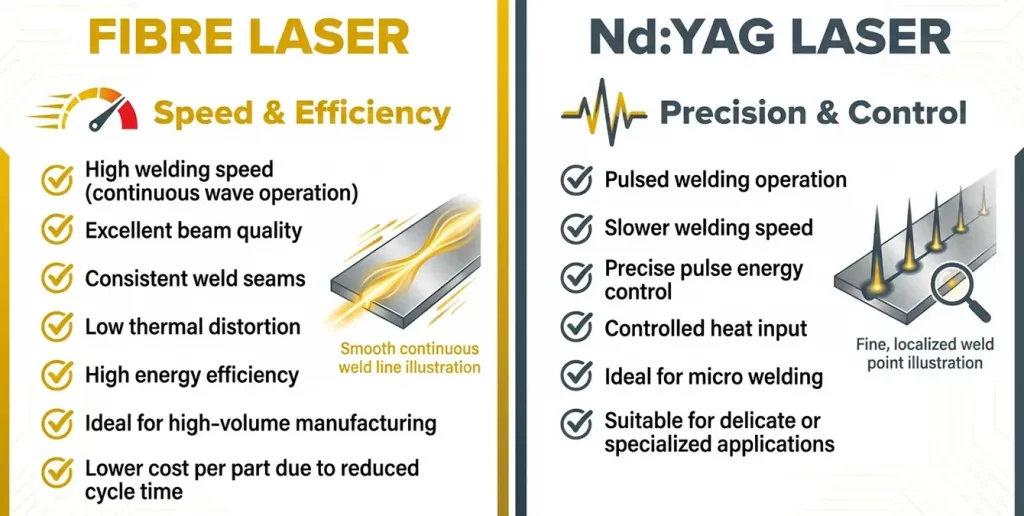
In the debate of Nd:YAG vs fibre laser welding, welding speed is a crucial factor for industries aiming to maximize efficiency. Fibre lasers are renowned for their high-speed welding capabilities. These lasers leverage their continuous wave operation and excellent beam quality to achieve rapid welding speeds, which is particularly advantageous in high-volume manufacturing environments.
In contrast, Nd:YAG lasers, which often operate in pulsed mode, have a slower welding speed. However, their precision and ability to control pulse parameters can be beneficial in specific applications such as micro welding where speed is less critical than precision.
When considering which laser is more cost-effective for industrial welding, the increased speed of fibre lasers often translates into lower operational costs due to reduced cycle times. This efficiency can outweigh the initial investment, making fibre lasers a preferred choice for many industrial settings focused on rapid production.
Assessing Welding Quality and Precision
Welding quality and precision are paramount for achieving high standards in finished products. Fibre lasers generally offer superior welding quality due to their beam quality and the ability to produce consistent welds with minimal thermal distortion. This attribute makes them ideal for applications requiring high welding precision and quality, such as in the automotive and aerospace industries.
Nd:YAG lasers, on the other hand, excel in scenarios where precise control of energy input is necessary. Their ability to deliver energy in short, controlled pulses allows for meticulous control of heat input, which is beneficial in delicate welding operations like those found in micro welding applications.
The choice between Nd:YAG and fibre lasers also involves evaluating energy efficiency. The efficiency of Nd:YAG vs fibre lasers often leans towards fibre lasers, which have lower energy consumption due to their more efficient light conversion mechanisms. This can result in substantial cost savings, particularly in large-scale industrial applications.
- Fibre lasers: high-speed, high-quality welds, efficient energy use.
- Nd:YAG lasers: precise control, suitable for specialized applications.
Ultimately, the decision between Nd:YAG and fibre laser welding should be guided by the specific industrial laser welding comparison needs and the trade-offs acceptable in terms of speed, precision, and cost.
Cost Implications and Long-Term Investment
Initial Investment vs. Long-Term Returns
In the realm of industrial laser welding comparison, understanding the cost-effectiveness of Nd:YAG vs fibre lasers is crucial for making an informed decision. The initial investment required for each laser type varies significantly, impacting long-term returns.
Typically, Nd:YAG lasers have a higher upfront cost due to their complex crystal components and cooling requirements. This cost can be a barrier for companies looking to invest in new laser welding technology. However, the precision and quality achieved with Nd:YAG can justify this initial expense, especially in micro welding applications where detailed work is paramount.
Conversely, fibre lasers often present a lower initial expenditure, making them more attractive for businesses seeking efficient budget allocation. Their design leads to efficient energy usage, potentially resulting in lower operational costs. The question of “how does Nd:YAG compare to fibre lasers for welding?” is frequently answered by considering such initial costs.
When evaluating long-term returns, fibre laser welding advantages become more apparent due to their high reliability and reduced downtime. These factors significantly contribute to operational efficiency, enhancing the long-term profitability of welding operations.
Maintenance Costs and Requirements
Another critical factor in assessing Nd:YAG vs fibre laser welding is the maintenance costs associated with each technology. The durability and maintenance of laser systems can majorly affect profitability and the overall cost of industrial operations.
Nd:YAG lasers require regular maintenance due to their sensitive crystalline structures and cooling systems. The ongoing costs for parts and servicing can be substantial over time. However, the Nd:YAG laser efficiency in certain precise welding tasks might offset the frequent maintenance needs, balancing out the overall cost.
In stark contrast, fibre lasers generally demand lower maintenance. Their solid-state design encapsulates fewer moving parts, resulting in fewer chances for mechanical failure. This translates into minimal maintenance and operational interruptions, which are vital for industries prioritizing continuous production.
The efficiency of fibre lasers also reduces energy consumption, leading to cost savings that accumulate substantially over time. Due to these factors, many industrial players find fibre lasers a cost-effective option in the long run.
When formulating a strategy for long-term investment analysis in laser welding technology, a comprehensive evaluation of both initial investments and operational expenditures is essential. Such considerations will ensure that businesses can sustainably capitalize on the benefits of these advanced welding technologies.
Energy Consumption and Environmental Impact
Comparing Energy Consumption
The choice between Nd:YAG vs fibre laser welding largely hinges on the differences in their energy consumption patterns. Fibre lasers are generally recognized for their energy efficiency, thanks to their advanced beam quality and compact design. This allows them to operate at lower power levels while maintaining high performance, making them suitable for industrial applications where energy costs are a concern.
In contrast, Nd:YAG lasers typically require more power to achieve similar results, largely due to their solid-state design which is inherently less efficient. The traditional lamp-pumped models consume more energy and generate additional heat, necessitating robust cooling systems that further increase energy usage. As a result, from a purely energy usage perspective, fibre laser welding has clear advantages over Nd:YAG technology.
Minimizing Environmental Impacts
When considering the environmental footprint, fibre lasers stand out as a more sustainable option. Their high energy efficiency translates into reduced electrical consumption, which not only lowers operational costs but also minimizes carbon emissions, aligning with industrial goals for sustainability. Furthermore, the longer lifetime of fibre lasers means less frequent disposal and replacement, reducing waste and the need for resource-intensive manufacturing processes.
On the other hand, Nd:YAG lasers, with their less efficient energy consumption, contribute more significantly to greenhouse gas emissions, especially when older, less efficient models are used. However, recent advancements in laser technology have sought to address these concerns, with newer models offering improved energy efficiency and environmental impact reduction. Nonetheless, the overall environmental efficacy of Nd:YAG lasers still lags compared to their fibre counterparts.
In conclusion, when considering energy usage and environmental impact as critical factors, fibre lasers offer a more eco-friendly and cost-effective solution for most industrial welding scenarios, further cementing their role in sustainable manufacturing practices.
Choosing the Right Laser for Your Industrial Needs
Application-Specific Suitability
In the realm of industrial laser welding comparison, selecting the appropriate laser technology is crucial for specific applications. The choice between Nd:YAG vs fibre laser welding hinges on a comprehensive understanding of their distinct characteristics and suitability for various tasks.
Nd:YAG lasers, known for their high peak power and micro welding applications, are particularly effective when welding materials with high reflectivity. This capability makes them a preferred choice in industries where precision and control are paramount, such as in the aerospace and electronics sectors. The efficiency of Nd:YAG lasers in handling intricate welding tasks cannot be overlooked, especially where small and precise welds are critical.
Conversely, fibre lasers, renowned for their efficiency and low maintenance requirements, offer superior welding speed and quality for large-scale industrial applications. With advancements in laser welding technology, fibre lasers provide enhanced welding precision and quality, proving especially advantageous in automotive manufacturing and large-scale metal fabrication.
Strategic Insights for Informed Decision-Making
When determining the best laser for industrial welding, several strategic factors must be considered. For businesses seeking cost-effective solutions, fibre lasers often present a compelling option. Their longer lifespan and reduced operational costs, coupled with lower energy consumption compared to Nd:YAG lasers, underscore their economic benefits in high-volume production environments.
The question, “how does Nd:YAG compare to fibre lasers for welding?”, is often answered by analyzing specific operational dynamics. Energy consumption, a critical factor, plays a pivotal role, with fibre lasers generally consuming less power while offering higher throughput. This translates to significant savings in terms of both energy costs and production time for industrial operatives.
Ultimately, the decision should balance immediate welding requirements with long-term strategic goals. Companies investing in laser systems should evaluate the broader implications, including maintenance, energy efficiency, and potential for technological upgrades. By aligning these considerations with organizational objectives, industry professionals can make informed, strategic investments in laser technology that best meet their operational needs.
Future Trends in Laser Welding Technology
Emerging Technologies and Innovations
The landscape of laser welding technology is constantly evolving, with innovations poised to transform the efficacy of Nd:YAG and fibre lasers. Emerging technologies, such as AI-driven systems, are expected to enhance welding precision and optimization. Integrating AI can lead to smarter, self-correcting systems that reduce errors and improve welding precision and quality.
Moreover, advancements in adaptive optics can significantly improve the focus quality of laser beams, boosting both the performance and flexibility of industrial laser welding. These innovations are crucial in extending the capabilities of both Nd:YAG and fibre lasers, especially in applications demanding high tolerance levels, such as micro welding applications.
Impacts on Future Industrial Applications
In the context of Nd:YAG vs fibre laser welding, future advancements could reshape the criteria for choosing between these technologies in industrial settings. The development of more efficient power sources and cooling systems is crucial, as it directly impacts the overall efficiency of Nd:YAG and fibre lasers. Enhancements in this area could significantly lower operational costs and improve laser lifetime, making them more cost-effective for extensive manufacturing applications.
Furthermore, the integration of real-time analytics and feedback mechanisms will allow monitoring and adjusting laser parameters instantly. This can optimize welding processes, leading to reduced material wastage and higher productivity, which is vital given the increasing demand for sustainable manufacturing solutions. As these technologies mature, they not only enhance existing capabilities but also open new possibilities for specialized industries, influencing the ongoing industrial laser welding comparison.
Ultimately, the adaptability and continued innovation within the field of laser welding are critical factors that will determine the future suitability and selection of the best laser for industrial welding. As demand for precision and efficiency strengthens, the industry must keep pace with these advancements to maintain competitive advantages in the global market.
Conclusion
The exploration of Nd:YAG and fibre lasers within the industrial welding sector highlights significant technological attributes that cater to distinct manufacturing needs. Nd:YAG lasers are distinguished by their capacity for precision and micro-welding, advantageous in industries where attention to minute details and adherence to tight tolerances are essential. Their ability to weld reflective metals such as copper and aluminum further enhances their value in specialized sectors.
On the other hand, fibre lasers are transforming the landscape of industrial welding with their exceptional beam quality and energy efficiency. These qualities support their application in high-speed production environments where efficient energy use is a pivotal cost-saving factor. The high-speed and high-quality welds achieved by fibre lasers underscore their suitability for large-scale production, where rapid cycle times and low maintenance offer competitive advantages.
The choice between Nd:YAG and fibre lasers should be guided not only by the upfront cost but also by long-term operational returns. While Nd:YAG lasers may demand a higher initial investment due to their intricate components, their precision in micro-welding can justify the expense. Conversely, fibre lasers, with lower initial costs and fewer maintenance requirements, display economic benefits in continuous production settings, making them an attractive long-term investment.
Assessing energy consumption reveals a critical advantage of fibre lasers over Nd:YAG lasers. Their energy-efficient nature not only reduces operational costs but also aligns with broader sustainability goals, as they demand less power and emit fewer greenhouse gases. This alignment with sustainable manufacturing practice is an increasingly important consideration for industries worldwide.
As technology advances, the integration of AI-driven systems and adaptive optics is set to revolutionize industrial laser welding, enhancing both existing technology efficiency and adaptability. Continuous innovation ensures Nd:YAG and fibre lasers evolve, offering sophisticated solutions that keep pace with the growing complexities of industrial demands. These advancements may shift current selection criteria, making long-term investment in laser technology a dynamic consideration.
Ultimately, choosing the right laser technology goes beyond immediate needs to consider future scalability, technological advancements, and cost-effectiveness over time. For organizations committed to high standards of precision, speed, and energy efficiency, making informed decisions today could secure competitive advantages tomorrow.
Whether prioritizing precision in micro-welding applications with Nd:YAG lasers or leveraging the energy-saving potential of fibre lasers for high-volume production, the strategic deployment of laser technology can transform manufacturing processes. Companies must weigh these critical factors—precision, speed, investment, and environmental impact—against their unique operational needs to choose the most suitable laser solution.