
Unlocking the Secrets of Laser Welding Power Selection
Consider the intricate balance of welding two distinct metals with precision. Behind this meticulous art lies a crucial decision: selecting the right laser welding power level. As many professionals know, laser welding power selection is not merely about choosing raw power; it’s about understanding the unique needs of each welding application to achieve optimal efficiency and quality. This task, while challenging, becomes an endeavor of strategic planning when key factors such as material type, thickness, joint geometry, and production volume are considered.
The significance of laser welding power selection extends far beyond basic functionality. The success of weld quality in many industrial applications depends heavily on appropriately matching laser power with specific material properties and operational conditions. For instance, each type of material, from aluminum to stainless steel, absorbs laser energy differently, necessitating custom power adjustments to achieve seamless joins. Understanding these nuances not only ensures the structural integrity of welded components but also enhances operational efficiency, aligning with production demands and cost-effectiveness.
In this guide, professionals will find comprehensive insights into determining optimal laser power levels tailored to varied industry requirements. By exploring aspects such as material thickness and adjusting for specific joint geometries, you’ll learn how to maximize welding outcomes effectively. Additionally, we’ll delve into the implications of production volume on power settings, ensuring that both high and low-volume manufacturing retains its effectiveness and efficiency.
Let’s explore how these variables collectively influence the laser welding power decision process, providing you with the knowledge to enhance your welding applications across different settings and technological constraints. Delve into the strategic selection process and equip your enterprises with the potential to meet high-quality standards while adapting to ongoing technological advances.
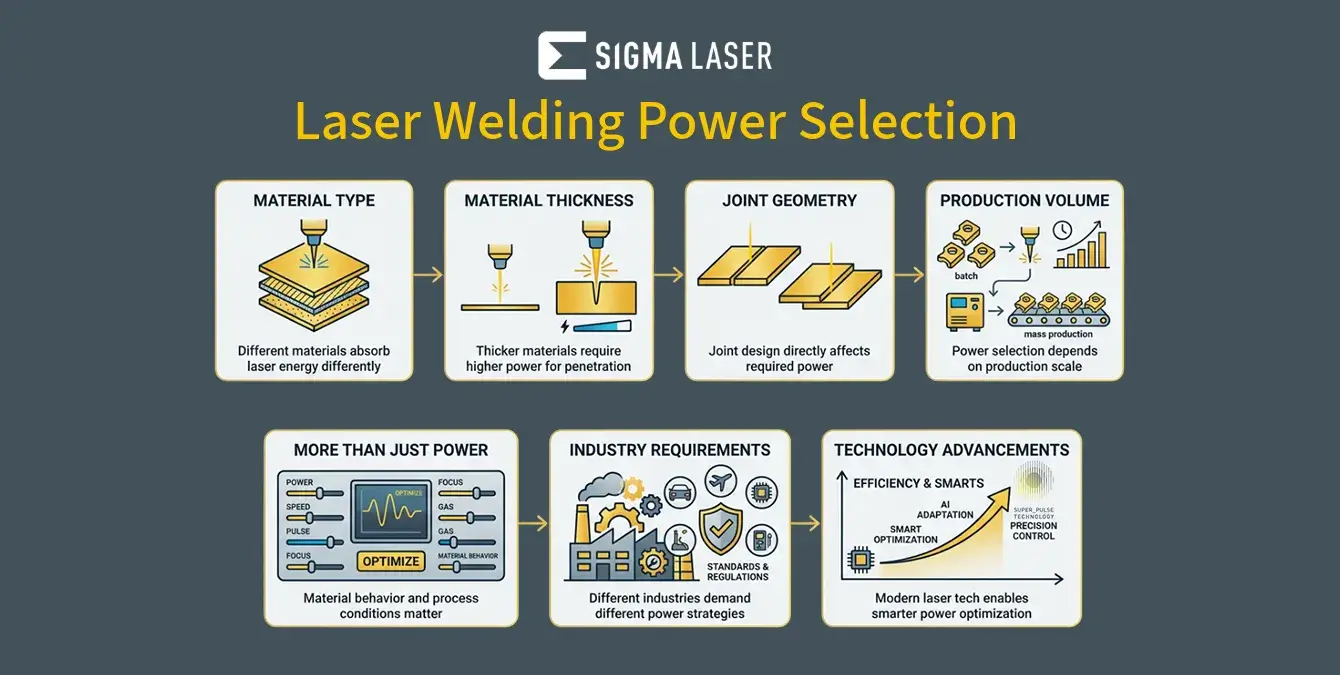
Choosing the right laser welding power level is crucial for achieving optimal efficiency and quality in welding applications. While many guides focus on the laser power itself, several other critical factors determine the best choice depending on the circumstances. Below are the key takeaways that will help professionals in the industry make informed decisions about laser welding power selection.
- Material Type Dictates Power Needs: Different materials absorb laser energy differently, affecting the required laser power for effective welding. Identifying the specific material’s characteristics is essential for accurate power determination.
- Material Thickness Influences Power Selection: Thicker materials typically require higher laser power to ensure adequate penetration and bonding. Adjustments should be made based on the material’s thickness to achieve desired weld quality.
- Consider Joint Geometry’s Impact on Power: The shape and design of the joint directly influence the laser power needed. Specific geometries may require tailored power adjustments to ensure proper weld integrity.
- Match Power Levels to Production Volume: High-volume production may benefit from different power settings compared to low-volume runs, impacting efficiency and cost-effectiveness. Selecting the appropriate power for the intended production scale is vital.
- Focus Beyond Absolute Power Levels: The laser’s power is only one aspect; factors such as material behavior, joint type, and production conditions often play more critical roles in determining suitable power levels.
- Optimize for Industry-Specific Requirements: Each industry might have distinct requirements and standards, influencing the choice of laser power levels to meet regulatory and practical demands efficiently.
- Adapt to Continuous Technological Advancements: Innovative developments in laser welding technology provide new solutions for optimizing power selection, enabling more effective application across various use cases.
The strategic selection of laser welding power is influenced by a comprehensive understanding of multiple factors that go far beyond simple power ratings. By considering aspects such as material type, thickness, joint geometry, and production volume, professionals can ensure efficient and high-quality welding results. In the sections that follow, we will explore detailed insights into determining optimal laser power levels tailored to different industry requirements and operational considerations.
Understanding the Essence of Laser Welding Power
What is Laser Welding?
Laser welding is a precise and efficient technique utilized in various industries to join materials with high precision. This method employs a laser beam as a concentrated energy source which melts the materials’ edges, fusing them together as they cool. The process is known for its speed, precision, and the minimal thermal distortion it causes compared to traditional welding methods.
Professionals exploring laser technology fundamentals can benefit from understanding the specific settings and parameters that dictate the weld quality and integrity. Correctly selecting the laser welding power level is crucial for achieving high-quality results in applications ranging from electronics to automotive manufacturing.
The Role of Power in Laser Welding
The core of laser welding machine power selection lies in determining the correct power settings necessary for a particular material and application. The power of the laser determines its ability to fully penetrate the material, affecting weld strength and quality.
- Material Thickness: One of the first factors to consider is the material thickness. Thicker materials require higher power levels, while thinner materials may be welded with lower power to prevent burn-through.
- Joint Geometry: The type of joint, whether it is butt, lap, or T-joint, influences the amount of power needed and the joint geometry in welding plays a vital role in power determination.
- Production Volume: In high-volume production scenarios, choosing the optimal power level can significantly impact overall efficiency and output quality. It is important to balance between adequate power and speed for time-saving without compromising the integrity of the weld.
Professionals must determine laser welding power based on these factors to ensure efficient and satisfactory welding outcomes. The best laser power for high-volume welding production involves evaluating these different elements to achieve a careful balance that meets industrial demands.
Material Type and Its Influence on Power Needs
Laser Welding Power by Material Type
In the laser welding industry, selecting the appropriate power level is critical and largely dictated by the type of material being welded. Different materials have distinct properties that impact how efficiently they absorb laser energy. For instance, aluminum requires higher laser power due to its high reflectivity and thermal conductivity, which can disperse energy quickly. On the other hand, stainless steel, being less reflective and possessing a lower thermal conductivity, can be welded effectively at comparatively lower power levels.
Understanding these material-specific requirements is essential for effective laser welding power selection. Factors like reflectivity, thermal conductivity, and specific heat capacity all play pivotal roles in determining the optimal laser power for each material type. Professionals must consider these unique material characteristics to match the laser power accurately, ensuring a quality weld.
How Material Characteristics Influence Power Selection
Material characteristics significantly influence the selection of laser welding power. A critical parameter to consider is material thickness in laser welding. Thicker materials typically necessitate higher laser power to achieve complete penetration and forge a strong joint. Conversely, thinner materials may be prone to burn-through with excess power, requiring careful adjustment of the laser settings.
Additionally, joint geometry in welding can affect how power is distributed across the weld. Complex geometries might require precise power settings to avoid defects. Understanding these nuances aids in the decision-making process of how to select laser welding power for different materials effectively.
Proper laser power selection not only aligns with material characteristics but also enhances production volume considerations for laser power. Fine-tuning power levels based on material type ensures efficiency in high-volume production settings, reducing the likelihood of defects and reprocessing, which are critical for enhancing industrial outcomes.
Impact of Material Thickness on Laser Welding Power
Determining Power Levels for Thick and Thin Materials
The impact of material thickness on laser power selection is a crucial factor in laser welding. For thin materials, choosing laser power for welding requires precision. Lower power levels are often suitable to prevent burn-through or warping. In contrast, thick materials necessitate higher power to ensure complete penetration and strong bonding.
In the laser welding industry applications, successful joint formation hinges on matching the laser power to the material thickness. Proper understanding and adjustments can significantly influence welding quality and efficiency.
Adjusting for Material Thickness
When adjusting laser welding machine power for different material thicknesses, professionals must consider varied parameters. Thin materials might need a fine-tuned approach for optimal results, whereas thicker materials often require an intensity boost to achieve deep penetration. It’s essential to balance power levels to prevent defects while ensuring sound welds.
Factors like joint geometry in welding also play a significant role. The geometry can dictate how the laser energy is absorbed and dispersed across material surfaces. Employing the correct laser power not only improves efficacy but also aids in high-volume production scenarios, where consistency is paramount.

Joint Geometry and Its Critical Role in Power Selection
Understanding Joint Geometry in Welding
Joint geometry in welding is a critical factor in determining the appropriate laser welding power selection. The configuration of welding joints affects how heat is distributed during the welding process, which directly impacts the fusion quality and strength of the joint. Different geometries such as butt, lap, and T-joints require distinct considerations due to their unique characteristics.
The choice of laser welding power is influenced by the need to penetrate varying thicknesses and angles presented by these geometries. For example, butt joints typically require precise alignment and adequate penetration depth to ensure strong bonds, whereas lap joints might necessitate adjustments in power to accommodate overlapping materials.
Adapting Power for Different Geometries
When selecting laser welding power, it’s essential to tailor the power settings based on the joint geometry to achieve optimal results. For butt joints, consistent power levels are crucial to maintain uniform penetration and avoid incomplete fusions. On the other hand, T-joints might require higher power settings to compensate for the increased material volume and angles.
Understanding how to adapt power for these different geometries not only ensures the structural integrity of the joints but also enhances the efficiency of high-volume welding production. Comprehensive knowledge of these adjustments is vital in industries that rely heavily on precision and durability in their welding processes.
Factors such as the material thickness in laser welding also play a significant role when modifying power levels for varying joint designs. By carefully considering each aspect of joint geometry, welding professionals can optimize their laser welding machine power selection, resulting in improved performance and reduced material waste.
Tailoring Power Levels to Production Volume
Power Considerations for High-Volume Production
When determining laser welding power, particularly for high-volume production, efficiency and cost-effectiveness are paramount. The best laser power for high-volume welding production should align with the material types and joint geometries used in your operations. Consistent high-volume demands necessitate reliable power output to maintain production speed and quality. Overestimating power needs can lead to unnecessary energy costs, while underestimating may result in inadequate weld quality.
To fine-tune your laser welding power selection, consider the specific characteristics of the materials you are working with, such as their material thickness and thermal conductivity. High-power lasers can efficiently penetrate thicker materials, but excessive use might waste energy. Instead, optimize laser settings to balance energy use with weld quality, thereby enhancing operational efficiency and minimizing machinery wear.
Efficiency in Low-Volume Welds
For low-volume production, laser welding machine power selection should prioritize flexibility and adaptability. The production volume considerations for laser power differ in this context, where the aim is to reduce setup times and adapt quickly to different welding requirements. Opt for adjustable laser welding systems that can switch between power levels to accommodate various materials and joint geometries without excessive downtime.
In low-volume scenarios, the focus should be on minimizing operating costs while maintaining precision. By applying strategies for optimizing efficiency, businesses can achieve the required weld quality without overspending. This approach also supports niche market applications where customization is key and offers potential savings by extending the life of the welding equipment through reduced stress levels.
Navigating Industry-Specific Requirements
Industry Standards and Regulations
When considering laser welding power selection, it’s essential to take into account industry-specific standards and regulations. Different industries have distinct requirements that directly impact the power level needed for effective welding. For instance, aerospace and automotive sectors often adhere to stringent guidelines to ensure durability and safety in their applications. The legal standards in these industries necessitate precise power adjustments to guarantee compliance and optimal results.
Adhering to these industry standards not only ensures compliance but also enhances the quality of the welding process. Proper selection of laser welding power can significantly affect the outcome, especially when dealing with critical components. Professionals must be well-versed with the applicable standards to make informed decisions.
Customizing Power Levels for Industry Needs
In the process of determining laser welding power, professionals must consider the unique requirements of their specific field. For example, in the medical device industry, the focus often lies on precision and minimizing thermal impact, which differs from the needs of heavy machinery manufacturing where deeper penetration is preferred. Customizing laser power levels can help address these varied requirements effectively.
The laser welding industry applications vary by sector, and so do the power levels needed. Factors such as production volume, material thickness in laser welding, and joint geometry play pivotal roles. For high-volume welding production, selecting the best laser power is crucial to ensure efficiency without compromising quality. The diversity in applications underscores the need for bespoke solutions that meet both the technical and regulatory demands of each industry.
- In electronics, precision is prioritized to handle delicate components.
- For automotive manufacturing, power levels must accommodate both speed and strength.
- Aerospace applications demand high accuracy for safety-critical parts.
Understanding these variable factors and adjusting the laser power decision accordingly allows for enhanced welding efficiency and quality. Tailoring power settings to meet industry needs is a fundamental step in ensuring that laser welding processes remain both compliant and competitive.
Adapting to Technological Advancements in Laser Welding
Emerging Technologies and Trends
In recent years, technological advancements in the laser welding industry have dramatically influenced laser welding power selection. The introduction of new laser types, such as fiber lasers and disk lasers, has enhanced precision and efficiency, allowing professionals to fine-tune power settings based on more specific requirements.
Moreover, advancements in control software have made it possible to automate many factors affecting laser welding power decisions. These technologies enable real-time monitoring and adjustments, improving adaptability and outcomes. Understanding these trends is crucial for professionals looking to optimize their processes.
The Future of Laser Welding Power Selection
Looking forward, the continuous drive for innovation in materials and systems promises further enhancements in the selection process. For instance, AI-driven algorithms can predict the best laser welding power levels by analyzing previous welding data and material properties. This development not only increases efficiency but also minimizes errors, catering to diverse applications within different industries, such as automotive and aerospace.
Integration of machine learning will allow welding machines to adapt automatically to variations in material thickness and joint geometry. As these technologies evolve, professionals must be ready to adapt and utilize these tools to maintain competitive advantage and ensure optimal welding performance.
Conclusion
Understanding the intricate dynamics of laser welding power is key to mastering this precise and efficient welding process. By exploring material properties, thickness, joint geometry, and production volume, professionals can fine-tune laser power settings to achieve optimal results across various applications. Each of these factors plays a pivotal role in dictating the weld quality, highlighting the importance of a comprehensive approach to laser power selection.
Material thickness is a primary consideration since it directly influences the required power to penetrate the material sufficiently without causing defects such as burn-through or inadequate weld strength. Joint geometry, on the other hand, requires careful adjustment of power to accommodate different heat distributions and material configurations. This ensures that welds are both structurally sound and aesthetically pleasing.
The role of material type cannot be understated, as its unique characteristics dictate specific power requirements. Understanding materials’ reflectivity and thermal conductivity allows for precise selection of laser power, thus minimizing energy waste while maximizing weld integrity. Professionals must pay close attention to these characteristics to prevent costly rework and ensure that high-volume production runs smoothly.
In the context of high-volume production, achieving a balance between power efficiency and production speed is crucial. Excessive power usage can lead to unnecessary energy expenditure and equipment wear, while insufficient power can compromise weld quality. A strategic approach to laser power selection can mitigate these issues, leading to cost-effective and reliable welding operations.
Industry standards and regulations further shape the laser power selection process, as different sectors have unique requirements. Whether it’s the precise demands of medical device manufacturing or the high-strength requirements of the aerospace industry, understanding and adapting to these standards ensure compliance and safety. This level of customization is vital for catering to the diverse needs of various industries, allowing for a superior welding solution that aligns with regulatory expectations.
As the laser welding industry continues to evolve, technological advancements, such as AI-driven algorithms and smart control systems, present exciting opportunities for further enhancing welding processes. These innovations promise improved precision and adaptability, enabling professionals to make data-driven decisions that optimize power usage and reduce errors. As these technologies become more integrated into welding practices, staying abreast of developments will be essential for maintaining a competitive edge.
In conclusion, mastering laser welding power selection is a multi-faceted endeavor. It requires a deep understanding of the materials involved, the specific technical requirements of different welding applications, and the latest technological advancements. By considering all these aspects, professionals can ensure efficient, high-quality welding outcomes that meet both industry standards and customer expectations. Adapting to emerging technologies and trends in laser welding will be integral to sustaining success in this ever-evolving field, allowing businesses to harness the full potential of this powerful welding method.